Showing posts with label visual studies. Show all posts

Friday, October 3, 2014

Fun With Texture: Demo from a Cartooning Workshop

This sheet was drawn on Strathmore medium drawing 400 series 9" x 12" creme paper as a demonstration for a cartooning sketchbook workshop at the Carnegie Museum of Art in 2008. I enjoyed those workshops immensely. They were usually held in summer, although in recent years I became too busy with graduate school to be able to offer them. For years the museum refused to offer cartooning instruction, insisting by policy that educational offerings coincide with works on view in the museum galleries. Finally, in 2004, with the R. Crumb retrospective as part of the Carnegie International that year, I was invited to give instruction.

 
Since then the museum has canceled adult education workshops in drawing, painting, ceramics and other traditional media in favor of lectures relating to contemporary works of art. It is nothing short of tragic to see the museum art world forsake interactive drawing, the basis of all the visual arts (including architecture, cinematic storytelling/storyboarding, theatrical set and costume design, etc.) for passive dispensation of theory. The proper response to art is artmaking, not idle attendance at a lecture.

Two CMAs and the Second Commandment: A Digression

The current artworld, centered in public museums housed in large, monumental neoclassical buildings, have run the risk of succumbing to an ideology centered on their own self-importance as elite palaces of culture rather than democratic institutions of municipal and civic engagement. Cleveland's museum early in its history built a palace but emphasized education for all classes of Clevelanders, and despite the impulse to move to the right, has managed to successfully balance the two; but Pittsburgh, unfortunately, has not. Under its current leadership, Pittsburgh's CMA (as opposed to Cleveland's CMA) has embraced the ideology of contemporaneity in which various pseudo-Dada practices form the basis of high-flown intellectual discourse. But such mere pseudo-political conversations as can result from the contemplation of found objects, installations, performance and the like, while often interesting and verbally challenging, are rarely as rich as the contemplation of visual art that are works of the mind, as manually-generated images almost by the very means of their origins almost inherently are.

The mistake that over-educated, verbally-adept critics, curators, theorists, and art historians continually make is to disregard visual composition such as only the hand produces as thoughtless, or at least not as thinking on a level comparable with words. Old-fashioned craft, according to this ideology, is reserved only for the wordsmith and never the image maker, who is invariably regarded as a capitalist sell-out for rendering illusions corresponding to apparent reality, or at the very least mechanical and uncritical like a camera. Likewise, such honorifics as thinker and genius are reserved for the writer of texts, and even the title artist, when bestowed upon maker of conversation pieces, is not done without the most arch and patronizing irony. The bias for text over image runs very deep in our culture, going back at least to the Judao-Christian second commandment, which Max Horkheimer claimed as the basis and justification for contemporary critical theory.*

In any case, one hopes that the ascendance of logos and the iconoclastic impulse that has subtended much enthusiasm for modern and contemporary art over the past century or more will prove to be only a temporary aberration in our culture, and for a return of drawing to the educational environment of the city of Pittsburgh, and to the artworld nationally and internationally, in the very near future.

*See Max Horheimer, letter to Otto O. Herz, September 1, 1969, in Gesammelte Schriften, volume 18 Briefwechsel 1949-1973 (Frankfurt am Main: Fischer, 1996) p. 743; cited in Sven Lüttken, "Monotheism à la Mode," in Alexander Dumbadze and Suzanne Hudson, Contemporary Art: 1989 to the Present (Wiley-Blackwell, 2013), pp. 304, 310, note 11. Lüttken attempts to make the rather unconvincing argument that a total ban on representative art is a valid form of criticism of the image and the proper role critical inquiry, suggesting the temperament of critical theorists.

For more on drawing, see The Withering Away of Drawing. For more on the Dumbadze anthology, see After Critical Thinking.

Sunday, August 10, 2014

Kunzle’s Pre-History of Comics: But Is It Really?


The scholar David Kunzle declared in 1973 that he was writing “a history or pre-history” of the modern newspaper comic strip. This enterprise has come to encompass a significant portion of his professional scholarship, including four major books with the term “comic strip” in the title: History of the Comic Strip, Volume I: The Early Comic Strip—Narrative Strips and Picture Stories in the European Broadsheet from c.1450 to 1825 (1973)[1]; The History of the Comic Strip, Volume II: The Nineteenth Century (1990)[2]; Rodolphe Töpffer: The Complete Comic Strips (2007)[3]; and Father of the Comic Strip: Rodolphe Töpffer (2007)[4]. These four volumes are preceded by one of Kunzle’s first published articles, a translation of Francis Lacassin’s “The Comic Strip and the Film Language,” which is augmented by almost 4 ½ pages of “supplementary notes” by Kunzle and amounts to a prolegomena to Kunzle’s own scholarship on pre-twentieth-century picture stories and their relationship with cinematic history.[5] Such a sizeable corpus of research and writing,[6] to say nothing of the publication of these sometimes cumbersome and profusely illustrated works, would be a worthy if not magisterial achievement for any scholar, particularly one working in such a pioneering area of graphic art as pre-twentieth-century printed picture stories. However, the twentieth-century term “comic strip” figures prominently in each of the titles mentioned, and Kunzle in his own right has become considered a father of sorts to scholars of comics, and has had a surprising and unexpectedly substantial impact on the way comics are being perceived today.

So it may seem impertinent to ask: is Kunzle's undeniable accomplishment really a history or pre-history of the comic strip? Does it do justice to the pre-twentieth-century material Kunzle studies to be considered primarily as comic strips or precursors to comic strips? What are Kunzle’s motivations for claiming the term “comic strip” as his rubric, and would his material have been better served by another term, such as “picture story”? What effect has Kunzle’s work, and his assimilation of his material to the modern comic strip, had on comics (both on its scholarship and the art form)? Would it be more productive, in fact, for comics scholars and artists to think, not of earlier graphic (printed) picture stories as latent comic strips (or comic books or graphic novels), but of comics as a particular formulation or solution to the problems presented by the graphic picture story? Would it be more productive for twenty-first century creators to consider the creative potential of combining words and pictures freely, with the entirety of the history of culture offering suggestion, rather than reducing the history of all previous words-and-pictures experiments down to a teleological, evolutionary drama narrowly concerned with the perfection of a specific, marketable form of picture story?

The reference room of the Frick Fine Arts Libary, University of Pittsburgh, which holds a copy of Kunzle’s History of Comics Volume I (not pictured).

An informal search Google N-Gram search and search of databases at my disposal suggests that the term comic strip did not emerge as a term of description for the American newspaper feature we now know by that name until probably the mid-1910s. All the material Kunzle studies in his four major works dates from prior to the twentieth century. The few times that Kunzle mentions twentieth-century newspaper comic strips throughout this corpus, it is with at least mild disdain; he seems to regard the more popular successors to his material as an attenuated if not fallen and debased artform when compared to the earlier material he finds more richly varied as to subject matter and political and social viewpoint and consequently so much more engrossing. So why does he so emphatically embrace the term comic strip by placing it firmly in the titles of all his works, and why does he so earnestly want us to view the narrative strips, picture stories, broadsheets, and other material under scrutiny as comic strips?

Kunzle acknowledges more than once that his project was inspired by the art historian Ernst Gombrich, who published his ground-breaking Art and Illusion in 1960 (which is still on some required reading lists).[7] Gombrich is the first to make the connection between early print picture stories (and specifically the work of Töpffe) to the modern newspaper comic strip form. Gombrich asserts, “to Töpffer belongs the credit, if we want to call it so, of having invented and propagated the picture story, the comic strip.”[8] Gombrich views Töpffer’s combination of words and pictures as especially prescient, “In view of what has happened during the last decades,” presumably a reference to the rising popularity of newspaper comic strips and children’s books (Gombrich was writing in the 1960s).[9] Gombrich, however, does not elaborate on the distinctions or definitions of the terms “picture story” or “comic strip,” let alone recount the evolution from one to the other. 

Enter Kunzle, Gombrich’s student, who does explore this terrain, and also assumes the elder scholar’s identification of Töpffer as a key figure in the development of the form(s). Kunzle also, at least at the outset, also assumes Gombrich’s terminological ambiguity (“the picture story, the comic strip”). Kunzle himself claims to “use the terms picture story and comic strip indifferently,” although he frequently refers to “the development of the picture story and comic strip,”[10] along with other terms, quite often, as if they were separate and distinct forms demanding the covering of all bases.

Kunzle establishes his use of the term comic strip in the Introduction to History of the Comic Strip Volume I, although he never justifies or explains his choice, or indeed, that he is making a choice. In the opening section, Kunzle considers a range of terms used to describe the twentieth century newspaper feature, particularly foreign variants such as Italian fumetti, the French bandes désinées (drawn strip), and the German term Bilderstreifen and Bildergeschichte (literally, picture strip and picture story, respectively), and the French term bande dessinée. Kunzle blandly asserts, “Of all these terms, ‘comic strip’ is the most commonly used for the newspaper strip,” which he describes as “an artistic phenomenon.” He writes,
All over the Western world, the comic strip has become a major form of mass communication, a potent force in molding public opinion, an international language […] understood and enjoyed by the literate and semi-literate alike.
But Kunzle offers no rationale as to why the term “comic strip” should be favored in describing this phenomenon, let alone why it should be applied retroactively to graphic material prior to the advent of the American daily newspaper. 

The clear inference is that Kunzle is saddled with the term “comic strip” whether he finds it appropriate or not for the pre-twentieth-century material he is studying. And indeed, he finds in completely inappropriate, arguing, “only the English language […] insists that ‘drawn strips’ are comic,” while in fact
the truly comic strip [Kunzle’s emphasis] does not emerge until … late eighteenth-century England. At this stage of its development, however, I have preferred to use the phrase “caricatural strip” …. [Therefore] I never refer to the pre-caricatural (i.e. pre-1780) strip as the “comic strip,” even when it contains an element of humor. I generally use the terms “narrative strip” or “narrative sequence,” “picture story” or “pictorial sequence” (depending on the format involved) in order to stress the narrative role of the medium, which I consider primary.[11]
Kunzle finds formal similarities between the material of his study and twentieth-century newspaper comic strips sufficient to justify the connection previously made by Gombrich, and constructs a definition of the term “comic strip” broad enough (most notably by not being dependent on the word balloons) to justify its application to his material.[12] However, Kunzle never again employs the term “comic strip” in History of the Comic Strip Volume I following the Introduction.

Further, Kunzle’s anachronistic application of the term “comic strip” to the material of his study is all the more puzzling, since he seems to have little knowledge or interest in twentieth-century material, or in discussing “comic strips” per se. Indeed, Kunzle rarely discusses twentieth century newspaper strips throughout his oeuvre, and then only generally and vaguely, usually only with broad reference to their popularity, and often with a good deal of disdain for what he sees as an artistic devolution from the rich social commentary and propaganda of his favored era into banal soap opera and gags of the time of his writing. Kunzle is also dismissive of the historically uninformed “Compilers of books on the twentieth-century comic strip” and their “potted” histories.[13] For example, Kunzle blasts a biography, “that modern stalwart, Milton Caniff,” for the name-dropping pretentions of its subtitle (“Rembrandt of the Comic Strip”), and the author’s ignorance in conflating Renaissance cartoons (preparatory drawings for paintings or tapestries) with the modern graphic form.[14] Kunzle expresses no interest in extending his own research into twentieth century material, to write a corrective history of twentieth century comic strips, or even to compare examples of the pre-1896 material of his study with more recent examples. 

In fact, Kunzle seems to have regretted his choice of placing the term “comic strip” in the title of his history of broadsheets and picture stories. In the Preface to History of the Comic Strip Volume II (1996), Kunzle goes on an extended, unscholarly rant about the problems the term “comic strip” has created for the reception of his scholarship in the intervening two decades.
As a respectable academic I have, I suppose, sought to give the comic strip academic respectability. I doubt that I have succeeded yet. The “scientific literature” of my discipline (art history) has tended to pass by Volume 1, The Early Comic Strip, no doubt because of its frivolous title, which has not convinced even the (nonacademic) celebrants of the genre in the 20th century that there is indeed a comic strip worthy of the name before the Americans “invented” it in 1896 or so. I was recently sent a script for an ambitious television series on the (20th century) comic strip, for which funding was being sought and to which I was nominated a “scholarly advisor.” The script started with the assertion that the first comic strips appeared in American newspapers at the end of the 19th century. Of course. By now I should have learned that to deny in the face of the U.S. media that the United States invented the comic strip is about as pointless as denying that the United States invented freedom and democracy. So I look once more to academe, which should understand that the real title of the present volume is “The acquisition and Manipulation of New Sites of Comoedic [sic] Narrative Discourses and Significations by Volatility-prone Social Sectors.” A big book should have a big title anyway.[15]
Kunzle further laments that his two-volume prehistory of the comic strip “has been a lonely endeavor in many ways, just how lonely I can now measure, in retrospect, as I enter the well-established field of 17th century Dutch art.”[16] More well established, and presumably more academically respectable. 

Fischer von Erlach’s Entwürf einer Historischen Arkitektur (inventive history), 1721, showing the Halikarnassus plate.

Nonetheless, Kunzle retains the term “comic strip” for the title of his second mammoth volume, and more freely and boldly uses the term in discussing nineteenth-century material, even while acknowledging its anachronism. He muses,
 The comic strip in the 19th century, for all its popularity, is without a recognized name. Töpffer called his comic albums either “picture novels” or, deprecatingly, “little follies.” In the trade they were called “caricatural albums,” or the “série Jabot,” after the initiating title. Töpffer himself pretended anonymity, which the pirates all too scrupulously observed. It is as if Jabot, the social upstart, having forced himself and his upstart graphic genre upon the public, was forever to be denied the dignity of a distinct literary or artistic category.[17]
Kunzle, to his credit, would stick with his guns, and even more boldly assert the term “comic strip” in the titles of his two subsequent publications on Töpffer.

But why did Kunzle initially adopt the term “comic strip” in the early 1970s? Kunzle seems to have made the pragmatic calculation that labeling his research on broadsheets and picture stories a “history or pre-history of the comic strip” would be of benefit to his scholarship both academically and in terms of landing a publisher for what was no doubt a prohibitively expensive undertaking. In the post-war era, after cinema and jazz, the comics strip seemed next in line as the American art destined for academic validation and publishing success. Several decades had elapsed since Coulton Waugh’s The Comics (1947), but in the first half of the 1970s, the first of a new wave of comic-strip histories were beginning to appear, or were being readied for publication. These included Dick Lupoff and Don Thompson’s anecdotal anthology All in Color for a Dime (1970)[18]; Les Daniels’ Comix: A History of Comic Books in America (1971)[19]; Marvel artist Jim Steranko’s two-volume The Steranko History of Comics (1970, 1972)[20]; Arthur Asa Berger’s sociological study The Comic-Stripped American: What Dick Tracy, Blondie, Daddy Warbucks and Charlie Brown Tell Us About Ourselves (1973)[21]; and Jerry Robinson’s The Comics: An Illustrated History of Comic Strip Art (1974)[22]. Kunzle may even had been aware of Maurice Horn’s The World Encyclopedia of Comics (1976), then in preparation.[23]


An important hint may lie in the fact that the Preface to History of the Comic Strip Volume I, dated 1968, contains no reference to or use of the term “comic strip” all, only “picture story” (twice).[24] But the volume was not published by the University of California Press until 1973, a five-year interval encompassing not only the publication of most of the comic strip histories listed above, but also Kunzle’s translation of the Lacassin article for Film Quarterly, also a UC publication (1972). The titling of the History of the Comic Strip Volume I and the writing of its Introduction, which uses the term “comic strip” more than 30 times (nowhere else in the volume does the term appear) may have taken place only after the Preface and body of the volume had been complete in 1968. The foregrounding of the term “comic strip,” for which Gombrich had already paved the way, may have belatedly occurred to Kunzle or been suggested by his publisher in recognition of  a “comic strip” trend in publishing that had emerged since 1968. Such a move would not have been merely a cynical ploy to make the publication of the mammoth volume more feasible, but could have also been a sincere effort to connect Kunzle’s rather obscure study of broadsheets and picture stories to more current (and more sexy) scholarly discourses, particularly cinema.
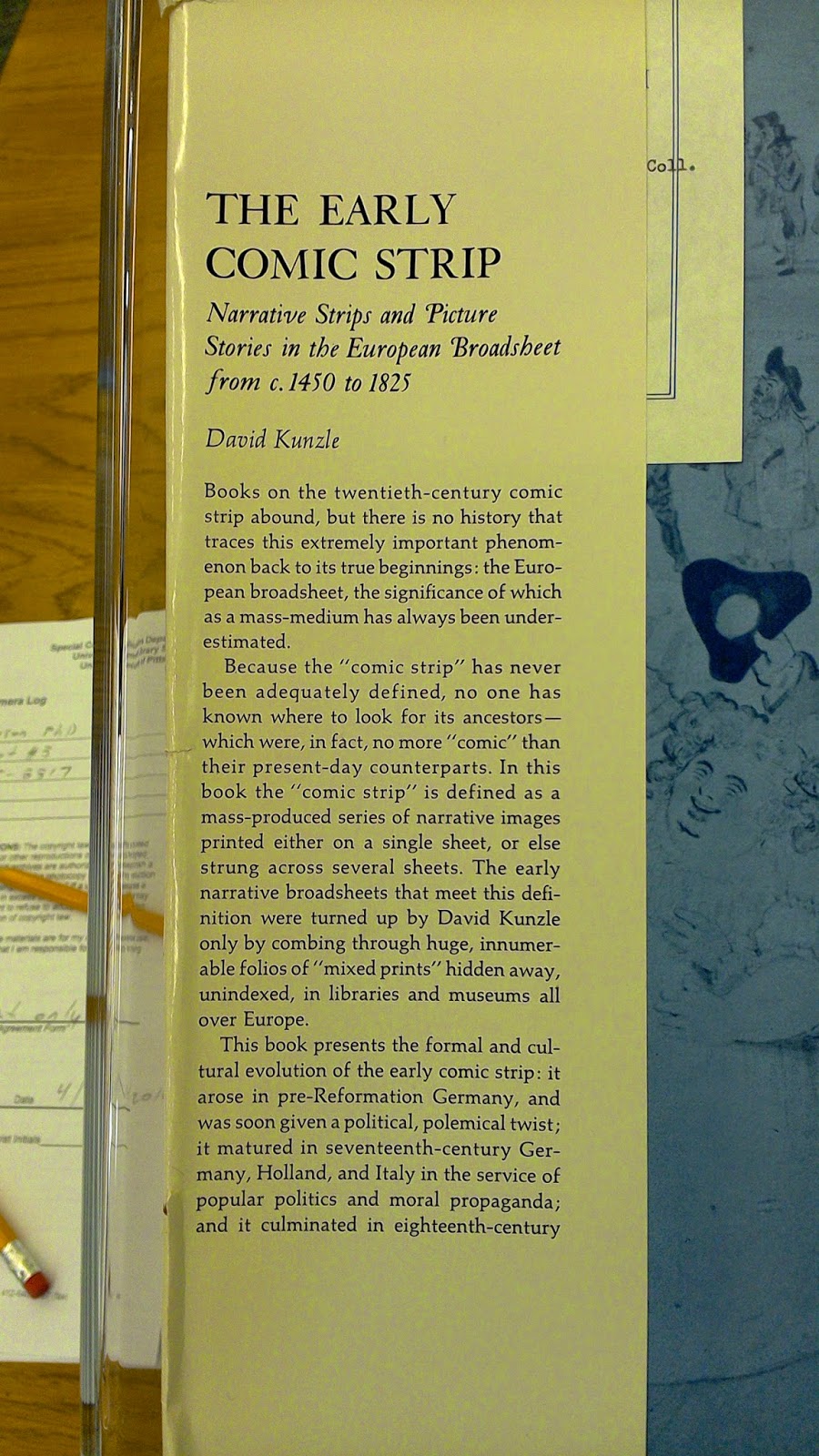

Back dustjacket flap of Kunzle's History of the Comic Strip Volume I: The Early Comic Strip—Narrative Strips and Picture Stories in the European Broadsheet from c.1450 to 1825, at the Special Collections room, Hillman Library, University of Pittsburgh.

This is most emphatically suggested by Kunzle’s 1972 translation of Lacassin for Film Quarterly. The introduction to the article, set in large bold italic that upstages the body text, presents the article not only as a precursor but also an unprecedented plug for Kunzle’s forthcoming History, and explicitly ties Kunzle’s work to the “intellectual respectab[ility]” belatedly emerging for comics that had been established for film “three or four decades ago.” The notes added by Kunzle, “which qualify some of Lacassin’s findings,” are half as long as Lacassin’s text.[25] Kunzle begins,
This is not the place to quarrel with Lacassin’s assumption, which is so widely shared, that the comic strip and cinema were born at the same period. Since the material has simply not been available hitherto, critics cannot know that, in fact, the narrative picture strip reached a certain maturity in German, Dutch, and English broadsheets in the seventeenth century. In my book, which the University of California Press will shortly publish, I reproduce an extensive corpus of these remarkable early picture stories, which will thus become available for analysis and discussion. Nor need we at this point question by what feat of logic Lacassin makes the “birth” of the comic strip postdate by two generations one of the recognized “fathers” of the art (for Gombrich, the father), Rodolphe Töpffer.[26]

Whatever his reasoning or motivation for declaring his work “a history or pre-history” of the comic strip, Kunzle stuck to his guns, using the term “comic strip” in the title of two more scholarly publications on Töpffer. It is now common, in fact, to see references in academic art historical publications and museum exhibition catalogs to Töpffer as  father or inventor of the comic strip.[27] But as Geoffrey Batchen reminds us in the case of the history of photography, such determinations are suspect. He remarks that historians
continue to squabble over which of them was the first to discover the one, true inventor of photography. […] [T]his is invariably an argument as much about virility and paternity as about history, as much about the legitimacy of both photographer and historian as historic primogenitors as about the timing of the birth itself.[28]
To the extent that Kunzle’s work is seen as foundational to comic strip and comic book scholarship, his legacy is a mixed bag. The unfortunate example of Kunzle’s snarky Preface to Volume II, mentioned above, as well as its Introduction which dwells at length on the status of nineteenth century picture stories as a “childish genre,”[29] suggests that a cloying desire for “academic respectability” has been passed down to more recent scholars who continue to openly bitch, “Why Are Comics Still in Search of Cultural Legitimization?”[30] On the positive side, as David Carrier attests, “I admire Kunzle, a bold and original scholar, for gathering these materials, without which my own philosophical study [on comics] could not have been conceived,” but departs from Kunzle on the issue of word balloons.[31] The more substantial implication being that Kunzle’s scholarship is not about comics at all, but something that predates comics historically, and if anything chronicles part of a pictorial and textual tradition that is larger than comics.

To the extent that Kunzle’s scholarship is a rebuke of twentieth and twenty-first century comic strips, comic books, and graphic novels (and there is plenty of ammunition for such an argument throughout Kunzle’s four major works on pre-twentieth-century picture stories),[32] and a prompt to live up to the larger pictorial and textual tradition that is Kunzle’s concern, this admonition might be stated in a more effective way. Instead of saying comics should be better than they are, one could simply say, stories told in words and pictures don’t have to be comics. Perhaps that is the far greater lesson to be derived from Kunzle’s work.

[1] David Kunzle, History of the Comic Strip, Volume I: The Early Comic Strip—Narrative Strips and Picture Stories in the European Broadsheet from c.1450 to 1825 (Berkeley, University of California Press, 1973).
[2] David Kunzle, History of the Comic Strip, Volume II: The Nineteenth Century (Berkeley, University of California Press, 1990).
[3] David Kunzle, ed., trans., Rodolphe Töpffer: The Complete Comic Strips (Jackson: University Press of Mississippi, 2007).
[4] David Kunzle, Father of the Comic Strip: Rodolphe Töpffer (Jackson : University Press of Mississippi, 2007).
[5] Francis Lacassin, “The Comic Strip and the Film Language,” trans. with additional notes by David Kunzle, Film Quarterly, vol. 26, no. 1, (Autumn 1972), pp. 11-23. Kunzle’s footnote on p. 11 reads as follows: “Translated from Lacassin’s Pour un neuvième art: la bande dessinée (Paris: Union Generale, 1971) and his preceding article “Bande dessinée et langage cinematographique,” Cinema ‘71, (September1971), by permission of the publishers. The material has been slightly abridged from its longer version in the book, but incorporates the refinements Lacassin made in the book.” Kunzle’s additional notes occupy the final 4 ½ pages of the article, set at the same type size as translated text, pp. 19-23.
[6] For brevity, these works will be referred to hereafter as History I and II, Complete, Father, and “Lacassin.”
[7] See Kunzle, History vol. 1, preface, and Father, p. ix.
[8] Ernst Gombrich, Art and Illusion: A Study in the Psychology of Pictorial Representation, 3rd ed. (Princeton: Bollingen, 2000 [1960]) p. 336.
[9] Gombrich, p. 337.
[10] Father, quotes from pp. xi and 53 respectively.
[11] History I, p. 1.
[12] History I, p. 2-3. David Carrier, among others, takes issue with Kunzle, claiming “The speech balloon is a defining element of the comic [strip].” See David Carrier, The Aesthetics of Comics, (University Park: The Pennsylvania State University Press, 2000), pp. 3-4; quote p. 4.
[13] History I, p. 1.
[14] History I, p. 2.
[15] History II, p. xix.
[16] History II, p. xx.
[17] History II, p. 6.
[18] Dick Lupoff and Don Thompson, eds., All in Color for a Dime (New Rochelle NY: Arlington House, 1970).
[19] Les Daniels, Comix: A History of Comic Books in America (New York: Bonanza Books, 1971).
[20] Jim Steranko, The Steranko History of Comics, vols I and II (Reading PA: Supergraphics1970, 1972).
[21] Arthur Asa Berger, The Comic-Stripped American: What Dick Tracy, Blondie, Daddy Warbucks and Charlie Brown Tell Us About Ourselves (New York: Walker, 1973).
[22] Jerry Robinson, The Comics: An Illustrated History of Comic Strip Art (New York: Putnam, 1974).
[23] Maurice Horn, The World Encyclopedia of Comics (New York: Chelsea House, 1976).
[24] History I, Preface [n.p.].
[25] The introduction or abstract of the article reads, in bolder and larger type than the article, “The comic strip is now becoming intellectually respectable in somewhat the same way that film did, three or four decades ago. Studies of contemporary strips abound; serious artists are using the form for their own purposes-often, of course, satirical purposes. As the French historian Francis Lacassin argues in the pioneering article below, the “language” or syntax of the comic strip shows many similarities to (and certain historical priorities over) the language of film. The article has been translated by David Kunzle, author of the forthcoming The Early Comic Strip: Narrative Strips and Picture Stories in the European Broadsheet, c. 1450-1826—a sociocultural history of the first mass medium’s origins—and he adds notes of his own which qualify some of Lacassin’s findings and extend them even further back in time.” See Lacassin, p. 11.
[26] Lacassin, p. 19. The Lacassin article and its influence on comics scholarships merits a discussion of its own, which in fact I first essayed on an earlier incarnation of this blog around 2005. I plan to revisit that article and repost soon.
[27] See for example Laura Hoptman, Drawing Now: Eight Propositions (New York: Museum of Modern Art, 2002), p. 129.
[28] Geoffrey Batchen, Burning with Desire: The Conception of Photography (Cambridge, MA: The MIT Press, 1997), p. 35.
[29] History II, pp. 2-4.
[30] Thierry Groensteen, “Why Are Comics Still in Search of Cultural Legitimization?” in Jeet Heer and Kent Worcester, eds., A Comics Studies Reader (Jackson: University Press of Mississippi Press, 2009), pp. 3-11. [I discuss this article in a previous post on this blog.]
[31] Carrier, pp. 3-4; quote p. 3.
[32] Not to mention Kunzle’s translation of Dorfman and Armand Mattelart’s 1973 Para leer al pato Donald into English as How to Read Donald Duck in 1975, suggesting that if Kunzle were to regard modern comics at all, their status as capitalist commodities would be foremost in his critique.

Back dustjacket flap of Kunzle's History of the Comic Strip Volume II: The Nineteenth Century, at the Special Collections room, Hillman Library, University of Pittsburgh.

Monday, July 7, 2014

The Fig Leaf of Cognitive Training: Navigating Our Mediated World by Conforming to Contemporaneity

In response to “The Crisis in Art History,” which I cited in my previous post, Amy K. Hamlin and Karen J. Leader, in “Art History That! A Manifesto for the Future of a Discipline,” characterize art historians as having “Highly developed visual discernment, a deep knowledge of history, [and] a nuanced understanding of cultural heritage.” They assert, “we need art historians because they are equipped to teach the skills urgently required by twenty-first century citizens to navigate the complexities of a visually driven information age.” The last point, that the study of art history is vital to navigate our mediated world, is related to the rationale I heard in my old department: that art history, unique among college offerings, uniquely offers an irreplaceable training in visual analysis. Any criticism of the curriculum, pedagogy, or methodologies currently trending in art history, for Hamlin and Leader, are attacks on the humanistic development of critical cognitive faculties; the real problem, as they see it, is rather the exorbitant expense acquiring a college education. [1]

This is a disingenuous argument for two reasons. First, while art historians are equipped to teach some of the skills required for citizenship in the twenty-first century, they are neither uniquely equipped or even the first choice for doing so. If we seriously want to prepare individuals to navigate modern visual media, if not inoculate them to the more subtle forms of visual manipulation deployed by advertising, political campaigns, and visceral entertainment, what is called for would be a practical and theoretical course in film editing and theory, and it would be mandatory in every undergraduate curriculum.

For starters, the Odessa Steps sequence from The Battleship Potemkin would be analyzed frame by frame (preferably in an old Moviola), and students would have the opportunity to edit their own footage (and tell their own truths or fabrications) in Adobe Premiere. The theoretical writings of Vsevolod Pudovkin and Sergei Eisenstein would be read and debated (preferably vehemently, in a café), and Indiana Jones and the Temple of Doom, one of the most brilliantly edited movies I can think of, would be dissected for its fluid technical mastery and somewhat crude cultural and ideological assumptions. Static images would be studied as well, particularly in their juxtaposition as storyboards or comic strips. (I am, of course, describing my own early training in the study of comic book storytelling, except that I viewed the Odessa Steps on an 8mm film viewer, and spliced together a few shots together on 16mm with pieces of adhesive tape, the old fashioned way.) Still life and figure drawing would be optional but strongly encouraged, as well as basics of photography (composition, lighting).

To this course of study, art history could perhaps be offered as an ancillary curriculum for those wishing to explore the ways in which manual images were made prior to the advent and inexorable conquest of photography and cinematography over the past 175 years, as well as studio courses for those wishing to master manual image making (figurative drawing, painting, sculpture) for themselves (filmmakers such as Eisenstein and Fellini, and art theorists such as Meyer Schapiro were all skillful and gifted artists in their own right, practices that informed their work).

Donald Simpson (American, b. 1961), Light Up! (With Apologies to Tony Smith), 1979. Photo-mechanical transfer on photo paper from found clip art, 8 1/2" x 11". Collection of the artist. © Donald Simpson, all rights reserved.


To another of Hamlin and Leader’s points, that art historians having a “Highly developed visual discernment, a deep knowledge of history, [and] a nuanced understanding of cultural heritage,” Patricia Mainardi and Pepe Karmel, in “The Crisis in Art History,” already dispute that. With the surge of contemporary art study threatening to overtake that of “historical art” (i.e., precontemporary art), the authors see an increasing neglect of historical study and a cheapening of the art history curriculum. Mainardi laments, “the vast amounts of wealth now moving through the world of contemporary art, in museums and auction houses, galleries, and international art fairs” are seducing art history students away from “the libraries and archives of previous generations.” She notes, “Wherever contemporary art studies have become dominant, the same results are apparent.” Students no longer study “the art of different periods and cultures,” but instead focus on the art of the twenty-first century, and almost exclusively on texts written in English.[2] Karmel notes that the average time to complete a dissertation in art history overall is 4.2 years; for premodern topics, the average is 5.5 to 6.3 years; modern art, 3.9 years; but for contemporary only 2.6 years. Karmel remarks,
You interview the artist a few times, you persuade the artist’s gallery to let you see their files and their photo archive (the real-world equivalent of a catalogue raisonné), you read the published criticism, you follow up on the artist’s remarks about texts and ideas that influenced him or her. Then you sit down and write. The resulting text may be very good. It may become a terrific book or exhibition catalog. But it simply is not the same thing as a PhD dissertation in other fields of art history. And the degree it earns should not be a PhD.[3]
What Hamlin and Leader’s (and my old department’s) defense of art history ignores is the overwhelming expenditure of energy, not on training students to navigate our mediated world or even to visually analyze right-wing print propaganda, but on genuflecting before all-powerful art world institutions (including the academic discipline of art history itself). Why would one-of-a-kind treasured works roped off in a museum, or a Jeff Koons guarded by bouncers at London Frieze,[4] best serve as examples of visual phenomena for such study anyway? Art history involves all kinds of fascinating side trips into aesthetic theory, the chemical analysis of pigments, and internecine doctrinal fights, but very little of this is of any practical use to the college student trying to make critical sense of the media barrage emanating from her smart phone. As I said, justifying art history on such grounds is tantamount to advocating the study of the history of world religions as the surest remedy for high blood pressure since we all need a quiet, meditative break from the frenzy of our lives now and then. It is absurd.

Far from a useful training in the navigation of our highly mediated world, art history is currently little more than an indoctrination into the current world of art. It is crucial to make this explicit as the wealth of that art world increasingly seduces and obtains a stranglehold on academic programs, away from the study of what Mainardi calls “historical art” to contemporary product, of which we are urged to “think historically” as Terry Smith puts in is ubiquitous writings on contemporary art.[5] Of course, it is not impossible to consider the present from an historical perspective. Indeed, an historic sensibility is desirable; hence the study of history. However, rendering pseudo-art historical judgments on what is valuable in our present visual culture, judgments that are immediately ratified and reified by institutions with the power, authority, and economic clout to makes such choices forever fixed and unalterable by later generations (by the inclusion of certain works in public exhibitions if not permanent collections and in textbooks) is not a historical process at all. Such complicity in contemporaneity is not a critical function but corruption itself. It is scholarship shilling for the current art world.

From this view, the promise of cognitive training can only serve as a cynical fig leaf to what is really going on in art history programs today: the spread of conformity and complicity in the pseudo-cultural machinations of capital.

Notes
[1] Amy K. Hamlin and Karen J. Leader, “Art History That! A Manifesto for the Future of a Discipline,” Visual Resources: An International Journal of Documentation, vol. 30, no. 2, pp. 138-144; quote p. 139.
[2] Patricia Mainardi, “Art History: “Research that ‘Matters’”? (pp. 305-307) in Patricia Mainardi, “The Crisis in Art History,” Visual Resources: An International Journal of Documentation, vol. 27, no. 4 (December 2011), pp. 303-343; quote p. 306.
[3] Pepe Karmel, “Just What Is It That Makes Contemporary Art So Different, So Appealing?” (pp. 318-327) in Patricia Mainardi, “The Crisis in Art History,” Visual Resources: An International Journal of Documentation, vol. 27, no. 4 (December 2011), pp. 303-343; quote p. 326.
[4] See A.A. Gill, “Frieze Until the Numbness Sets In,” Vanity Fair, January 2014, pp. 44-45; p. 45.
[5] Terry Smith, “Contemporaneity in the History of Art: A Clark Workshop 2009, Summaries of Papers and Notes on Discussions,” Contemporaneity: Historical Presence in Visual Culture [http://contemporaneity.pitt.edu], vol 1 (2011), p. 13.

Saturday, July 5, 2014

Dead End: Why Art History is No Longer (and Perhaps Never Was) an Academic Discipline

When I decided to stop my adult life and return to college, I did so for many reasons, including the desire to widen my career options and a more general desire to satisfy my intellectual curiosity. I chose the history of art and architecture as my undergraduate major and subsequent area of graduate research specifically to answer a number of immediate questions I harbored as a life-long artist. On social media not too long ago, I remarked that I deeply regretted that decision from a professional as well as intellectual standpoint, for, while I had diligently finished what I started and despite having satisfied my intellectual curiosity in regard to particular questions pertaining to art early on, I found the discipline dogmatic, constrained, and for all practical purposes exhausted (art history moreso than architectural history, although for all intents and purposes my dissertation was in urban planning history), and wished that I had taken a more general course of study such as history, urban policy and planning studies, languages and literatures, or philosophy. The grass may not be any greener in those disciplines, but after eleven years of mid-life college, I felt entitled to indulge briefly in a bit of buyer’s remorse (although one of my advisors regarded my remarks as a personal and permanent betrayal); in any case the lawns certainly seem wider. I am of the growing conviction that art history as an academic discipline is a completely exhausted field of study that for all intents and purposes could be hermetically sealed, requiring only a few caretakers to tend to the classified, archived, and salted away extant body of knowledge.

In one interdisciplinary conference I attended just prior to receiving my doctorate, it was claimed that what made art history an indispensable academic discipline was its unique emphasis on “visual analysis,” learning to describe objects verbally, and elicit increasingly probing questions about their facture and purpose, characterized as a vital and necessary skill in our increasingly mediated world. This I thought rather weak tea, a feeble rationale accounting for only a miniscule portion of the skills demanded by the field, and hardly a convincing justification for the immense energies expended on grasping theories, styles, and archives of key works a (what used to be called canons). Besides, the same skills can be acquired in English 102 by describing a dried leaf, to say nothing of film or media studies. It is analogous to claiming that the study of the history of world religions is justified because after all we all can all use a quiet moment of prayerful meditation now and then in this stressful, frenzied world. In other words, on that score, there is nothing about the study of art history that is not shared by many other academic disciplines.

Art history, as I have found it to be practiced, is a narrow and constricted discipline, an academic ghetto. Art history is to history, to paraphrase Mark Twain, what a lightning bug is to lightning. Although there are many histories and manifold interpretations thereof, there is only one art history, dogmatically dispensed and disciplinarily policed. The general narrative proceeds teleologically from the Venus of Willendorf and the caves of Lascaux to the Acropolis and the Sistine ceiling, ending with elephant dung paintings and a shark in a tank of formaldehyde. It is a story that, to say the least, does not have a happy ending.

Donald Simpson (American, b. 1961), Still Life with Bust of Venus de Milo from Pier One Imports, 2007. Charcoal on paper, 18" x 22". Collection of the artist.

Miss Helen Clay Frick, the American art historian and founder of the department in which I earned by BA, MA, and PhD in history of art and architecture, believed art history to have come to an end by the Civil War, or at least that there had been little art produced since that time worth serious study. The mid-nineteenth century date for the end of art history is not far from a general consensus among figures as diverse as Hegel and Hans Sedlmeyer, whom, for different reasons, regarded art as having disappeared some time since the middle ages. But one need not be an avowed anti-modernist like Miss Frick; the consensus even of modernists is that a certain tradition of art came to an end in the nineteenth century with the dawn of modernism. This admittedly loose periodization comports with a general view that in the nineteenth century, with the advent of the public art museum and the formation of the academic discipline of art history, art history itself, paradoxically, had come to an end.

Art, as it were, having become historically conscious of itself by collecting and studying its own past, at the same was inherently incapable of collecting and judging the art of the present, or of adding any of it to art history, at least with the same authority as the unfolding of history itself. To claim certain works of living artists as of historical importance without the passage of time as proof of enduring value, it was clear, would have been to pick winners and losers with the imprimatur of history, a de facto illegitimate procedure. Museums and art history therefore created “museums of living artists,” quarantined holding tanks for new art, so that this new work could be viewed and appreciated by the public but also so that the final verdict of art history (inclusion in the encyclopedic museum) could be postponed at least until an artist’s death. Until at least that much time had passed, the jury was considered still out.[1]

This self-imposed restriction on including living artists in the newly-forming encyclopedic art museum was short-lived, lasting little more than a generation or two; but it was sufficient time to create a permanent rupture in art history. Paradoxically, anti-modernist collectors such as Henry Clay Frick, his daughter Helen Clay Frick, Samuel P. Huntington, and J. Pierpont Morgan, whose private collections became the founding permanent collections in a network of museums in the United States, essentially starved out a generation of traditional figurative painters by denying them commissions while sinking millions into Old Masters, antiques, and rare manuscripts. This perverse neglect, along with the inexorable conquest of photography, removed any incentive for artists to master such representational skills as perspective and anatomy. John White Alexander, a painter once as famous as Sargent, spent the final 15 years of his life on a mural that, while on public view to this day, languishes in art historical obscurity: The Apotheosis of Pittsburgh, for the Carnegie Institute in Pittsburgh. For this monumental masterpiece, Alexander received $175,000, a large sum for a living artist, to be sure, but a mere pittance approximating the amount a Frick or a Morgan habitually spent on an Houdon bust or a Gobelin-manufactured piece of Louis XIV furniture, which they in fact bought by the carload, sometimes from each other.[2] Artists with representational skills and inclinations naturally migrated to where the money was: illustration and other forms of commercial art; galleries that served collectors and the museums they fed were surrendered to the avant-garde. With friends of traditional art like Frick and Morgan, who needed enemies? Anti-modernism produced its opposite, modernism, almost without any help. In any case, academic art history faced a choice: follow classically-trained figurative artists into new media (print) with its alien editorial-advertising model of patronage, or remain with the easel painters and the familiar system of galleries and collectors (and ultimately museum patrons). And the changing stylistic tastes? Progressivism.

By the mid-twentieth century, museums had gotten over their reluctance and began adding works of art from the late nineteenth century to the present into their collections and narratives, only somewhat belatedly incorporating modernism into art history. This work was all of a certain ideological character, namely socially progressive in terms of content or avant garde in terms of form, and its inclusion was strictly on the basis of adding something to the constructed narrative of art history that had never been seen before, like adding newly discovered atoms to the table of elements. What is significant about this move, as Boris Groys has pointed out, is not so much what was added to the art historical narrative but what was excluded: works that were deemed visually repetitive in that they carried on traditional representational practices and/or were created for a popular audience or served a commercial purpose. Groys calls this the “museum taboo”: after the mid-nineteenth formation of the museum, new additions to art history could not look like anything that had come before. A new work had to be something apparently different, novel, that in some way expanded the meaning of, or our understanding of, art. Art history is thus reduced to a chronology of scientific breakthroughs, or as Gabriel Tarde put it, “history above all is a record of inventions.”[3] But this is to make of art history nothing more than an inventory of neologisms compiled in a dictionary quite for their own sake, regardless of whether or not anyone ever puts these new expressions or idioms to practical use. Indeed, as Groys formulates it (although he does necessarily endorse this view), the museum taboo virtually prohibits artists from adopting the language or style of another artist.[4] Once something has been invented, like penicillin, the invention cannot be repeated. But while penicillin is still manufactured and in use, who can possibly drip after Pollock?

If such a taboo of apparent repetition, of art not being allowed to “look” like previous art, were extended back in time, it would eliminate much of the art prior to modernism. The Renaissance, the Baroque, and neoclassicism, to say nothing of the classicizing tendency of later Bauhaus architecture, are all reiterations or reinterpretations of classical antiquity that on some level “look” like ancient art. To eliminate works such as Soufflot’s Ste. Geneviève, a work that consciously tried to “look” Greco-Roman, from the canon of works deemed worthy of art historical study would be to ignore how Soufflot sought to outdo the Greeks and Romans in terms of structural engineering and scale. In other words, there is always more going on in art than meets the eye, and the exclusion of decades of representational work from art history on the grounds that it “looks” like the art of the past is more than an irrational taboo; it is intellectual laziness.

But this is only one instance of the double-standard that pertains to art created since the advent of art history. Another example would be the grounds upon which commercial illustration has traditionally been excluded from the museum: because it was not created with the gallery wall in mind, but rather for reproduction on a printing press, and not for the delectation of an elite audience, but a broad public.[5] This denies the fact that Norman Rockwell, trained as a painter along with legitimate “gallery” artists of his generation and an assiduous museum-goer, certainly was acutely aware of the gallery wall at his easel, whether he was painting a Saturday Evening Post cover or a coffee advertisement, and nursed a barely-concealed ambition that at least some portion of his work would one day grace the gallery wall, while a great many artists of the past, such as icon painters, never had the least intention that their sacred works would ever be exhibited as purely aesthetic objects in a profanely secular space. Indeed, most modern and contemporary work that has been included in art history has the distinction of having been explicitly intended for the gallery wall. If works not so intended were to be expelled from art history, major museums around the world would have to deaccession much of their holdings and sit emptied and bereft of sizeable portions of their permanent collections.

There is no greater divide in art history than that marked by the rise of art history itself. Premodern art, the only kind thought valuable by Miss Frick, is held to an altogether different set of standards than art since the late nineteenth century, the kind of work that is implicitly subject to Groys’ museum taboo. From this view, premodern or what might be termed precritical art forms a sort of primordial unconscious to the more acutely self-conscious modern and contemporary period. Modern and contemporary art is nothing if not conscious (and critical) of itself and previous art history, positioning itself against the past or freely (and usually without a trace of cleverness) appropriating it. Anti-modernists like Frick saw art history coming to an end with the advent of modernism, while modern and contemporary theorists see art history beginning with the same moment of rupture.

For Arthur C. Danto, modernism and contemporaneity are the two eras surrounding “the end of art,” distinguished by their attitude toward the premodern art of the past. For Danto, modernism is characterized by celebrate “a repudiation of the art of the past,” while “Contemporary art, by contrast, has no brief against the art of the past, no sense that the past is something from which liberation must be won, no sense even that it is at all different as art from modern art generally. It is part of what defines contemporary art that the art of the past is available for such use as artists care to give it.”[6] To use a theological metaphor, modernism is the Old Testament and contemporaneity is the New Testament in a new dispensation that has transformed the current art history Master Narrative. Within this dogma slight denominational and doctrinal differences can occur, but no great deviations of dissent or heresy.

To return to the example of commercial illustration, art that persists in “looking” like the art of the past, e.g., representational art, is relegated to Visual Culture Studies, and art historians who choose a topic like the posters of Alphonse Mucha are not so much permitted to pursue such research as discouraged to pursue it, in that they are encumbered by the additional superfluous methodologies pertaining to visual culture. That art historians cannot simply consider such material as a part of art history with methodologies acquired by the study of premodern art demonstrates how the boundaries of the discipline are so thoroughly ideologically policed.[7]

The problem is not what is included in art history (the elephant dung paintings, the shark in the tank of formaldehyde) so much as what is excluded: mountains of creative visual material that do not suit a preordained set of ideological assumptions and scholarly methodologies. As Raymond Williams writes,
There is great danger in the assumption that art serves only on the frontiers of knowledge. It serves on those frontiers, particularly in disturbed and rapidly changing societies. Yet it serves, also, at the very center of societies. It is often through the art that the society expresses its sense of being a society. The artist, in this case, is not the lonely explorer, but the voice of his community. Even in our own complex society, certain artists seem near the center of common experience while others seem out on the frontiers, and it would be wrong to assume that this difference is the difference between ‘mediocre art’ and ‘great art.’
For Williams, the notion that “ creative’ equals ‘new’ […] is a really disabling idea, in that it forces the exclusion of a large amount of art which it is clearly our business to understand.”[8]

In such a case, as someone once said (I think it was Mark Kingwell), art history becomes little more than a chronological listing of works whose sole interest lies in the fact that at one time they were considered authentically modern. One has to explain to the undergraduate that Duchamps’ urinal or Joseph Kosuth’s One and Three Chairs was once cutting edge, and Andrew Loomis was not an “artist” because his work was published in magazines, all of which is dutifully noted without question (other than, “Is this going to be on the test?”).

A substantial survey in the journal Visual Resources entitled “The Crisis in Art History,” paints an even more dire picture. Patricia Mainardi points out “the skewing of academic art history and museum exhibitions toward contemporary and away from historical art,” and that “The tail of contemporary art is now wagging the dog of art history,” resulting in a neglect of archival research in favor of superficial gallery-hopping. Pepe Karmel reports that “Quietly but rapidly, there has been a broad loss of interest in older art—meaning art made before 1980.” Both Mainardi and Karmel note the huge amounts of money and students gravitating toward the study of contemporary art, to the neglect of “historical art” and its methodologies, resulting in the loss of a sense of history as well as tenured positions in pre-contemporary art, and a general dilution and cheapening, if not dumbing down, of the discipline. Still, Karmel sees little choice but for the discipline to increasingly serve this growing market.
It seems likely that, in years to come, there will be more and more money available for the study of contemporary art, and less and less for the study of everything else,” but if art history does not service this market “another department will.” Still, Karmel argues forcefully that the study of contemporary art should be relegated to a certificate in which “There would be a capstone project requiring research and writing on a particular artist or movement. However, this would not be a doctoral dissertation, and the resulting degree would be a certificate in contemporary art, not a PhD. Such a degree would not qualify graduates to teach at a university level.[9]
But even if the field of art history were to eschew contemporary art for a return to hardcore “historical art,” it begs the question as to how it can be justified as an autonomous academic discipline.

In his early (1939) essay “The History of Art as a Humanistic Discipline,” Erwin Panofsky describes the work of the art historian as a fusion of rational archeology and sensitive connoisseurship. Or as he puts it, “the art historian subjects his ‘material’ to a rational archaeological analysis […] but he constitutes his ‘material’ by means of an intuitive aesthetic re-creation,” rather like “a loquacious connoisseur.” In other words, the art historian “constitutes his object” of art historical study by first recognizing in it its “demand to be experienced aesthetically.”[10] (Panofsky recognized that every art historian may be limited in terms of aesthetic sensitivity by experience and “cultural equipment,” but that this can be broadened by erudition.) As an ideal, this is perfectly plausible—although no example is given to illustrate, one imagines an art historian going out into the world, digging up a find from a tomb or rummaging through an attic, and recognizing a work of art worth that both arrests her aesthetic sensibility and demands further documentary investigation.

However, even in 1939, when Panofsky was writing, it was becoming increasingly unlikely that many hitherto undifferentiated objects awaited in the natural world for art historians, uniquely qualified by virtue of their sensitivity and training, to come along and declare them works of art. This is even moreso in the twenty-first century, especially for the undergraduate student in a typical survey course, in which any objects or works to come under discussion have already been declared works of art by virtue of having hung in museums for decades or having been included in the latest contemporary art texts. The material of art history already comes pre-constituted, as it were, under what Jonathan Culler calls “the hyper-protected cooperative principle.” In simple communication, we assume that our interlocutors are trying to cooperate with us, that is, make sense, even if we don’t immediately understand their vocabulary or idiomatic phrasing. In the case of literary texts, especially obscure or difficult ones, the assumption is that they are worth study, if only by virtue of being on a course reading list.[11] When a work of art comes to us already in an art history textbook, a museum, or other consecrated artworld space such as an art fair, biennial, or remote location (e.g. Robert Smithson’s Spiral Jetty or James Turrell’s Roden Crater), Panofsky’s aesthetic recreation never comes into play; indeed, aesthetic sensitivity is not required at all. Art history is merely a form of archival (in the case of historic art) or gallery- or biennial-going (in the case of contemporary art) archeology.

This is crucial particularly in the area of contemporary art, where aesthetic criteria are not even a consideration, and the status of the work of art as such is beyond question. How is one to even know if the object differentiated from the natural word is even a work of art? The answer is one cannot, and the student who studies this area has no recourse but to simply accept the dogma of their professors and their textbook materials. As Mark Kingwell writes, “Art is simply whatever the art world talks about.”[12] Under such dogma, the study of contemporary art operates not so much under a hyper-protected cooperative principle, but a hyper-protected conformity principle.

Like the evaporation of the American frontier in 1890, art history is a closed book.

[More on "The Crisis in Art History" here.]

[1] For the firewalling of living artists from Old Masters in a kind of farm-club system of museums in Paris in the nineteenth century, see Terry Smith, What is Contemporary Art? (University of Chicago, 2009), pp. 39-40.
[2] On the mania for Old Masters and the formation of collections that served as the basis for several large public museums in the U.S., see Meryle Secrest, Duveen: A Life in Art (University of Chicago Press, 2004).
[3] Quoted in Jean-Philippe Antoine, “The History of the Contemporary is Now!” Contemporary Art: 1989 to the Present, ed. Alexander Dumbadze and Suzanne Hudson (Wiley-Blackwell, 2013), p. 32.
[4] On the “museum taboo,” see Boris Groys, “On the New,” RES: Anthropology and Aesthetics, no. 38 (Autumn 2000), pp. 5-17, reprinted with minor modifications in Boris Groys, Art Power (Cambridge MA: MIT Press, 2008), pp. 23-42.
[5] On the unsuccessful campaign to persuade the Metropolitan Museum of Art to collect and exhibit illustration art, see Michele H. Bogart, Artists, Advertising, and the Borders of Art (University of Chicago Press, 1995), pp. 43-47.
[6] Arthur C. Danto, After the End of Art: Contemporary Art and the Pale of History (Princeton University Press, 1997), p. 5.
[7] See a previous blog post.
[8] Raymond Williams, “The Creative Mind,” The Long Revolution (Columbia University Press, 1961), pp.
[9] See Patricia Mainardi, “Art History: “Research that ‘Matters’”? (pp. 305-307) and Pepe Karmel, “Just What Is It That Makes Contemporary Art So Different, So Appealing?” (pp. 318-327) in Patricia Mainardi, “The Crisis in Art History,” Visual Resources, vol. 27, no. 4 (December 2011), pp. 303-343; quotes from pp. 305, 306, 320, 323, and 326.
[10] Erwin Panofsky, “The History of Art as a Humanistic Discipline,” in Meaning in the Visual Arts (Doubleday Anchor, 1955), pp. 1-25; quotes from pp. 14, 20, 16 and 12, respectively.
[11] See Jonathan Culler, Literary Theory: A Very Short Introduction (Oxford University Press, 1997), pp. 25-26.
[12] Mark Kingwell, “Art Will Eat Itself,” Harper’s (August 2003), pp. 80-85; quote p. 82.