I will be offering a slideshow lecture at this year's 2019 Three Rivers Comic Con on Sunday, May 12, 2019 at 3:00 pm.
Showing posts with label academic freedom. Show all posts
Showing posts with label academic freedom. Show all posts
Monday, May 6, 2019

Thursday, July 2, 2015
Illustration and Art History: Beyond the Snob Barrier
A couple of commercial artist acquaintances asked me last night why illustration wasn't covered in their art history class at The Art Institute of Philadelphia. I have touched on this subject before (here and here), but let me see if I can't formulate a more succinct statement.
The short answer would be snobbery. A slightly longer answer is that art is that which rich people collect and educated (and overeducated) people study. An even longer answer might be that art history is extremely conservative and prone to a herd mentality.
Art history before World War I exemplified an Old Master ethos and a preference for allegorical subjects (nude nymphs and the like); at mid-century formalist modernism prevailed; these days it is a kind of theatrical political gesturing descended from Zurich Dada. It is not a question of left or right, so much as whatever the herd happens to be grazing on at the moment (i.e., wherever the funding can be located). Academia is nothing if not overwhelmingly conformist.
Michele H. Bogart is the author of one of the few scholarly works on the subject, entitled Artists, Advertising, and the Borders of Art (University of Chicago Press, 1995), a highly readable account of how institutions like the Metropolitan Museum of Art declined to collect illustration art when it had the chance. A few years ago she lamented to me that more scholars had not ventured into this territory.
Increasing work is being done on popular material of the past, but this is problematic because scholarship is only useful if it enlightens on meanings that have been lost over time. Baxandall is necessary because he reminds us of the lost context of Early Medieval art, but we really don't need scholars to interpret Rockwell or Maxfield Parrish for us, just yet. Although, as print itself disappears, along with the modernist prejudice against commercial art as capitalist commodity, this will change. For today's college students, it is increasingly necessary to explain what print is, and that there were creative minds who created visuals for that lost media, and that some of it is very worthwhile. (Academically, such work is appearing on the radar in something called "Visual Culture Studies," a kind of purgatory for tainted objects that have yet to pass the high-brow cultural snob test.)
The argument that triptychs and other premodern genres of art had not been created for gallery display, but nonetheless had long incorporated into museological-academic art history, still does not sway art historians who continue to discount art made for reproduction on the grounds that, well, it was not made to hang on a gallery wall. Even obvious connections to illustration, such as the early careers of Winslow Homer, Edward Hopper, Andy Warhol, and other American artists, are overlooked or given incredibly short shrift. Marxist-inflected critical theory mandates that art intended for mass consumption is not art, while art sold to capitalist art collectors and capital-underwritten institutions somehow achieves ideological purity. In other words, ideological predisposition (snobbery) is still the primary determinant of what constitutes art.

Art that still speaks to us on a gut level does not need a wall text or a journal article. And, as Raymond Williams and Jonathan Miller remind us (in The Long Revolution and Subsequent Performances, respectively), all historical art of the past once spoke to a contemporary audience in an immediately comprehensible way. Paradoxically, and perversely, contemporary art does not speak to us very clearly at all, which is why current scholarship in art history has shifted so heavily in that direction. Such work cannot stand on its own (Tom Wolfe's point in the now dated and somewhat ham-handed The Painted Word). Art has to give writers employment, or, a picture has to be worth a thousand words (or a thesis or dissertation or paper or book chapter), or it's not really art, is it?
Illustration, no matter how skillful or talented or imaginative or creative, is merely illustration unless it can function as a conversation piece for critical theorist to expound a political discourse. We used to ask, "But is it art?" Now we have to ask, "But can it be used in a scholarly argument that advances a professional academic or institutional-museological career?" Once illustration crosses that threshold, it may be permitted to pass through the Pearly Gates into the discipline of art history.
The short answer would be snobbery. A slightly longer answer is that art is that which rich people collect and educated (and overeducated) people study. An even longer answer might be that art history is extremely conservative and prone to a herd mentality.
Art history before World War I exemplified an Old Master ethos and a preference for allegorical subjects (nude nymphs and the like); at mid-century formalist modernism prevailed; these days it is a kind of theatrical political gesturing descended from Zurich Dada. It is not a question of left or right, so much as whatever the herd happens to be grazing on at the moment (i.e., wherever the funding can be located). Academia is nothing if not overwhelmingly conformist.
Michele H. Bogart is the author of one of the few scholarly works on the subject, entitled Artists, Advertising, and the Borders of Art (University of Chicago Press, 1995), a highly readable account of how institutions like the Metropolitan Museum of Art declined to collect illustration art when it had the chance. A few years ago she lamented to me that more scholars had not ventured into this territory.

Increasing work is being done on popular material of the past, but this is problematic because scholarship is only useful if it enlightens on meanings that have been lost over time. Baxandall is necessary because he reminds us of the lost context of Early Medieval art, but we really don't need scholars to interpret Rockwell or Maxfield Parrish for us, just yet. Although, as print itself disappears, along with the modernist prejudice against commercial art as capitalist commodity, this will change. For today's college students, it is increasingly necessary to explain what print is, and that there were creative minds who created visuals for that lost media, and that some of it is very worthwhile. (Academically, such work is appearing on the radar in something called "Visual Culture Studies," a kind of purgatory for tainted objects that have yet to pass the high-brow cultural snob test.)
The argument that triptychs and other premodern genres of art had not been created for gallery display, but nonetheless had long incorporated into museological-academic art history, still does not sway art historians who continue to discount art made for reproduction on the grounds that, well, it was not made to hang on a gallery wall. Even obvious connections to illustration, such as the early careers of Winslow Homer, Edward Hopper, Andy Warhol, and other American artists, are overlooked or given incredibly short shrift. Marxist-inflected critical theory mandates that art intended for mass consumption is not art, while art sold to capitalist art collectors and capital-underwritten institutions somehow achieves ideological purity. In other words, ideological predisposition (snobbery) is still the primary determinant of what constitutes art.

Art that still speaks to us on a gut level does not need a wall text or a journal article. And, as Raymond Williams and Jonathan Miller remind us (in The Long Revolution and Subsequent Performances, respectively), all historical art of the past once spoke to a contemporary audience in an immediately comprehensible way. Paradoxically, and perversely, contemporary art does not speak to us very clearly at all, which is why current scholarship in art history has shifted so heavily in that direction. Such work cannot stand on its own (Tom Wolfe's point in the now dated and somewhat ham-handed The Painted Word). Art has to give writers employment, or, a picture has to be worth a thousand words (or a thesis or dissertation or paper or book chapter), or it's not really art, is it?
Illustration, no matter how skillful or talented or imaginative or creative, is merely illustration unless it can function as a conversation piece for critical theorist to expound a political discourse. We used to ask, "But is it art?" Now we have to ask, "But can it be used in a scholarly argument that advances a professional academic or institutional-museological career?" Once illustration crosses that threshold, it may be permitted to pass through the Pearly Gates into the discipline of art history.
Monday, July 7, 2014
The Fig Leaf of Cognitive Training: Navigating Our Mediated World by Conforming to Contemporaneity
In response to “The Crisis in Art History,” which I cited in my previous post, Amy K. Hamlin and Karen J. Leader, in “Art History That! A Manifesto for the Future of a Discipline,” characterize art historians as having “Highly developed visual discernment, a deep knowledge of history, [and] a nuanced understanding of cultural heritage.” They assert, “we need art historians because they are equipped to teach the skills urgently required by twenty-first century citizens to navigate the complexities of a visually driven information age.” The last point, that the study of art history is vital to navigate our mediated world, is related to the rationale I heard in my old department: that art history, unique among college offerings, uniquely offers an irreplaceable training in visual analysis. Any criticism of the curriculum, pedagogy, or methodologies currently trending in art history, for Hamlin and Leader, are attacks on the humanistic development of critical cognitive faculties; the real problem, as they see it, is rather the exorbitant expense acquiring a college education. [1]
This is a disingenuous argument for two reasons. First, while art historians are equipped to teach some of the skills required for citizenship in the twenty-first century, they are neither uniquely equipped or even the first choice for doing so. If we seriously want to prepare individuals to navigate modern visual media, if not inoculate them to the more subtle forms of visual manipulation deployed by advertising, political campaigns, and visceral entertainment, what is called for would be a practical and theoretical course in film editing and theory, and it would be mandatory in every undergraduate curriculum.
For starters, the Odessa Steps sequence from The Battleship Potemkin would be analyzed frame by frame (preferably in an old Moviola), and students would have the opportunity to edit their own footage (and tell their own truths or fabrications) in Adobe Premiere. The theoretical writings of Vsevolod Pudovkin and Sergei Eisenstein would be read and debated (preferably vehemently, in a café), and Indiana Jones and the Temple of Doom, one of the most brilliantly edited movies I can think of, would be dissected for its fluid technical mastery and somewhat crude cultural and ideological assumptions. Static images would be studied as well, particularly in their juxtaposition as storyboards or comic strips. (I am, of course, describing my own early training in the study of comic book storytelling, except that I viewed the Odessa Steps on an 8mm film viewer, and spliced together a few shots together on 16mm with pieces of adhesive tape, the old fashioned way.) Still life and figure drawing would be optional but strongly encouraged, as well as basics of photography (composition, lighting).
To this course of study, art history could perhaps be offered as an ancillary curriculum for those wishing to explore the ways in which manual images were made prior to the advent and inexorable conquest of photography and cinematography over the past 175 years, as well as studio courses for those wishing to master manual image making (figurative drawing, painting, sculpture) for themselves (filmmakers such as Eisenstein and Fellini, and art theorists such as Meyer Schapiro were all skillful and gifted artists in their own right, practices that informed their work).
To another of Hamlin and Leader’s points, that art historians having a “Highly developed visual discernment, a deep knowledge of history, [and] a nuanced understanding of cultural heritage,” Patricia Mainardi and Pepe Karmel, in “The Crisis in Art History,” already dispute that. With the surge of contemporary art study threatening to overtake that of “historical art” (i.e., precontemporary art), the authors see an increasing neglect of historical study and a cheapening of the art history curriculum. Mainardi laments, “the vast amounts of wealth now moving through the world of contemporary art, in museums and auction houses, galleries, and international art fairs” are seducing art history students away from “the libraries and archives of previous generations.” She notes, “Wherever contemporary art studies have become dominant, the same results are apparent.” Students no longer study “the art of different periods and cultures,” but instead focus on the art of the twenty-first century, and almost exclusively on texts written in English.[2] Karmel notes that the average time to complete a dissertation in art history overall is 4.2 years; for premodern topics, the average is 5.5 to 6.3 years; modern art, 3.9 years; but for contemporary only 2.6 years. Karmel remarks,
Far from a useful training in the navigation of our highly mediated world, art history is currently little more than an indoctrination into the current world of art. It is crucial to make this explicit as the wealth of that art world increasingly seduces and obtains a stranglehold on academic programs, away from the study of what Mainardi calls “historical art” to contemporary product, of which we are urged to “think historically” as Terry Smith puts in is ubiquitous writings on contemporary art.[5] Of course, it is not impossible to consider the present from an historical perspective. Indeed, an historic sensibility is desirable; hence the study of history. However, rendering pseudo-art historical judgments on what is valuable in our present visual culture, judgments that are immediately ratified and reified by institutions with the power, authority, and economic clout to makes such choices forever fixed and unalterable by later generations (by the inclusion of certain works in public exhibitions if not permanent collections and in textbooks) is not a historical process at all. Such complicity in contemporaneity is not a critical function but corruption itself. It is scholarship shilling for the current art world.
From this view, the promise of cognitive training can only serve as a cynical fig leaf to what is really going on in art history programs today: the spread of conformity and complicity in the pseudo-cultural machinations of capital.
Notes
[1] Amy K. Hamlin and Karen J. Leader, “Art History That! A Manifesto for the Future of a Discipline,” Visual Resources: An International Journal of Documentation, vol. 30, no. 2, pp. 138-144; quote p. 139.
[2] Patricia Mainardi, “Art History: “Research that ‘Matters’”? (pp. 305-307) in Patricia Mainardi, “The Crisis in Art History,” Visual Resources: An International Journal of Documentation, vol. 27, no. 4 (December 2011), pp. 303-343; quote p. 306.
[3] Pepe Karmel, “Just What Is It That Makes Contemporary Art So Different, So Appealing?” (pp. 318-327) in Patricia Mainardi, “The Crisis in Art History,” Visual Resources: An International Journal of Documentation, vol. 27, no. 4 (December 2011), pp. 303-343; quote p. 326.
[4] See A.A. Gill, “Frieze Until the Numbness Sets In,” Vanity Fair, January 2014, pp. 44-45; p. 45.
[5] Terry Smith, “Contemporaneity in the History of Art: A Clark Workshop 2009, Summaries of Papers and Notes on Discussions,” Contemporaneity: Historical Presence in Visual Culture [http://contemporaneity.pitt.edu], vol 1 (2011), p. 13.
This is a disingenuous argument for two reasons. First, while art historians are equipped to teach some of the skills required for citizenship in the twenty-first century, they are neither uniquely equipped or even the first choice for doing so. If we seriously want to prepare individuals to navigate modern visual media, if not inoculate them to the more subtle forms of visual manipulation deployed by advertising, political campaigns, and visceral entertainment, what is called for would be a practical and theoretical course in film editing and theory, and it would be mandatory in every undergraduate curriculum.
For starters, the Odessa Steps sequence from The Battleship Potemkin would be analyzed frame by frame (preferably in an old Moviola), and students would have the opportunity to edit their own footage (and tell their own truths or fabrications) in Adobe Premiere. The theoretical writings of Vsevolod Pudovkin and Sergei Eisenstein would be read and debated (preferably vehemently, in a café), and Indiana Jones and the Temple of Doom, one of the most brilliantly edited movies I can think of, would be dissected for its fluid technical mastery and somewhat crude cultural and ideological assumptions. Static images would be studied as well, particularly in their juxtaposition as storyboards or comic strips. (I am, of course, describing my own early training in the study of comic book storytelling, except that I viewed the Odessa Steps on an 8mm film viewer, and spliced together a few shots together on 16mm with pieces of adhesive tape, the old fashioned way.) Still life and figure drawing would be optional but strongly encouraged, as well as basics of photography (composition, lighting).
To this course of study, art history could perhaps be offered as an ancillary curriculum for those wishing to explore the ways in which manual images were made prior to the advent and inexorable conquest of photography and cinematography over the past 175 years, as well as studio courses for those wishing to master manual image making (figurative drawing, painting, sculpture) for themselves (filmmakers such as Eisenstein and Fellini, and art theorists such as Meyer Schapiro were all skillful and gifted artists in their own right, practices that informed their work).
 |
| Donald Simpson (American, b. 1961), Light Up! (With Apologies to Tony Smith), 1979. Photo-mechanical transfer on photo paper from found clip art, 8 1/2" x 11". Collection of the artist. © Donald Simpson, all rights reserved. |
To another of Hamlin and Leader’s points, that art historians having a “Highly developed visual discernment, a deep knowledge of history, [and] a nuanced understanding of cultural heritage,” Patricia Mainardi and Pepe Karmel, in “The Crisis in Art History,” already dispute that. With the surge of contemporary art study threatening to overtake that of “historical art” (i.e., precontemporary art), the authors see an increasing neglect of historical study and a cheapening of the art history curriculum. Mainardi laments, “the vast amounts of wealth now moving through the world of contemporary art, in museums and auction houses, galleries, and international art fairs” are seducing art history students away from “the libraries and archives of previous generations.” She notes, “Wherever contemporary art studies have become dominant, the same results are apparent.” Students no longer study “the art of different periods and cultures,” but instead focus on the art of the twenty-first century, and almost exclusively on texts written in English.[2] Karmel notes that the average time to complete a dissertation in art history overall is 4.2 years; for premodern topics, the average is 5.5 to 6.3 years; modern art, 3.9 years; but for contemporary only 2.6 years. Karmel remarks,
You interview the artist a few times, you persuade the artist’s gallery to let you see their files and their photo archive (the real-world equivalent of a catalogue raisonné), you read the published criticism, you follow up on the artist’s remarks about texts and ideas that influenced him or her. Then you sit down and write. The resulting text may be very good. It may become a terrific book or exhibition catalog. But it simply is not the same thing as a PhD dissertation in other fields of art history. And the degree it earns should not be a PhD.[3]What Hamlin and Leader’s (and my old department’s) defense of art history ignores is the overwhelming expenditure of energy, not on training students to navigate our mediated world or even to visually analyze right-wing print propaganda, but on genuflecting before all-powerful art world institutions (including the academic discipline of art history itself). Why would one-of-a-kind treasured works roped off in a museum, or a Jeff Koons guarded by bouncers at London Frieze,[4] best serve as examples of visual phenomena for such study anyway? Art history involves all kinds of fascinating side trips into aesthetic theory, the chemical analysis of pigments, and internecine doctrinal fights, but very little of this is of any practical use to the college student trying to make critical sense of the media barrage emanating from her smart phone. As I said, justifying art history on such grounds is tantamount to advocating the study of the history of world religions as the surest remedy for high blood pressure since we all need a quiet, meditative break from the frenzy of our lives now and then. It is absurd.
Far from a useful training in the navigation of our highly mediated world, art history is currently little more than an indoctrination into the current world of art. It is crucial to make this explicit as the wealth of that art world increasingly seduces and obtains a stranglehold on academic programs, away from the study of what Mainardi calls “historical art” to contemporary product, of which we are urged to “think historically” as Terry Smith puts in is ubiquitous writings on contemporary art.[5] Of course, it is not impossible to consider the present from an historical perspective. Indeed, an historic sensibility is desirable; hence the study of history. However, rendering pseudo-art historical judgments on what is valuable in our present visual culture, judgments that are immediately ratified and reified by institutions with the power, authority, and economic clout to makes such choices forever fixed and unalterable by later generations (by the inclusion of certain works in public exhibitions if not permanent collections and in textbooks) is not a historical process at all. Such complicity in contemporaneity is not a critical function but corruption itself. It is scholarship shilling for the current art world.
From this view, the promise of cognitive training can only serve as a cynical fig leaf to what is really going on in art history programs today: the spread of conformity and complicity in the pseudo-cultural machinations of capital.
Notes
[1] Amy K. Hamlin and Karen J. Leader, “Art History That! A Manifesto for the Future of a Discipline,” Visual Resources: An International Journal of Documentation, vol. 30, no. 2, pp. 138-144; quote p. 139.
[2] Patricia Mainardi, “Art History: “Research that ‘Matters’”? (pp. 305-307) in Patricia Mainardi, “The Crisis in Art History,” Visual Resources: An International Journal of Documentation, vol. 27, no. 4 (December 2011), pp. 303-343; quote p. 306.
[3] Pepe Karmel, “Just What Is It That Makes Contemporary Art So Different, So Appealing?” (pp. 318-327) in Patricia Mainardi, “The Crisis in Art History,” Visual Resources: An International Journal of Documentation, vol. 27, no. 4 (December 2011), pp. 303-343; quote p. 326.
[4] See A.A. Gill, “Frieze Until the Numbness Sets In,” Vanity Fair, January 2014, pp. 44-45; p. 45.
[5] Terry Smith, “Contemporaneity in the History of Art: A Clark Workshop 2009, Summaries of Papers and Notes on Discussions,” Contemporaneity: Historical Presence in Visual Culture [http://contemporaneity.pitt.edu], vol 1 (2011), p. 13.
Thursday, July 3, 2014
Independence Day: Celebrating Non-Conformity
Names have been omitted to maintain an aura of confidentiality. If you can connect the dots, you know too much. Plausible deniability is truth. If the shoe fits, for God's sake, don't continue running around barefoot over sharp tacks.
At the beginning of this past spring break, I posted a series of remarks on social media about some of my quite recent graduate school and college teaching experiences, as well as some general observations on academia and my chosen discipline. By their very nature, these random and in some cases nearly incoherent remarks neglected to dwell on the many wonderful and positive experiences I have enjoyed over more than a decade of college, and my deep appreciation and gratitude for the opportunity—and amounted to little more than letting off a portion of the steam that had built up over various irritations and perceived injustices I felt during that period of time. Initially, I had only intended to make a single snarky quip or two concerning a recent development that had stuck in my craw; but one remark led to another, and another, and another, and within no time I had compiled myself quite a little diatribe. Since no more than a handful of social media acquaintances (none from my immediate academic environment) had offered their comments on this thread, I convinced myself that the conversation had remained private and of no interest to anyone besides those who had directly participated. In any case my remarks would have made little sense to few outside of an immediate workplace circle, since after all no names had been used, and the situations described could have only been recognized by a handful of coworkers (and perhaps in the abstract by a few outsiders who were in some way acquainted with analogous stresses and irritations of university life). Still, in reading back the postings the following day, I decided that in their rough, stream-of-consciousness form, replete with certain rhetorical exaggerations and more than a few unkind characterizations of the name-withheld variety, were not fit to be left dangling in cyberspace, so I completely deleted them. Having successfully purged myself of a good bit of pent-up negative energy, I promptly forgot the entire incident and enjoyed the rest of my spring break, relaxing and preparing for the final month of school. No harm done—or so I thought.
Alas—the following Monday, much to my horror, I learned that some person or persons (whose identity remains both completely unknown and utterly irrelevant to me) had observed the thread, cut, pasted and converted it into a PDF, and circulated it (reportedly) to “everyone” in my department. My remarks, in other words, had gone “viral” among an inconceivably small and inbred group that included friends, colleagues, advisors, and even a teacher’s aide, few of whom hitherto had ever so much as “liked” any of my other social media postings, and none of whom apparently held me in high enough regard to tip me off that my remarks had become the subject of departmental scrutiny and discussion. Imagine Martin Luther’s embarrassment had his rough and nearly incoherent notes for the ninety-nine theses been leaked before he could realize a more refined, final draft and you’ll understand something of my chagrin on stylistic grounds alone. But of course, the story does not end there.
As classes resumed the following week, I was summoned to the department office to be called on the carpet. My ersatz social media musings—which had been made virtually, off-campus, on my own computer and utilizing my own internet connection—had been deemed, quite arbitrarily, an appropriate and material workplace issue (this after a long history of ignoring complaints I had made concerning actual, non-virtual workplace behaviors—observed with my own eyes and experienced first-hand). Options such as mandatorily-sentenced therapy, the withholding of future letters of recommendation (just as I was beginning my crucial post-departmental job search), the launching of personal defamation lawsuits, and even summary firing were all discussed matter-of-factly as very real possibilities, as though any or all of the above (or threats of retaliation in general) would have only been perfectly reasonable and understandable coming from those who presumed to call themselves scholars. Indeed, the only reason I agreed to meet was out of a genuine concern that my 130 undergraduate students would have had to suffer replacement instructors for the last few weeks of class—a reckless and destructive action I was convinced the powers-that-be were in spiteful enough of a mood to take.
“This stuff is out there,” I was told repeatedly, as if the deleted thread contained nuclear secrets that would eventually and inevitably fall into terrorist hands (ironic that those who profess an admiration for Edward Snowden or Julian Assange have a very different take on the free flow of opinion when it concerns far more mundane matters closer to home). My remarks, only briefly posted on the internet, had a life of their own, or so the reasoning went—a trope conveniently denying the willful agency of those who had, for whatever motives, consciously cut, pasted, and circulated those postings to colleagues, who had indeed “pushed” them even to those who were not customarily online nor otherwise paying any attention to my social media persona. To underscore the gravity of my predicament, I was reminded of certain policies prohibiting the use of university equipment and networks to circulate materials that could potentially be, among other things, defamatory or in violation of copyright—a complete irrelevancy since, as I said above, I had used neither university equipment nor networks to offer my remarks, but posted at home using my own personal computer with my own internet connection. On the other hand, the person or persons who had cut and pasted my copyrighted postings, probably with the goal of defaming me (it would not have been the first time such a thing had happened in my experience in this happy, collegial environment) and almost certainly by utilizing university equipment, networks, and email addresses to distribute them, had violated this particular policy on several counts—an irony no doubt completely lost on the powers-that-be.
In point of fact, my original remarks were no longer “out there” at all. Of my own volition, long before I was even aware that any colleague had seen them, I had deleted the thread from my social media page and expunged it entirely from the internet, although presumably the PDF still resides on several offline personal hard drives (I have in my possession only a blurred print-out passed along to me by a fourth or fifth party). Little of the contents of my original remarks bears repeating, least of all verbatim, and I am not going to do so now. Consequently, unless you participated in or happened to have seen the thread when it was live online, you will have to take my word for it when I characterize them as the stuff of typical profane griping of the sort commonly overheard in any after-working-hours bar, all but meaningless outside the context of the long-running private conversations in which they originated. In other words, it is material that could only cause harm if intentionally pirated by tattle-tales and magnified by malice, and then only to the extent to which any given remark may have hit a truthful nerve or two (in other words, if the shoe fits, wear it). On the other hand, if you only happen to have read the pirated PDF or learned of its contents through third parties, please be advised that you are culpable in an extremely tawdry conspiracy and paradoxically cannot admit any acquaintance at all with what I’m talking about—let alone feign outrage—without confessing to your own monumental lapse of ethics. In any case, you hardly count as my friend or colleague any more—but only you would know that, not I. Nota bene.
This Stasi-like behavior—the secret surveillance, informancy, scrutiny of furtively obtained materials, “telling mommy” and bidding her to take action, to say nothing of the subsequent shunning and other career repercussions I have had to endure since—needless to say, is in itself far worse than anything I could have asserted in my initial posted remarks or even have dreamt of alleging. The entire incident—from the oppressive environment prohibiting any form of criticism to the repressive actions taken as a consequence—speaks to the dysfunctional and poisonous culture that prompted their expression in an uncontrollable and unconstructive outburst in the first place. Although these actions do not retroactively affirm any of my individual complaints explicitly, they certainly do nothing to dispel them, and tend rather to generally confirm their validity—at least as topics that should be discussed and debated among fair-minded friends. In any case, it is utterly reprehensible behavior, especially coming from a group of individuals who presume to call themselves educators, and most of whom, individually if not collectively, I continue to hold in high esteem (including those who, it pains me to think, conferred upon me my degrees). It speaks volumes about the curious phenomenon in which erudite and enlightened individuals—in this case those of whom in their own scholarship, classroom teaching, and committee advising demonstrate openness, honesty, collaboration, and a willingness to transgress almost any boundary for the sake of critical inquiry—can devolve collectively into an expedient affiliation based on little more than careerism and self-seeking: autocratic, authoritarian, intolerant of dissent, demanding of absolute conformity at all costs, to say nothing of the blatant violations of university policy, principles of academic freedom, and simple human decency that are in abundant evidence here.
I alluded to this matter in another posting on this blog, and was reminded of it recently when I came across this commentary on the I Ching reading, number 13 (a fateful number for me), T’ung Jên/Fellowship with Men, in which the six in the second place reads, “Fellowship with men in the clan. Humiliation.” Of this, Wilhelm Baynes remarks,
The “one group” in this case are the dissenters, non-conformists, and heretics who cannot keep their mouths shut, some of whom have been among our most valuable educators.
*Wilhelm Baynes, The I Ching or Book of Changes, trans. Cary F. Banes (Princeton University Press, 1950/1967), p. 57.
At the beginning of this past spring break, I posted a series of remarks on social media about some of my quite recent graduate school and college teaching experiences, as well as some general observations on academia and my chosen discipline. By their very nature, these random and in some cases nearly incoherent remarks neglected to dwell on the many wonderful and positive experiences I have enjoyed over more than a decade of college, and my deep appreciation and gratitude for the opportunity—and amounted to little more than letting off a portion of the steam that had built up over various irritations and perceived injustices I felt during that period of time. Initially, I had only intended to make a single snarky quip or two concerning a recent development that had stuck in my craw; but one remark led to another, and another, and another, and within no time I had compiled myself quite a little diatribe. Since no more than a handful of social media acquaintances (none from my immediate academic environment) had offered their comments on this thread, I convinced myself that the conversation had remained private and of no interest to anyone besides those who had directly participated. In any case my remarks would have made little sense to few outside of an immediate workplace circle, since after all no names had been used, and the situations described could have only been recognized by a handful of coworkers (and perhaps in the abstract by a few outsiders who were in some way acquainted with analogous stresses and irritations of university life). Still, in reading back the postings the following day, I decided that in their rough, stream-of-consciousness form, replete with certain rhetorical exaggerations and more than a few unkind characterizations of the name-withheld variety, were not fit to be left dangling in cyberspace, so I completely deleted them. Having successfully purged myself of a good bit of pent-up negative energy, I promptly forgot the entire incident and enjoyed the rest of my spring break, relaxing and preparing for the final month of school. No harm done—or so I thought.
 |
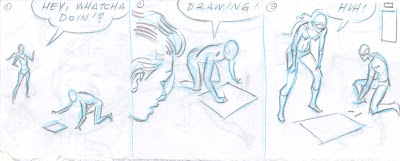
| An irrelevant cartoon from seventeen years ago (my lucky number). |
Alas—the following Monday, much to my horror, I learned that some person or persons (whose identity remains both completely unknown and utterly irrelevant to me) had observed the thread, cut, pasted and converted it into a PDF, and circulated it (reportedly) to “everyone” in my department. My remarks, in other words, had gone “viral” among an inconceivably small and inbred group that included friends, colleagues, advisors, and even a teacher’s aide, few of whom hitherto had ever so much as “liked” any of my other social media postings, and none of whom apparently held me in high enough regard to tip me off that my remarks had become the subject of departmental scrutiny and discussion. Imagine Martin Luther’s embarrassment had his rough and nearly incoherent notes for the ninety-nine theses been leaked before he could realize a more refined, final draft and you’ll understand something of my chagrin on stylistic grounds alone. But of course, the story does not end there.
As classes resumed the following week, I was summoned to the department office to be called on the carpet. My ersatz social media musings—which had been made virtually, off-campus, on my own computer and utilizing my own internet connection—had been deemed, quite arbitrarily, an appropriate and material workplace issue (this after a long history of ignoring complaints I had made concerning actual, non-virtual workplace behaviors—observed with my own eyes and experienced first-hand). Options such as mandatorily-sentenced therapy, the withholding of future letters of recommendation (just as I was beginning my crucial post-departmental job search), the launching of personal defamation lawsuits, and even summary firing were all discussed matter-of-factly as very real possibilities, as though any or all of the above (or threats of retaliation in general) would have only been perfectly reasonable and understandable coming from those who presumed to call themselves scholars. Indeed, the only reason I agreed to meet was out of a genuine concern that my 130 undergraduate students would have had to suffer replacement instructors for the last few weeks of class—a reckless and destructive action I was convinced the powers-that-be were in spiteful enough of a mood to take.
“This stuff is out there,” I was told repeatedly, as if the deleted thread contained nuclear secrets that would eventually and inevitably fall into terrorist hands (ironic that those who profess an admiration for Edward Snowden or Julian Assange have a very different take on the free flow of opinion when it concerns far more mundane matters closer to home). My remarks, only briefly posted on the internet, had a life of their own, or so the reasoning went—a trope conveniently denying the willful agency of those who had, for whatever motives, consciously cut, pasted, and circulated those postings to colleagues, who had indeed “pushed” them even to those who were not customarily online nor otherwise paying any attention to my social media persona. To underscore the gravity of my predicament, I was reminded of certain policies prohibiting the use of university equipment and networks to circulate materials that could potentially be, among other things, defamatory or in violation of copyright—a complete irrelevancy since, as I said above, I had used neither university equipment nor networks to offer my remarks, but posted at home using my own personal computer with my own internet connection. On the other hand, the person or persons who had cut and pasted my copyrighted postings, probably with the goal of defaming me (it would not have been the first time such a thing had happened in my experience in this happy, collegial environment) and almost certainly by utilizing university equipment, networks, and email addresses to distribute them, had violated this particular policy on several counts—an irony no doubt completely lost on the powers-that-be.
In point of fact, my original remarks were no longer “out there” at all. Of my own volition, long before I was even aware that any colleague had seen them, I had deleted the thread from my social media page and expunged it entirely from the internet, although presumably the PDF still resides on several offline personal hard drives (I have in my possession only a blurred print-out passed along to me by a fourth or fifth party). Little of the contents of my original remarks bears repeating, least of all verbatim, and I am not going to do so now. Consequently, unless you participated in or happened to have seen the thread when it was live online, you will have to take my word for it when I characterize them as the stuff of typical profane griping of the sort commonly overheard in any after-working-hours bar, all but meaningless outside the context of the long-running private conversations in which they originated. In other words, it is material that could only cause harm if intentionally pirated by tattle-tales and magnified by malice, and then only to the extent to which any given remark may have hit a truthful nerve or two (in other words, if the shoe fits, wear it). On the other hand, if you only happen to have read the pirated PDF or learned of its contents through third parties, please be advised that you are culpable in an extremely tawdry conspiracy and paradoxically cannot admit any acquaintance at all with what I’m talking about—let alone feign outrage—without confessing to your own monumental lapse of ethics. In any case, you hardly count as my friend or colleague any more—but only you would know that, not I. Nota bene.
This Stasi-like behavior—the secret surveillance, informancy, scrutiny of furtively obtained materials, “telling mommy” and bidding her to take action, to say nothing of the subsequent shunning and other career repercussions I have had to endure since—needless to say, is in itself far worse than anything I could have asserted in my initial posted remarks or even have dreamt of alleging. The entire incident—from the oppressive environment prohibiting any form of criticism to the repressive actions taken as a consequence—speaks to the dysfunctional and poisonous culture that prompted their expression in an uncontrollable and unconstructive outburst in the first place. Although these actions do not retroactively affirm any of my individual complaints explicitly, they certainly do nothing to dispel them, and tend rather to generally confirm their validity—at least as topics that should be discussed and debated among fair-minded friends. In any case, it is utterly reprehensible behavior, especially coming from a group of individuals who presume to call themselves educators, and most of whom, individually if not collectively, I continue to hold in high esteem (including those who, it pains me to think, conferred upon me my degrees). It speaks volumes about the curious phenomenon in which erudite and enlightened individuals—in this case those of whom in their own scholarship, classroom teaching, and committee advising demonstrate openness, honesty, collaboration, and a willingness to transgress almost any boundary for the sake of critical inquiry—can devolve collectively into an expedient affiliation based on little more than careerism and self-seeking: autocratic, authoritarian, intolerant of dissent, demanding of absolute conformity at all costs, to say nothing of the blatant violations of university policy, principles of academic freedom, and simple human decency that are in abundant evidence here.
I alluded to this matter in another posting on this blog, and was reminded of it recently when I came across this commentary on the I Ching reading, number 13 (a fateful number for me), T’ung Jên/Fellowship with Men, in which the six in the second place reads, “Fellowship with men in the clan. Humiliation.” Of this, Wilhelm Baynes remarks,
There is a danger here of formation of a separate faction on the basis of personal and egotistic interests. Such factions, which are exclusive and, instead of welcoming all men, must condemn one group in order to unite the others originate from low motives and therefore lead in the course of time to humiliation.*
The “one group” in this case are the dissenters, non-conformists, and heretics who cannot keep their mouths shut, some of whom have been among our most valuable educators.
*Wilhelm Baynes, The I Ching or Book of Changes, trans. Cary F. Banes (Princeton University Press, 1950/1967), p. 57.
Subscribe to:
Posts (Atom)