For decades, comix beat-up has been your source for finding out who will be rebooting West Coast Avengers six months from now! But we’re much more than that—
Showing posts with label comic books. Show all posts
Showing posts with label comic books. Show all posts
Friday, May 17, 2024

Thursday, June 16, 2022
The Summer of '85 and the Megaton Man Reprints That Never Happened
By the summer of 1985, it was clear that Megaton Man was the hottest title Kitchen Sink Press had ever published to that point.
Monday, May 9, 2022
The Secrets of Dumbalmoore: Fantastic Bleats and Where to Find Them
This text began as a Facebook reply to Stephen Bissette, who was commenting on a link to Mikey Crotty's video, and somehow turned into yet another long-winded and self-serving blog post, rehashing the same tired, stale tropes as I've done elsewhere, on my insignificant collaboration with Alan Moore. Enjoy!
Thursday, March 3, 2022
Shows and Other Cons: The Disappearance of Comics, Episode Omega
The comic book convention as we know is disappearing out from under us; the replacement of the word “con” with “show” in the fan vernacular is our first clue. I for one am ambivalent; except for the 1985 Dallas Fantasy Fair, which was a rip-roaring good time, I can’t think of a convention that wasn’t in some way excessive, vulgar, in bad taste, arduous, or sleep-deprived—apart from discovering the occasional treasure and meeting some my then still-living drawing board heroes (Gil Kane, Murphy Anderson, John Romita, Jack Kirby, Jean Giraud/Moebius, Burne Hogarth—even Jerry Siegel). Being a professional comic book artist during the years when attendance was virtually mandatory for a professional career, I can tell you: Cons were hard work.
Monday, August 5, 2019
King Kong Cover for Amazing Heroes!
Originally posted July 13, 2017; updated with an addendum below, August 5, 2019.
Perhaps the best piece of art I created for the entire King Kong adaptation I drew for Fantagraphics' Monster Comics imprint in the early 1990s never appeared as part of the series. Instead, it was the cover for Amazing Heroes, the little sister publication to their more upscale publication, The Comics Journal. Here is a look at the original colored blueline.

Perhaps the best piece of art I created for the entire King Kong adaptation I drew for Fantagraphics' Monster Comics imprint in the early 1990s never appeared as part of the series. Instead, it was the cover for Amazing Heroes, the little sister publication to their more upscale publication, The Comics Journal. Here is a look at the original colored blueline.

For more on the art of my Kong adaptation, visit my King Kong blog!
Monday, February 18, 2019
"How Much Do You Need?" Hate and Jealousy in Comics, 2019-Style
The recent spate of comics hate that has emanated from certain dethroned creators reminds me of the early Image Comics years. I happened to have had a front-row seat, thanks to Moondog's Comics in Chicago, who hosted the Chicago Comicon in 1992, and my friendship with Larry Tales of the Beanworld Marder and Chris Eb'nn Ecker. Both worked for Gary Colabuono in the Moondog's central office and along with Bevin Brown, masterminded the Image Tent.
Saturday, February 16, 2019
When a Giant Pencil is Worn to a Nub on South Craig Street: Yet Another Pittsburgh Arts Casualty
Just two weeks after the announcement that the Art Institute of Pittsburgh (once the flagship of a national chain of trade schools), and only a week after a realigned Pittsburgh Center for Arts and Media tacitly announced a downgraded role for traditional manual arts such as drawing, painting, and sculpture in their newest incarnation, an iconic Pittsburgh art supply store has abruptly announced it will be going out of business after 48 years.
Saturday, February 8, 2014
Can Doc Savage be Adapted to Comics? Or to Anything?
I've been looking forward to Dynamite Entertainment's new comic book adaptation of Doc Savage ever since I heard about it through Comic Shop News last fall. Not because I was particularly impressed with any of the preview art, or even the Alex Ross faux-James Bama covers, but because of this very question: Can Doc Savage be adapted to comics? Or to anything?
I was first exposed to Doc Savage with Marvel Comics' Doc Savage #1 with the cover date of October, 1972. This was the second month for me as a Marvel reader (the September 1972 cover date, probably June or July in reality, still holding a nigh-cosmic significance in my life experience), and the first #1 issue of a comic book series I ever bought, thus an unforgettable milestone. It was a weird experience: a crimefighter who was not a super-powered costumed character, set in the Depression era, and adapted from another medium, books. I immediately latched onto several of the Bantam Books paperbacks, themselves reprints of something from the past called pulps, and within months had also sent away for Steranko's History of Comics volume I, which included a chapter called "The Bloody Pulps," positing the even stranger thesis that the comic book artform had evolved out of pulp fiction (still problematic in my mind), with a lengthy passage on Lester Dent's (the real name of the pseduonymous author Kenneth Robeson) Doc Savage adventures. Later, I bought Bantam's 1976 edition of Philip José Farmer's Doc Savage: His Apocalyptic Life, an even weirder experience. (This mind-blowing tome suggested, among other things, that Doc Savage, The Shadow, Tarzan, and Sherlock Holmes, among others, were all real and in fact related to one another through something called the Wold-Newton family tree.) Lastly, I recall Marvel's Doc Savage magazine by Doug Moench, John Buscema, and Tony DeZuniga, perhaps the best adaptation of Doc Savage ever done (peremptorily answering my own question on one level, that yes, Doc Savage can be adapted to comics, at least in longer-format chunks), in any case more satisfying than the Steve Englehart and Ross Andru version of 1972.
To make a long story short, I was nearly as much a Doc Savage fan, for a certain portion of my teenage years, as I was a Marvel fan, and at least as much as I was a fan of Jeff Rice's Kolchak: The Night Stalker, Pierre Boulle's Planet of the Apes, and Martin Caidin's The Six-Million Dollar Man. While I can't say that I've read more than twenty of the 181 "supersagas," I've read Farmer's Gnostic history of The Man of Bronze at least a dozen times, and pondered the impracticalities (to say nothing of the social implications) of the Wold-Newton Universe.
To make a short story even shorter, I don't think the new Dynamite version is very good. Let me be clear that my purpose is not to pick on writer Chris Roberson (who after all boasts three editions of Farmer's Apocalyptic Life in his library) or newcomer artist Bilquis Evely, for whom this is clearly a labor of love. Let me further state that I could never imagine performing the research on all the Art Deco necessary to pull off an even passable period adaptation of Doc Savage.
In any case, the first two issues are far from satisfying. I can't imagine anyone other than a diehard Savage fan being at all interested in this project. In each, a complete, original "supersaga" is presented, telescoped into something barely as long as your average movie trailer. The Savage supersagas were known for there outlandishly improbably and inexhaustible twists and turns, if not intellectual complexity; here they are simplified into brief glimpses of icon Savage locales: the Empire State Building, the Fortress of Solitude, the Crime College. In these two installments, the nemeses turns out to a be lone nut jobs with ham radios who are easily dispensed with a few punches, hardly the Johnny Sunlight-caliber evil-doers who could keep Doc and his fabulous five at bay for at least a hundred prose pages. Further, it is often difficult to tell Doc apart from his fabulous five aides, since this adaptation has forgone the dark bronze complexion, has chosen to integrate both the Clark Gable loose hair and James Bama widow's peak, and not even shown him in a torn shirt (except for the Ross covers), or even the 1972 Marvel blue vest.
On the other hand, I will say that there does come across, even in these absurdly truncated exploits, a certain egalitarian camaraderie among Doc and his five aides that is quite enjoyable, reminiscent perhaps more of Buckaroo Banzai than the Doc stories proper, or of any of Doc's artistic progeny (James Bond, Indiana Jones, Jor El -- all of whom I at least tend to think of as loners). And Ms. Evely's art, although indecisive when it comes to depicting the male characters (they all wear suits and are about the same stature, with even Monk blending into the crowd), her art really comes alive when she is drawing that butch-femme dynamo Pat Savage. Pat, Doc's proto-feminist metrosexual sister, is seen in jodhurs and unbuttoned safari shirt that, while not torn to shreds, recalls the iconography of the Bama covers associated with Doc more vividly and convincingly than even the Ross covers (the first of which fetishize the shreds into a kind of swirling whirlwind of flames--a kind of divine transfiguration). One is tempted to say just to forget the traced skyscrapers and cardboard male characters altogether, and let Evely draw Pat kicking ass for 17 pages an issue. And let the shirt get torn to shreds. I would buy it.*
It is too soon to tell where Roberson (not to say Robeson) is going with his multi-decade story arc (if you can call these fleeting episodes stories at all). It seems clear that Doc and Pat are the only ones who will not age (although whether this is the result of Doc's pharmacological ingenuity or of immortal chromosomes mutated by the Wold-Newton meteor remain to be seen), while Monk, Ham, and the other three (who were never very discernible anyway) are slated to die off, to be replaced by next-gen whiz kids. Frankly, I would prefer to see the comics adapters attempt a "rattling good story" faithful to the original time period rather than a meta-discursus on the post-Street and Smith narrative (with its obsession of integrating the various hair-eras of Doc with Farmer's Gnostic history of pulplit). Needless to say, the only creative idea that Marvel and DC have been able to come up with these past few decades have been these kinds of Talmudic exegesis on continuity rather than creative storylines, and this is hardly in the spirit of the American comic book. Neither is it in the spirit of Doc or the pulps.
On the other hand, it just may be that Doc is too plainclothes, too cerebral (after a fashion), too literary a property to be properly adapted to such a visual medium as comics (the George Pal and Ron Ely film version not offering much a rebuttal on behalf of film). I have always felt, since the time I was enjoying various entertainment in media in my teen years, that certain ideas lent themselves to certain artforms better than other, and that adaptation for the sake of spin-off licensing always involved either radical alteration or sheer loss of the charm and magic of the idea in its native form. Doc Savage was best in prose; Planet of the Apes (as it was transformed by Rod Serling and others) best in film; superheroes (prior to big-budget special effects in the late 1970s and cgi since) in comics, and so on. Since Star Wars, The Lord of the Rings, and Harry Potter, however, we've all gotten used to the idea that properties that can be more than just merchandising bonanzas but actually artistically successful on multiple platforms while at the same time faithful to their original conceptions. But I'm still not convinced this is now a universal law, hence my continued interest in the Dynamite Doc Savage as it unfolds. Can Doc Savage be adapted to comics? Or to anything? To my mind, the jury is still out.
More art from the Dynamite adaptation and an interview with Chris Roberson @ Between the Covers.
___
* Let's be honest, I would draw it. Jenny Woodlore, the female protagonist from my series Border Worlds, had her origins in an eroticized drawing I made in high school of a brunette in a Bamaesque torn shirt and jodhpurs--not exactly Pat Savage, but close enough. Such is the power of that curious motif over one young (now middle-aged) male imagination.
I was first exposed to Doc Savage with Marvel Comics' Doc Savage #1 with the cover date of October, 1972. This was the second month for me as a Marvel reader (the September 1972 cover date, probably June or July in reality, still holding a nigh-cosmic significance in my life experience), and the first #1 issue of a comic book series I ever bought, thus an unforgettable milestone. It was a weird experience: a crimefighter who was not a super-powered costumed character, set in the Depression era, and adapted from another medium, books. I immediately latched onto several of the Bantam Books paperbacks, themselves reprints of something from the past called pulps, and within months had also sent away for Steranko's History of Comics volume I, which included a chapter called "The Bloody Pulps," positing the even stranger thesis that the comic book artform had evolved out of pulp fiction (still problematic in my mind), with a lengthy passage on Lester Dent's (the real name of the pseduonymous author Kenneth Robeson) Doc Savage adventures. Later, I bought Bantam's 1976 edition of Philip José Farmer's Doc Savage: His Apocalyptic Life, an even weirder experience. (This mind-blowing tome suggested, among other things, that Doc Savage, The Shadow, Tarzan, and Sherlock Holmes, among others, were all real and in fact related to one another through something called the Wold-Newton family tree.) Lastly, I recall Marvel's Doc Savage magazine by Doug Moench, John Buscema, and Tony DeZuniga, perhaps the best adaptation of Doc Savage ever done (peremptorily answering my own question on one level, that yes, Doc Savage can be adapted to comics, at least in longer-format chunks), in any case more satisfying than the Steve Englehart and Ross Andru version of 1972.
To make a long story short, I was nearly as much a Doc Savage fan, for a certain portion of my teenage years, as I was a Marvel fan, and at least as much as I was a fan of Jeff Rice's Kolchak: The Night Stalker, Pierre Boulle's Planet of the Apes, and Martin Caidin's The Six-Million Dollar Man. While I can't say that I've read more than twenty of the 181 "supersagas," I've read Farmer's Gnostic history of The Man of Bronze at least a dozen times, and pondered the impracticalities (to say nothing of the social implications) of the Wold-Newton Universe.
To make a short story even shorter, I don't think the new Dynamite version is very good. Let me be clear that my purpose is not to pick on writer Chris Roberson (who after all boasts three editions of Farmer's Apocalyptic Life in his library) or newcomer artist Bilquis Evely, for whom this is clearly a labor of love. Let me further state that I could never imagine performing the research on all the Art Deco necessary to pull off an even passable period adaptation of Doc Savage.
In any case, the first two issues are far from satisfying. I can't imagine anyone other than a diehard Savage fan being at all interested in this project. In each, a complete, original "supersaga" is presented, telescoped into something barely as long as your average movie trailer. The Savage supersagas were known for there outlandishly improbably and inexhaustible twists and turns, if not intellectual complexity; here they are simplified into brief glimpses of icon Savage locales: the Empire State Building, the Fortress of Solitude, the Crime College. In these two installments, the nemeses turns out to a be lone nut jobs with ham radios who are easily dispensed with a few punches, hardly the Johnny Sunlight-caliber evil-doers who could keep Doc and his fabulous five at bay for at least a hundred prose pages. Further, it is often difficult to tell Doc apart from his fabulous five aides, since this adaptation has forgone the dark bronze complexion, has chosen to integrate both the Clark Gable loose hair and James Bama widow's peak, and not even shown him in a torn shirt (except for the Ross covers), or even the 1972 Marvel blue vest.
On the other hand, I will say that there does come across, even in these absurdly truncated exploits, a certain egalitarian camaraderie among Doc and his five aides that is quite enjoyable, reminiscent perhaps more of Buckaroo Banzai than the Doc stories proper, or of any of Doc's artistic progeny (James Bond, Indiana Jones, Jor El -- all of whom I at least tend to think of as loners). And Ms. Evely's art, although indecisive when it comes to depicting the male characters (they all wear suits and are about the same stature, with even Monk blending into the crowd), her art really comes alive when she is drawing that butch-femme dynamo Pat Savage. Pat, Doc's proto-feminist metrosexual sister, is seen in jodhurs and unbuttoned safari shirt that, while not torn to shreds, recalls the iconography of the Bama covers associated with Doc more vividly and convincingly than even the Ross covers (the first of which fetishize the shreds into a kind of swirling whirlwind of flames--a kind of divine transfiguration). One is tempted to say just to forget the traced skyscrapers and cardboard male characters altogether, and let Evely draw Pat kicking ass for 17 pages an issue. And let the shirt get torn to shreds. I would buy it.*
 |
| "Do these jodhpurs make my thighs look fat?" More problematic is the shirt, clearly made of more durable fabric than those of her clothing-optional cousin. Bilquis Evely's art comes (Tarzan!) alive when she draws Pat Savage, from the Dynamite adaptation. |
It is too soon to tell where Roberson (not to say Robeson) is going with his multi-decade story arc (if you can call these fleeting episodes stories at all). It seems clear that Doc and Pat are the only ones who will not age (although whether this is the result of Doc's pharmacological ingenuity or of immortal chromosomes mutated by the Wold-Newton meteor remain to be seen), while Monk, Ham, and the other three (who were never very discernible anyway) are slated to die off, to be replaced by next-gen whiz kids. Frankly, I would prefer to see the comics adapters attempt a "rattling good story" faithful to the original time period rather than a meta-discursus on the post-Street and Smith narrative (with its obsession of integrating the various hair-eras of Doc with Farmer's Gnostic history of pulplit). Needless to say, the only creative idea that Marvel and DC have been able to come up with these past few decades have been these kinds of Talmudic exegesis on continuity rather than creative storylines, and this is hardly in the spirit of the American comic book. Neither is it in the spirit of Doc or the pulps.
On the other hand, it just may be that Doc is too plainclothes, too cerebral (after a fashion), too literary a property to be properly adapted to such a visual medium as comics (the George Pal and Ron Ely film version not offering much a rebuttal on behalf of film). I have always felt, since the time I was enjoying various entertainment in media in my teen years, that certain ideas lent themselves to certain artforms better than other, and that adaptation for the sake of spin-off licensing always involved either radical alteration or sheer loss of the charm and magic of the idea in its native form. Doc Savage was best in prose; Planet of the Apes (as it was transformed by Rod Serling and others) best in film; superheroes (prior to big-budget special effects in the late 1970s and cgi since) in comics, and so on. Since Star Wars, The Lord of the Rings, and Harry Potter, however, we've all gotten used to the idea that properties that can be more than just merchandising bonanzas but actually artistically successful on multiple platforms while at the same time faithful to their original conceptions. But I'm still not convinced this is now a universal law, hence my continued interest in the Dynamite Doc Savage as it unfolds. Can Doc Savage be adapted to comics? Or to anything? To my mind, the jury is still out.
More art from the Dynamite adaptation and an interview with Chris Roberson @ Between the Covers.
___
* Let's be honest, I would draw it. Jenny Woodlore, the female protagonist from my series Border Worlds, had her origins in an eroticized drawing I made in high school of a brunette in a Bamaesque torn shirt and jodhpurs--not exactly Pat Savage, but close enough. Such is the power of that curious motif over one young (now middle-aged) male imagination.
Saturday, August 3, 2013
Don, You Drew a Frank Santoro and a Rachel Masilmani
These are studies I made of Frank Santoro's "Frank, You Made a Tom Wesselmann," which was exhibited as part of the Pittsburgh Biennial in 2011. I brought my Carnegie Museum of Art sketchbook class through the exhibit and must have made a quick sketch of it on site; later I refined the figure with two layers of tracing paper. Frank's original was a large airbrush sketch that was somewhere between a contour and gesture line, somewhat indefinite, but suggestive of the entire figure. I loved the pose and wanted to fill it in and render it more literally (in my inimitable flat-footed way, as is my wont). I've done that with other sources, such as Duchamp's Nude Descending a Staircase and Picasso, etc., where I've taken sketchy or abstract figures that I've tried to interpret more literally. (More recently, I've done this with some of my old sketchbook doodles, to mixed success.)
(Note: This effort, including the tracings, has remained in my sketchbook, and therefore technically is a study and not a swipe, the latter being only when one attempts to pass off a published drawing as one's own work without acknowledgement or satiric intent.)
I saw Frank last night at the Little Book Fair in the Garfield section of Pittsburgh, and met him recently at Copacetic Comics, but never made the connection that he was the gallery artist whose work I had swiped! I've owned a copy of his Storeyville for years. Apparently I need names, faces, and work impressed on me all at once to make the connection, or the information goes flying off into space.


Below, I did pretty much the same thing with a selection of figures from Rachel Masilmani's haunting comic Las Cuerpas (you can download a pdf) after coming across it and meeting her in April 2013, again at the Carnegie Museum of Art, at Drawing Power, a 'zine-and-comics fair and symposium. I've extracted all the pretty figures, but as you'll see, the story concerns the gruesome gynocide of women in Juarez, Mexico, and the conspiracy of silence surrounding these murders, and the revenge of a ghostly, gargantuan Goyaesque figure who strides over the landscape.

(Note: This effort, including the tracings, has remained in my sketchbook, and therefore technically is a study and not a swipe, the latter being only when one attempts to pass off a published drawing as one's own work without acknowledgement or satiric intent.)
I saw Frank last night at the Little Book Fair in the Garfield section of Pittsburgh, and met him recently at Copacetic Comics, but never made the connection that he was the gallery artist whose work I had swiped! I've owned a copy of his Storeyville for years. Apparently I need names, faces, and work impressed on me all at once to make the connection, or the information goes flying off into space.


Below, I did pretty much the same thing with a selection of figures from Rachel Masilmani's haunting comic Las Cuerpas (you can download a pdf) after coming across it and meeting her in April 2013, again at the Carnegie Museum of Art, at Drawing Power, a 'zine-and-comics fair and symposium. I've extracted all the pretty figures, but as you'll see, the story concerns the gruesome gynocide of women in Juarez, Mexico, and the conspiracy of silence surrounding these murders, and the revenge of a ghostly, gargantuan Goyaesque figure who strides over the landscape.

Tuesday, July 30, 2013
Teaching Cartooning: Streetwise (2000)
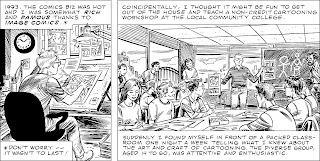
Here's the autobiographical short story I created for TwoMorrow's Streetwise (edited by Jon B. Cooke in 2000). It begins with my experiences teaching a non-credit workshop in cartooning for the Community College of Allegheny County in the early 1990s, which was a wonderful experience, and where I met my wife (the marriage lasted a decade). Then it deals with my experiences with a shabby but venerated "art" institution in Pittsburgh, which had its moments, but to which I would not send an inmate on parole (it is a notorious for-profit tuition-fleecing operation). Since then, I've had the far more uplifting experience of teaching workshops for the Carnegie Museum of Art and completing my PhD at the University of Pittsburgh, so despite some early rough spots I am still very much an arts educator. Live and learn!



Saturday, July 6, 2013
Jim Pascoe: Pittsburgh Zombie
Below is a sketch of Jim Pascoe, drawn in a coffee shop on
Carson Street in Pittsburgh some time in the late 1990s. You can tell it is late at night because I tend to want to
sketch like Moebius when I’m tired.

Here is a detail of the same page. Jim seems to have a
jaundiced eye, but that is my mistake. I tried touching it up, but I had used some fountain pen I had been trying out with water-based ink, and painting over it with white
watercolor didn’t work too well. What that Bill Sienkiewicz-like doodle is
doing in the upper right corner I have no idea.

Jim wrote a zombie script for some kind of anthology some time in the mid-2000s, which
I thumbnailed below.

Here is one of the penciled pages. I regret drawing it in 11
x 17” format which I found to be constraining. That’s one of the main reasons I
never finished it. As I’m getting older, I need to draw bigger originals just
to see what I’m doing and to be able to put in all the detail, such as carnival
backgrounds in this case.

I liked these drawings a lot, though. I had to do some research on drawing children to get the right age. I like the dynamism of the figures. But I did not leave enough room to letter, which became part of my frustration with this job. I think I must have been going to school already by this time, and I was really out of practice. My instincts were just off.

Here’s the top tier of the last page I attempted to pencil. I had school and other commitments that made it impossible for me to complete this project; the inker ended up completing the art from my thumbnails. I wish I had gone that route in the first place! Jim later showed me the finished art.

Air Shark 3000: Spacecraft for Suburbia
In an attempt to channel Raymond Loewy and Ralph Mcquarrie, I sketched out this vehicle for Border Worlds sometime in the early 2000s. I recall looking at a remaindered book I had gotten on military aircraft. Notice the garage with the basketball backboard and hoop in the background.

See also Border Worlds: The Aftermath
See also Border Worlds: The Aftermath
Paleo-Girl: The Wild Child
I’ve always loved this drawing,
dating from the mid- or even early-1990s, which would make it 20 years old now. I call her Paleo-Girl, for lack of a
better moniker. She takes up less
than a quarter of a 14" x 17" Strathmore 400 Series drawing sheet,
with the remaining space to be taken up by her pet dinosaur or something. I never knew exactly what to do with her. Being
semi-nude, she couldn’t appear in Bizarre Heroes without substantially
changing the nature of that series; besides, with the spear and animal skin, she’s
a bit too close to the Phantom Jungle Girl, shown below (although Paleo-Girl is supposedly an
actual prehistoric feral child, while PJG is a modern urbanite dressed as a
cave woman). The stories I can imagine for Paleo-Girl all tend to be rather on
the erotic side, but not to the extent of Wendy Whitebread. They also range
from the prehistoric to the post-apocalyptic, suggesting that she travels
through time. Possibly she’ll wind up as a guest star in the Ms. Megaton Man
sequence I’ve been toying with in my spare time for many a year now.


(Below is a sketch of the Phantom Jungle Girl for comparison.)

Speaking of semi-nudity (which,
growing up in the ‘70s, we all thought would be completely legal now, along
with marijuana and liberal politics) and post-apocalypticism, one of the great
post-underground comic book series will soon be back in print with improved
lettering (but no doubt the same overwrought, clumsy prose): First Kingdom by Jack Katz. Well, you
have to be willing to take your epic sweep with a lot of melodramatic banality (which is
no worse than most comics anyway, I suppose). My only wish is that it was being
issued all in one volume.
Border Worlds: The Aftermath
Three sketchbook pages from c. 2000 that envision a scene from Border Worlds following the events of Marooned #1. Jenny takes leave of Sparky on her jetpack but soon runs into problems...
(See this same sequence, expanded and in color, on my new Border Worlds blog!)


(See this same sequence, expanded and in color, on my new Border Worlds blog!)


(See this same sequence, expanded and in color, on my new Border Worlds blog!)
Wednesday, June 26, 2013
Cultural Legitimacy for Comics: Act Like You've Found It
A Comics Studies Reader
(University Press of Mississippi, 2009), edited by Jeet Heer and Kent
Worcester, offers itself as a concise survey of the scholarly field of comics
studies, one that its editors hope will be, as its back cover boasts, “ideal
for classroom use.” For someone like me, a past comic book artist who has been
away from the field and would like to catch up, and is now a college instructor
contemplating developing either a studio or art history course of some kind that
would involve readings on cartooning, this anthology promises to serve a double
purpose: as a useful “state-of-the-field” overview, and as a prospective course
text. With that in mind, I will offer a serialized preliminary evaluation, starting
with the Introduction and first essay.

To illustrate what Groensteen perceives as the unfair persecution of comics, he quotes from a 1964 French dictionary, an art historian, a novelist, and a former curator of prints at the Bibliothèque Nationale, among a few other select publications, averaging only one quotation per decade from the 1950s to the 1990s. However, these ostensible condemnations of comics are often more insightful than the author’s own remarks on the medium, which tend toward the cliché, the trite, and the shopworn. For example, the curator attributes comics’ failure to achieve a sufficient literary and artistic density that would merit serious attention to the hybridity of the form itself, and to the overriding imperative for legibility that induces creators to simplify their material and presentation at all costs or else risk the confusion and alienation of potential readers. To this practicing cartoonist, at least, this strikes me as a fascinating and perfectly apt observation.
The Introduction by the editors cites the “long but often
marginal history at the periphery of scholarly and intellectual worlds” of
comics studies, but reports that in recent years it has become “a lively field
of inquiry.” The growth in scholarly writing and publications on comics, the
explosion of reprint projects, the formation of substantial research archives,
and a general awareness of comics in the culture at large, the editors assert,
have all “helped to legitimize comics studies.” Oddly, there is no specific
mention of the onslaught of blockbuster films based on comic book properties, the
most obvious cultural trend accompanying the social climb of comics studies
over the past two decades. In this period in particular, the editors claim, comics
scholars have “had the advantage of greater resources, numbers, and academic
respectability” than that enjoyed by the pioneering generation of comics scholars
of the 1960s and 1970s.
The editors are cautious in their triumphalism, however. “The
emergence of a research-driven scholarly corpus … is a relatively recent
occurrence,” they note, but “the energy and ferment of contemporary writing on
comics” presents “an ideal moment to step back and survey the terrain.” They hope
that their interdisciplinary anthology of “twenty-eight noteworthy
contributions” will serve “as a starting point for defining comics studies as
well as a springboard for further investigation.” The editors pause only
briefly to cast an envious eye toward film, which they remark is “a younger art
form” than comics (a debatable assertion) with a comparatively “larger, more
systematic, and more culturally respectable” literature.
The first text in their anthology is entitled “Why Are
Comics Still in Search of Cultural Legitimization?” by Thierry Groensteen.
Given the generally upbeat tenor of the Introduction, it is a puzzling choice
to lead off such an anthology of comics studies, since it contravenes nearly
every assertion the editors have just made. Written in 2000, and therefore prior
the presumed scholarly and artistic achievements of the subsequent decade, Groensteen
complains that comics still “suffer from a considerable lack of legitimacy.”
While he avers that what he is describing may be unique to France and not
necessarily applicable to “other national situations,” he claims that comics
are regarded as “infantile, vulgar, or insignificant” by “legitimizing
authorities (universities, museums, the media)” in the Francophone world. In
Groensteen’s view, comics history is still “widely misunderstood,” its study
“retarded” due to “a complete absence of critical, archivistic, and academic
attention.” A chief source of official opprobrium are educators, who view the
medium as childish, in particular the curious mixture of word and pictures that
achieves its apotheosis in the word balloon.
To illustrate what Groensteen perceives as the unfair persecution of comics, he quotes from a 1964 French dictionary, an art historian, a novelist, and a former curator of prints at the Bibliothèque Nationale, among a few other select publications, averaging only one quotation per decade from the 1950s to the 1990s. However, these ostensible condemnations of comics are often more insightful than the author’s own remarks on the medium, which tend toward the cliché, the trite, and the shopworn. For example, the curator attributes comics’ failure to achieve a sufficient literary and artistic density that would merit serious attention to the hybridity of the form itself, and to the overriding imperative for legibility that induces creators to simplify their material and presentation at all costs or else risk the confusion and alienation of potential readers. To this practicing cartoonist, at least, this strikes me as a fascinating and perfectly apt observation.
But rather than a productive engagement with this remark,
Groensteen declares it “difficult to refute,” owing to the different aesthetic
criteria applicable to cartoon drawings and “art drawings,” and moves on.
Similarly, he scoffs at “great French writers” in scare quotes, but declines to
engage in the fairly thoughtful observation of one novelist who observes that
the blending of words and pictures is fraught with the prospect of the two
channels canceling one another out, confounding the average adult literate
mind. Rather than inquiring as to why this should be the case, Groensteen insists
that comic book readers, and perhaps other world cultures, don’t seem to have
this particular problem. The upshot is that critics of comics are stuffy,
hidebound, and not hip to the at once vernacular and avant-garde form
represented by comics. Needless to say, this argument would be more convincing
if large numbers of people were making similar statements in 2000, at the time
Groensteen is writing; the fact that he must survey half a century or more to
locate a handful of benign dismissals makes one question what is really
bothering the author, and why the editors find this issue so urgent as to place
it at the beginning of their anthology.
Further, it is by no means clear, either in the editors’
Introduction or Groensteen’s text, what constitutes cultural legitimation, or
for whom the legitimation is being sought: comics creators or comics scholars.
More to the point, it is unclear how either the enjoyment of comics or their
scholarly study has been hampered by this perceived lack, or how something
described as cultural legitimacy would be of material benefit to creators or
scholars. Apparently, some art forms enjoy cultural legitimacy as if by nature,
and it is felt that comics deserve the same respect. Clearly, it pains
Groensteen that the work of cartoonists like Hergé, Crumb, and Moebius do not
enjoy “a wider diffusion” and appreciation, and that the keepers of official culture
cannot discern this work from the run of average material. But it seems
unlikely that these creators in particular, who enjoyed enormous success and
near-celebrity status during their careers, were ever particularly harmed by
never having been accorded cultural legitimacy. Indeed, Groensteen never makes
this assertion, adding to the suspicion that the only legitimacy he is
concerned with is his own. Had these creators desired cultural legitimacy,
whatever that entails, they certainly had the talent to pursue other avenues to
achieve that end. Rather, it seems that the imagined plight of cartoonists is
invoked only as a proxy for and to be conflated with the social and academic
anxieties of comics scholars, the gains set forth in the Introduction notwithstanding.
Whether poorly written, poorly translated, or poorly
excerpted, Groensteen’s text is unconvincing, and reads as if he is merely preaching
to the converted. Against the paltry and rather benign (and perhaps even
constructive) criticisms he has dredged up, Groensteen offers no serious
argumentation, but provides the usual litany of bland generalizations. Critics
of comics, he asserts, unfairly tar the medium with the brush of childhood
entertainment, and, imbued with modernism’s mandate for specificity, simply fail
to understand the unique hybridity of the comics form. Never mind that
Groensteen ends the article by laying claim to his inner child (although he
does not employ that term), or that he makes the completely modernist assertion
that “Comic art is an autonomous and original medium,” i.e., that comics can
pass the same modernist test of specificity he has just denounced. In short,
one gets the impression not so much of a widespread, culturally-ingrained
discrimination towards comics as a comic book fan with a persecution complex
looking to manufacture rejection from the most obscure and forgotten
denunciations he can cobble together.
In any case it is abundantly clear from the positioning of
Groensteen’s text immediately following the Introduction that cultural legitimation
is a preoccupation of comics scholars or at least the editors of A Comics Studies Reader, the attainment
of which is seen as a primary goal of comics studies. “How are we to defend
comic art,” Groensteen pleads, from those who would rashly disqualify it as an art?
One strategy, one is tempted to respond, might be to simply ignore or forget
the scattered denunciations that Groensteen has labored so mightily to unearth.
Better still, to seriously address the sticking points that these critics have
so helpfully pointed out, rather than to petulantly dismiss them.
For all I know, Groensteen’s is an apt summation of the
situation in France at the end of the 1990s (and as far as that goes, belies
the cherished myth Americans have that comics are taken more seriously in
Europe), but devoting eight pages of precious space to these neurotic musings
in an English-language anthology in 2009 is more than questionable and worse
than unfortunate. Certainly, the critical reception of comics over time is of
historiographic interest, but Groensteen’s text is not presented
historiographically, but rather as if still reflecting current concerns in the
field. If the intent was rhetorical, to show that as recently as a decade earlier
scholars were still ruminating about cultural legitimacy but now things look
brighter, this might have been dealt with more efficiently in a citation in the
editors’ Introduction, before reporting on the substantial gains in the
fortunes of comics and comics scholarship in the interim. More to the point, I
know of no scholarly field that foregrounds the question cultural legitimacy of
its objects of study to such an extent as comics studies. Of course, scholarly
activism in nothing new in the humanities, but it is generally on behalf of some
social cause, political issue, or exploited group, never an art form. The
appeal being made on behalf of comics is not being made on behalf of any
ethnic, gender, or identity group, but rather an expressive form, which, by the
editors’ own account, is finally receiving its due. Besides, most scholars
assume that their objects of scholarly study are worth scholarly attention by
virtue of the fact that they are bothering to study it, at the very least that
cultural legitimacy is bestowed by their act of investigation. Why isn’t this
the case in comics?
From the viewpoint of tradition, the anxieties expressed by
Groensteen and the editors concerning the cultural legitimacy of comics are
little more than the continuation of an entrenched tradition in comics scholarship:
comics studies as the academic expression of comics fans seeking validation for
their juvenile enthusiasms, avid enthusiasts who have never gotten over some
early rejection by relatives or some potential object of affection, even years
after they have made a success of it. By including Groensteen’s text, however,
the editors have elevated their deep-seated anxieties concerning the cultural
legitimacy of comics or comics studies to the level of a social cause, risking
ridicule for the entire field, and worse, perpetuating the worst tendencies of
twentieth-century fandom into the twenty-first century. While not completely
ruling out the use of A Comics Studies
Reader for classroom use, the inclusion of “Why Are Comics Still in Search
of Cultural Legitimization?” should give any comics scholar or educator pause.
Why indeed. Do we really want to visit the neuroses and prejudices of the past
on the college students of today, who see only an artistically viable and valid
art form, capable of great depth and range of expression? Perhaps if comics and
comics studies acted as if they already had cultural legitimacy, they would
find it.
Subscribe to:
Posts (Atom)