The scholar David Kunzle declared in 1973 that he was
writing “a history or pre-history” of the modern newspaper comic strip. This
enterprise has come to encompass a significant portion of his professional scholarship,
including four major books with the term “comic strip” in the title: History of the Comic Strip, Volume I: The
Early Comic Strip—Narrative Strips and Picture Stories in the European
Broadsheet from c.1450 to 1825 (1973)[1]; The History of the Comic Strip, Volume II: The Nineteenth Century (1990)[2]; Rodolphe Töpffer: The Complete Comic Strips (2007)[3]; and
Father of the Comic Strip: Rodolphe
Töpffer (2007)[4].
These four volumes are preceded by one of Kunzle’s first published articles, a
translation of Francis Lacassin’s “The Comic Strip and the Film Language,”
which is augmented by almost 4 ½ pages of “supplementary notes” by Kunzle and
amounts to a prolegomena to Kunzle’s own scholarship on pre-twentieth-century
picture stories and their relationship with cinematic history.[5] Such
a sizeable corpus of research and writing,[6]
to say nothing of the publication of these sometimes cumbersome and profusely
illustrated works, would be a worthy if not magisterial achievement for any
scholar, particularly one working in such a pioneering area of graphic art as
pre-twentieth-century printed picture stories. However, the twentieth-century term
“comic strip” figures prominently in each of the titles mentioned, and Kunzle
in his own right has become considered a father of sorts to scholars of comics,
and has had a surprising and unexpectedly substantial impact on the way comics
are being perceived today.
So it may seem impertinent to ask: is Kunzle's undeniable
accomplishment really a history or pre-history of the comic strip? Does it do
justice to the pre-twentieth-century material Kunzle studies to be considered
primarily as comic strips or precursors to comic strips? What are Kunzle’s motivations
for claiming the term “comic strip” as his rubric, and would his material have been
better served by another term, such as “picture story”? What effect has
Kunzle’s work, and his assimilation of his material to the modern comic strip, had
on comics (both on its scholarship and the art form)? Would it be more productive,
in fact, for comics scholars and artists to think, not of earlier graphic
(printed) picture stories as latent comic strips (or comic books or graphic
novels), but of comics as a particular formulation or solution to the problems
presented by the graphic picture story? Would it be more productive for
twenty-first century creators to consider the creative potential of
combining words and pictures freely, with the entirety of the history of
culture offering suggestion, rather than reducing the history of all previous words-and-pictures
experiments down to a teleological, evolutionary drama narrowly concerned with
the perfection of a specific, marketable form of picture story?
 |
| The reference room of the Frick Fine Arts Libary, University of Pittsburgh, which holds a copy of Kunzle’s History of Comics Volume I (not pictured). |
An informal search Google N-Gram search and search of
databases at my disposal suggests that the term comic strip did not emerge as a
term of description for the American newspaper feature we now know by that name
until probably the mid-1910s. All the material Kunzle studies in his four major
works dates from prior to the twentieth century. The few times that Kunzle
mentions twentieth-century newspaper comic strips throughout this corpus, it is
with at least mild disdain; he seems to regard the more popular successors to
his material as an attenuated if not fallen and debased artform when compared
to the earlier material he finds more richly varied as to subject matter and
political and social viewpoint and consequently so much more engrossing. So why
does he so emphatically embrace the term comic strip by placing it firmly in
the titles of all his works, and why does he so earnestly want us to view the
narrative strips, picture stories, broadsheets, and other material under
scrutiny as comic strips?
Kunzle acknowledges more than once that his project was
inspired by the art historian Ernst Gombrich, who published his ground-breaking
Art and Illusion in 1960 (which is
still on some required reading lists).[7]
Gombrich is the first to make the connection between early print picture
stories (and specifically the work of Töpffe) to the modern newspaper comic
strip form. Gombrich asserts, “to Töpffer belongs the credit, if we want to
call it so, of having invented and propagated the picture story, the comic
strip.”[8]
Gombrich views Töpffer’s combination of words and pictures as especially prescient,
“In view of what has happened during the last decades,” presumably a reference
to the rising popularity of newspaper comic strips and children’s books
(Gombrich was writing in the 1960s).[9]
Gombrich, however, does not elaborate on the distinctions or definitions of the
terms “picture story” or “comic strip,” let alone recount the evolution from
one to the other.
Enter Kunzle, Gombrich’s student, who does explore this
terrain, and also assumes the elder scholar’s identification of Töpffer as a
key figure in the development of the form(s). Kunzle also, at least at the
outset, also assumes Gombrich’s terminological ambiguity (“the picture story,
the comic strip”). Kunzle himself claims to “use the terms picture story and
comic strip indifferently,” although he frequently refers to “the development
of the picture story and comic strip,”[10]
along with other terms, quite often, as if they were separate and distinct
forms demanding the covering of all bases.
Kunzle establishes his use of the term comic strip in the
Introduction to History of the Comic
Strip Volume I, although he never justifies or explains his choice, or
indeed, that he is making a choice. In the opening section, Kunzle considers a
range of terms used to describe the twentieth century newspaper feature,
particularly foreign variants such as Italian fumetti, the French bandes
désinées (drawn strip), and the German term Bilderstreifen and Bildergeschichte
(literally, picture strip and picture story, respectively), and the French term
bande dessinée. Kunzle blandly
asserts, “Of all these terms, ‘comic strip’ is the most commonly used for the
newspaper strip,” which he describes as “an artistic phenomenon.” He writes,
All over the Western world, the comic strip has become a
major form of mass communication, a potent force in molding public opinion, an
international language […] understood and enjoyed by the literate and
semi-literate alike.
But Kunzle offers no rationale as to why the term “comic
strip” should be favored in describing this phenomenon, let alone why it should
be applied retroactively to graphic material prior to the advent of the
American daily newspaper.
The clear inference is that Kunzle is saddled with the term “comic
strip” whether he finds it appropriate or not for the pre-twentieth-century
material he is studying. And indeed, he finds in completely inappropriate,
arguing, “only the English language […] insists that ‘drawn strips’ are comic,”
while in fact
the truly comic
strip [Kunzle’s emphasis] does not emerge until … late eighteenth-century
England. At this stage of its development, however, I have preferred to use the
phrase “caricatural strip” …. [Therefore] I never refer to the pre-caricatural
(i.e. pre-1780) strip as the “comic strip,” even when it contains an element of
humor. I generally use the terms “narrative strip” or “narrative sequence,”
“picture story” or “pictorial sequence” (depending on the format involved) in
order to stress the narrative role of the medium, which I consider primary.[11]
Kunzle finds formal similarities between the material of his
study and twentieth-century newspaper comic strips sufficient to justify the
connection previously made by Gombrich, and constructs a definition of the term
“comic strip” broad enough (most notably by not being dependent on the word
balloons) to justify its application to his material.[12]
However, Kunzle never again employs the term “comic strip” in History of the Comic Strip Volume I following
the Introduction.
Further, Kunzle’s anachronistic application of the term
“comic strip” to the material of his study is all the more puzzling, since he seems
to have little knowledge or interest in twentieth-century material, or in
discussing “comic strips” per se. Indeed, Kunzle rarely discusses twentieth
century newspaper strips throughout his oeuvre, and then only generally and
vaguely, usually only with broad reference to their popularity, and often with
a good deal of disdain for what he sees as an artistic devolution from the rich
social commentary and propaganda of his favored era into banal soap opera and
gags of the time of his writing. Kunzle is also dismissive of the historically uninformed
“Compilers of books on the twentieth-century comic strip” and their “potted”
histories.[13]
For example, Kunzle blasts a biography, “that modern stalwart, Milton Caniff,” for
the name-dropping pretentions of its subtitle (“Rembrandt of the Comic Strip”),
and the author’s ignorance in conflating Renaissance cartoons (preparatory
drawings for paintings or tapestries) with the modern graphic form.[14]
Kunzle expresses no interest in extending his own research into twentieth
century material, to write a corrective history of twentieth century comic
strips, or even to compare examples of the pre-1896 material of his study with
more recent examples.
In fact, Kunzle seems to have regretted his choice of
placing the term “comic strip” in the title of his history of broadsheets and
picture stories. In the Preface to History
of the Comic Strip Volume II (1996), Kunzle goes on an extended,
unscholarly rant about the problems the term “comic strip” has created for the
reception of his scholarship in the intervening two decades.
As a respectable academic I have, I suppose, sought to give
the comic strip academic respectability. I doubt that I have succeeded yet. The
“scientific literature” of my discipline (art history) has tended to pass by
Volume 1, The Early Comic Strip, no
doubt because of its frivolous title, which has not convinced even the
(nonacademic) celebrants of the genre in the 20th century that there
is indeed a comic strip worthy of the name before the Americans “invented” it
in 1896 or so. I was recently sent a script for an ambitious television series
on the (20th century) comic strip, for which funding was being
sought and to which I was nominated a “scholarly advisor.” The script started
with the assertion that the first comic strips appeared in American newspapers
at the end of the 19th century. Of course. By now I should have
learned that to deny in the face of the U.S. media that the United States
invented the comic strip is about as pointless as denying that the United
States invented freedom and democracy. So I look once more to academe, which
should understand that the real title
of the present volume is “The acquisition and Manipulation of New Sites of
Comoedic [sic] Narrative Discourses and Significations by Volatility-prone
Social Sectors.” A big book should have a big title anyway.[15]
Kunzle further laments that his two-volume prehistory of the
comic strip “has been a lonely endeavor in many ways, just how lonely I can now
measure, in retrospect, as I enter the well-established field of 17th century
Dutch art.”[16]
More well established, and presumably more academically respectable.
 |
Fischer von Erlach’s Entwürf einer Historischen Arkitektur (inventive history), 1721, showing the Halikarnassus plate.
|
Nonetheless, Kunzle retains the term “comic strip” for the
title of his second mammoth volume, and more freely and boldly uses the term in
discussing nineteenth-century material, even while acknowledging its
anachronism. He muses,
The comic strip in
the 19th century, for all its popularity, is without a recognized name. Töpffer
called his comic albums either “picture novels” or, deprecatingly, “little
follies.” In the trade they were called “caricatural albums,” or the “série
Jabot,” after the initiating title. Töpffer himself pretended anonymity, which
the pirates all too scrupulously observed. It is as if Jabot, the social
upstart, having forced himself and his upstart graphic genre upon the public,
was forever to be denied the dignity of a distinct literary or artistic
category.[17]
Kunzle, to his credit, would stick with his guns, and even
more boldly assert the term “comic strip” in the titles of his two subsequent
publications on Töpffer.
But why did Kunzle initially adopt the term “comic strip” in
the early 1970s? Kunzle seems to have made the pragmatic calculation that
labeling his research on broadsheets and picture stories a “history or
pre-history of the comic strip” would be of benefit to his scholarship both
academically and in terms of landing a publisher for what was no doubt a
prohibitively expensive undertaking. In the post-war era, after cinema and
jazz, the comics strip seemed next in line as the American art destined for
academic validation and publishing success. Several decades had elapsed since
Coulton Waugh’s The Comics (1947),
but in the first half of the 1970s, the first of a new wave of comic-strip
histories were beginning to appear, or were being readied for publication.
These included Dick Lupoff and Don Thompson’s anecdotal anthology All in Color for a Dime (1970)[18];
Les Daniels’ Comix: A History of Comic
Books in America (1971)[19];
Marvel artist Jim Steranko’s two-volume The
Steranko History of Comics (1970, 1972)[20];
Arthur Asa Berger’s sociological study The
Comic-Stripped American: What Dick Tracy, Blondie, Daddy Warbucks and Charlie
Brown Tell Us About Ourselves (1973)[21];
and Jerry Robinson’s The Comics: An
Illustrated History of Comic Strip Art (1974)[22].
Kunzle may even had been aware of Maurice Horn’s The World Encyclopedia of Comics (1976), then in preparation.[23]
An important hint may lie in the fact that the Preface to History of the Comic Strip Volume I,
dated 1968, contains no reference to or use of the term “comic strip” all, only
“picture story” (twice).[24]
But the volume was not published by the University of California Press until
1973, a five-year interval encompassing not only the publication of most of the
comic strip histories listed above, but also Kunzle’s translation of the
Lacassin article for Film Quarterly,
also a UC publication (1972). The titling of the History of the Comic Strip Volume I and the writing of its
Introduction, which uses the term “comic strip” more than 30 times (nowhere
else in the volume does the term appear) may have taken place only after the
Preface and body of the volume had been complete in 1968. The foregrounding of
the term “comic strip,” for which Gombrich had already paved the way, may have
belatedly occurred to Kunzle or been suggested by his publisher in recognition
of a “comic strip” trend in publishing
that had emerged since 1968. Such a move would not have been merely a cynical
ploy to make the publication of the mammoth volume more feasible, but could
have also been a sincere effort to connect Kunzle’s rather obscure study of
broadsheets and picture stories to more current (and more sexy) scholarly
discourses, particularly cinema.
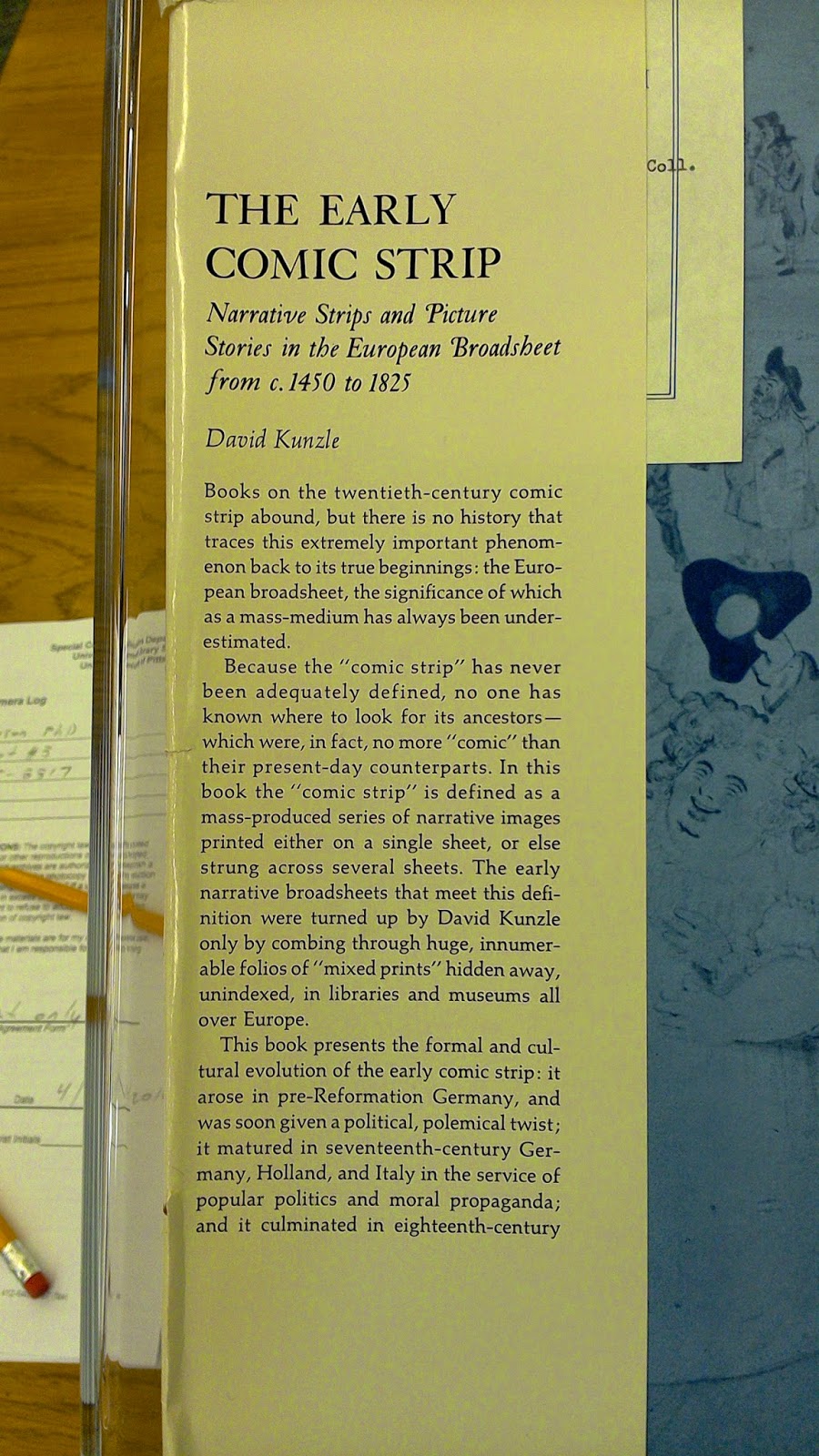 |
| Back dustjacket flap of Kunzle's History of the Comic Strip Volume I: The Early Comic Strip—Narrative Strips and Picture Stories in the
European Broadsheet from c.1450 to 1825, at the Special Collections room, Hillman Library, University of Pittsburgh. |
This is most emphatically suggested by Kunzle’s 1972
translation of Lacassin for Film
Quarterly. The introduction to the article, set in large bold italic that
upstages the body text, presents the article not only as a precursor but also
an unprecedented plug for Kunzle’s forthcoming History, and explicitly ties Kunzle’s work to the “intellectual
respectab[ility]” belatedly emerging for comics that had been established for
film “three or four decades ago.” The notes added by Kunzle, “which qualify
some of Lacassin’s findings,” are half as long as Lacassin’s text.[25]
Kunzle begins,
This is not the place to quarrel with Lacassin’s
assumption, which is so widely shared, that the comic strip and cinema were
born at the same period. Since the material has simply not been available
hitherto, critics cannot know that, in fact, the narrative picture strip
reached a certain maturity in German, Dutch, and English broadsheets in the
seventeenth century. In my book, which the University of California Press will
shortly publish, I reproduce an extensive corpus of these remarkable early
picture stories, which will thus become available for analysis and discussion.
Nor need we at this point question by what feat of logic Lacassin makes the
“birth” of the comic strip postdate by two generations one of the recognized
“fathers” of the art (for Gombrich, the
father), Rodolphe Töpffer.[26]
Whatever his reasoning or motivation for declaring his work “a
history or pre-history” of the comic strip, Kunzle stuck to his guns, using the
term “comic strip” in the title of two more scholarly publications on Töpffer.
It is now common, in fact, to see references in academic art historical
publications and museum exhibition catalogs to Töpffer as father or inventor of the comic strip.[27]
But as Geoffrey Batchen reminds us in the case of the history of photography,
such determinations are suspect. He remarks that historians
continue to squabble over which of them was the first to
discover the one, true inventor of photography. […] [T]his is invariably an
argument as much about virility and paternity as about history, as much about
the legitimacy of both photographer and historian as historic primogenitors as
about the timing of the birth itself.[28]
To the extent that Kunzle’s work is seen as foundational to
comic strip and comic book scholarship, his legacy is a mixed bag. The
unfortunate example of Kunzle’s snarky Preface to Volume II, mentioned above, as well as its Introduction which dwells at length on the status of nineteenth
century picture stories as a “childish genre,”
[29]
suggests that a cloying desire for “academic respectability” has been passed
down to more recent scholars who continue to openly bitch,
“Why Are Comics Still in Search of Cultural Legitimization?”[30]
On the positive side, as David Carrier attests, “I admire Kunzle, a bold and
original scholar, for gathering these materials, without which my own
philosophical study [on comics] could not have been conceived,” but departs
from Kunzle on the issue of word balloons.
[31]
The more substantial implication being that Kunzle’s scholarship is not about
comics at all, but something that predates comics historically, and if anything
chronicles part of a pictorial and textual tradition that is larger than
comics.
To the extent that Kunzle’s scholarship is a rebuke of
twentieth and twenty-first century comic strips, comic books, and graphic
novels (and there is plenty of ammunition for such an argument throughout Kunzle’s four major works on pre-twentieth-century picture stories),[32]
and a prompt to live up to the larger pictorial and textual tradition that is Kunzle’s concern, this
admonition might be stated in a more effective way. Instead of saying comics
should be better than they are, one could simply say, stories told in words and pictures don’t have to be comics. Perhaps
that is the far greater lesson to be derived from Kunzle’s work.
[1] David Kunzle, History of the Comic Strip,
Volume I: The Early Comic Strip—Narrative Strips and Picture Stories in the
European Broadsheet from c.1450 to 1825 (Berkeley, University of California
Press, 1973).
[2] David Kunzle, History of the Comic Strip,
Volume II: The Nineteenth Century (Berkeley, University of California
Press, 1990).
[3] David Kunzle, ed., trans., Rodolphe Töpffer: The Complete Comic Strips
(Jackson: University Press of Mississippi, 2007).
[4] David Kunzle, Father of the Comic Strip:
Rodolphe Töpffer (Jackson
: University Press of Mississippi, 2007).
[5] Francis
Lacassin, “The Comic Strip and the Film Language,” trans. with additional notes
by David Kunzle, Film Quarterly, vol.
26, no. 1, (Autumn 1972), pp. 11-23. Kunzle’s footnote on p. 11 reads as
follows: “Translated from Lacassin’s Pour
un neuvième art: la bande dessinée (Paris: Union Generale, 1971) and his
preceding article “Bande dessinée et langage cinematographique,” Cinema ‘71, (September1971), by
permission of the publishers. The material has been slightly abridged from its
longer version in the book, but incorporates the refinements Lacassin made in
the book.” Kunzle’s additional notes occupy the final 4 ½ pages of the article,
set at the same type size as translated text, pp. 19-23.
[6] For brevity, these works will be referred to hereafter as History I and II, Complete, Father, and “Lacassin.”
[7] See Kunzle, History vol. 1, preface,
and Father, p. ix.
[8] Ernst Gombrich, Art and Illusion: A Study
in the Psychology of Pictorial Representation, 3rd ed. (Princeton:
Bollingen, 2000 [1960]) p. 336.
[10] Father, quotes from pp. xi and 53
respectively.
[12] History I, p. 2-3. David Carrier, among
others, takes issue with Kunzle, claiming “The speech balloon is a defining
element of the comic [strip].” See David Carrier, The Aesthetics of Comics, (University Park: The Pennsylvania State
University Press, 2000), pp. 3-4; quote p. 4.
[18] Dick
Lupoff and Don Thompson, eds., All in
Color for a Dime (New Rochelle NY: Arlington House, 1970).
[19] Les
Daniels, Comix: A History of Comic Books
in America (New York: Bonanza Books, 1971).
[20] Jim
Steranko, The Steranko History of Comics,
vols I and II (Reading PA: Supergraphics1970, 1972).
[21] Arthur
Asa Berger, The Comic-Stripped American:
What Dick Tracy, Blondie, Daddy Warbucks and Charlie Brown Tell Us About
Ourselves (New York: Walker, 1973).
[22] Jerry
Robinson, The Comics: An Illustrated
History of Comic Strip Art (New York: Putnam, 1974).
[23] Maurice
Horn, The World Encyclopedia of Comics
(New York: Chelsea House, 1976).
[24] History I, Preface [n.p.].
[25] The introduction or abstract of the article reads, in bolder and larger type than
the article, “The comic strip is now becoming intellectually respectable in
somewhat the same way that film did, three or four decades ago. Studies of
contemporary strips abound; serious artists are using the form for their own
purposes-often, of course, satirical purposes. As the French historian Francis
Lacassin argues in the pioneering article below, the “language” or syntax of
the comic strip shows many similarities to (and certain historical priorities
over) the language of film. The article has been translated by David Kunzle,
author of the forthcoming The Early Comic
Strip: Narrative Strips and Picture Stories in the European Broadsheet, c.
1450-1826—a sociocultural history of the first mass medium’s origins—and he
adds notes of his own which qualify some of Lacassin’s findings and extend them
even further back in time.” See Lacassin, p. 11.
[26] Lacassin, p. 19. The Lacassin article and its influence on comics
scholarships merits a discussion of its own, which in fact I first essayed on
an earlier incarnation of this blog around 2005. I plan to revisit that article
and repost soon.
[27] See for example Laura Hoptman, Drawing Now: Eight Propositions (New York:
Museum of Modern Art, 2002), p. 129.
[28] Geoffrey
Batchen, Burning with Desire: The
Conception of Photography (Cambridge, MA: The MIT Press, 1997), p. 35.
[29] History II, pp. 2-4.
[31] Carrier, pp. 3-4; quote p. 3.
[32] Not
to mention Kunzle’s translation of Dorfman and Armand Mattelart’s 1973
Para leer al pato Donald into English as
How to Read Donald Duck in 1975,
suggesting that if Kunzle were to regard modern comics at all, their status as
capitalist commodities would be foremost in his critique.
 |
| Back dustjacket flap of Kunzle's History of the Comic Strip Volume II: The Nineteenth Century, at the Special Collections room, Hillman Library, University of Pittsburgh. |


