Updated January 7, 2021.
Since 2014, I have composed a number of reviews for book editor Tony Norman at the Pittsburgh Post-Gazette. Here is a running list of the links (all have been for the P-G, unless otherwise noted):
Showing posts with label art. Show all posts
Showing posts with label art. Show all posts
Friday, September 9, 2022

Tuesday, June 7, 2022
Pretensions on the Edge of Forever: New Age Comics #1
“Megaton Man artist … Donald Simpson,” from New Age Comics #1, 1985:
With Megaton Man #4, artist-writer Don Simpson began to add depth to his cast of madcap characters.
With Megaton Man #4, artist-writer Don Simpson began to add depth to his cast of madcap characters.
Thursday, March 3, 2022
Shows and Other Cons: The Disappearance of Comics, Episode Omega
The comic book convention as we know is disappearing out from under us; the replacement of the word “con” with “show” in the fan vernacular is our first clue. I for one am ambivalent; except for the 1985 Dallas Fantasy Fair, which was a rip-roaring good time, I can’t think of a convention that wasn’t in some way excessive, vulgar, in bad taste, arduous, or sleep-deprived—apart from discovering the occasional treasure and meeting some my then still-living drawing board heroes (Gil Kane, Murphy Anderson, John Romita, Jack Kirby, Jean Giraud/Moebius, Burne Hogarth—even Jerry Siegel). Being a professional comic book artist during the years when attendance was virtually mandatory for a professional career, I can tell you: Cons were hard work.
Saturday, November 14, 2020
Other People’s Plato’s Caves
The Allegory of the Cave is told in Plato’s Republic
514a–520a. Briefly, it says,
In a cave deep underground, a group of prisoners are chained to a bench in such a way that they face a wall. The only light from the tunnel leading up to the surface behind them projects murky shadows on the wall; these shadows the prisoners mistake for substance, reality.
Sunday, September 27, 2020
Fans Didn’t Enable Rowling; Success, Ego, and Power Did That.
I watched part of a YouTube video last night in which a
longtime Potter fan basically laid out a thesis that fans have progressively
enabled Rowling to become a bigot. This is an interest thesis, with some very
small, partial truth to it; but it’s naïve—fannishly so, imagining a closer
relationship and more influence on the author than fans actually have.
Friday, August 28, 2020
Conan the Uncorrupted: Pure Robert E. Howard, Belatedly
Two books came in the mail today: The Conan Chronicles volumes I and II by Robert E. Howard. Originally published in the UK in the early 2000s, I must have missed their debut. I still can't figure out if there ever were counterpart editions in the United States, but if there were, they have evaded me.
Monday, August 5, 2019
King Kong Cover for Amazing Heroes!
Originally posted July 13, 2017; updated with an addendum below, August 5, 2019.
Perhaps the best piece of art I created for the entire King Kong adaptation I drew for Fantagraphics' Monster Comics imprint in the early 1990s never appeared as part of the series. Instead, it was the cover for Amazing Heroes, the little sister publication to their more upscale publication, The Comics Journal. Here is a look at the original colored blueline.

Perhaps the best piece of art I created for the entire King Kong adaptation I drew for Fantagraphics' Monster Comics imprint in the early 1990s never appeared as part of the series. Instead, it was the cover for Amazing Heroes, the little sister publication to their more upscale publication, The Comics Journal. Here is a look at the original colored blueline.

For more on the art of my Kong adaptation, visit my King Kong blog!
Thursday, August 1, 2019
Don't Look Now: Identifying with Heroes Is More than Demographic (or Skin Deep)
Don’t wait for someone who looks like you to live your dream before you do.
The whole “looks like me” movement is quite baffling to me. Who are all these people who’ve been waiting for some media figure (or some fictional character) to look like them before they could fulfill their potential? Who are these kids who need a sports or movie star, or Disney princess, to be of their complexion, nationality, or religion before they have the gumption to charge ahead? And where were all those real and ideal people who looked like something who modeled for the last two or three generations of minority achievers, who apparently didn’t have anyone who looked like them to serve as role models, but found their way to success despite this lack?
Wednesday, March 20, 2019
Thirty Years of Ms. Megaton Man: 1989 to 2019!
Here is the first page of sketches I did of Clarissa James in 1989 - up to that point a minor Civilian (Megapowerless) character in the cast of my Megaton Man comics - as Ms. Megaton Man. It was in an old hardbound sketchbook I took around to shows to collect sketches of interpretations of my characters from fellow pros (I've posted some of the more memorable ones here and there).
Saturday, February 9, 2019
PCAM: 21st C. "Arts" .org Too Ashamed to Mention Drawing, Painting, or Sculpture by Name
If you want another sign of how completely debased the word "art" has become in our twenty-first century civilization (not to mention the intellectually corrosive effects of an MFA in the visual arts), herewith the Friday, February 8, 2019 email announcing a new local arts .org (note the words drawing, painting, and sculpture are completely absent):
Wednesday, January 30, 2019
Gorging at the Trump Trough: Editorial Cartooning Goes Belly-Up
It is a paradox that Donald Trump, the worst president in U.S. history, has been a boon to the Left in general and to late-night comedians in particular, but absolutely anathema to the dwindling number of local newspaper editorial cartoonists. Rather than a comic feast, cartoonists are gorging on Trump and going belly-up, like goldfish that have no better sense than to eat themselves to death.
The reasons for this phenomenon are no doubt complex and varied, but there are a few basic tendencies. For starters, the profession – and art form – has been in decline for a generation (it peaked some time around 1978; some might even say it peaked with Thomas Nast around 1878), even as the print newspaper industry itself has radically contracted. Most major cities that had two daily newspapers now only have one, and even one-newspaper markets have begun going less-than-daily or even completely paperless.
The remaining herd of staff editorial cartoonists (numbering in the hundreds a generation ago but now down to less than two dozen, with an average age inching up to around sixty) has thinned to the point that perhaps the gene pool is simply no longer robust or diverse enough to remain viable.
At the same time, less and less has been demanded of the profession. Mid-century newspaper editorial cartoonists once drew political cartoons on a daily basis, and even contributed spot illustrations and special features regularly (witness the herculean efforts of Billy Ireland, whose output for small-market Columbus, Ohio would match any five cartoonists practicing today). Since the 1980s, however, few editorial cartoonists have offered more than three daily cartoons plus Sunday, such have been the arduous demands of the political muse; the craft, for some inexplicable reason, became a part-time job.
It also became a phone-it-in line of work, literally. With the scanner and the modem, more and more cartoonists worked from suburban homes or gentrified urban neighborhoods, venturing into the downtown office only rarely. (The romantic picture of a cartoonist at a drawing board wielding a bottle of India ink and crowquill in the middle of a bustling newsroom probably wasn’t even true in 1910, let alone by end of the twentieth century.)
By the same token, more and more cartoonists won the right to start their own websites, widening their audiences by increasing easy access, but at the same time no longer motivating readers to pick up a printed newspaper. This perk no doubt kept cartoonists happy while compensating for fewer raises and even cuts to their newspaper paychecks, but it also exacerbated the erosion of loyalty between home newspapers and their respective cartoonists.
Syndicates provided newspapers with easy and cheap (and often a better selection of) cartoons on national issues; at the same time, local cartoonists, eyeing potential syndication revenue, sought to maximize their income by devoting more and more of their energy to national issues, and less and less to local themes. A cartoon devoted to city politics or regional issues came to be viewed as anathema to the current generation – a wasted drawing.
Into this perfect storm strode Donald J. Trump, perhaps the most perfect foil for a political cartoonist since Richard M. Nixon. Cartoonists already instinctively driven to low-hanging fruit and the easy pot-shot have found such a trove of material in Trump and his cronies they couldn’t resist. But at the same time, they were dealing with a political phenomenon that made editorial cartooning irrelevant. Trump has been so polarizing, no thinking person has needed a cartoon to help them make up their mind.
Yet cartoonists have effectively gorged themselves to death at the Trump trough. Staff positions that haven’t dematerialized for purely economic reasons have succumbed to the “broken record” syndrome: drawings that are ugly, depressing, and utterly monotonous in their dead-horse-beating humorlessness. What rationale does a local newspaper have to keep a one-note, one-issue “voice” that only wants to speak about one thing to a national audience outside the reach of its local or regional distribution, especially when that voice is only screeching at one unmodulated pitch all the time?
While Stephen Colbert can summarize the latest Trump atrocities in a daily five-minute monologue before moving onto other entertainments, the poor editorial cartoonist could fill an entire newspaper page every day and still not scratch the surface of the trove of Trump material – and could cover reams of Bristol board before finding anything funny - let alone uplifting - about any of it. On top of which, carefully hand-crafting three or four anti-Trump cartoons per week has come to seem an almost absurdly painstaking and paltry response to a buffoon who generates three or four national emergencies per hour.
The paradox of 2019 may well be that we will witness the final demise of a once-proud art form, one that hasn’t probably hasn’t been vital or viable in more than a generation, in what - on paper - should have been a Renaissance or Golden Age. Future historians will ponder the precise reasons while those of us alive today will hardly have noticed.
The reasons for this phenomenon are no doubt complex and varied, but there are a few basic tendencies. For starters, the profession – and art form – has been in decline for a generation (it peaked some time around 1978; some might even say it peaked with Thomas Nast around 1878), even as the print newspaper industry itself has radically contracted. Most major cities that had two daily newspapers now only have one, and even one-newspaper markets have begun going less-than-daily or even completely paperless.
The remaining herd of staff editorial cartoonists (numbering in the hundreds a generation ago but now down to less than two dozen, with an average age inching up to around sixty) has thinned to the point that perhaps the gene pool is simply no longer robust or diverse enough to remain viable.
At the same time, less and less has been demanded of the profession. Mid-century newspaper editorial cartoonists once drew political cartoons on a daily basis, and even contributed spot illustrations and special features regularly (witness the herculean efforts of Billy Ireland, whose output for small-market Columbus, Ohio would match any five cartoonists practicing today). Since the 1980s, however, few editorial cartoonists have offered more than three daily cartoons plus Sunday, such have been the arduous demands of the political muse; the craft, for some inexplicable reason, became a part-time job.
It also became a phone-it-in line of work, literally. With the scanner and the modem, more and more cartoonists worked from suburban homes or gentrified urban neighborhoods, venturing into the downtown office only rarely. (The romantic picture of a cartoonist at a drawing board wielding a bottle of India ink and crowquill in the middle of a bustling newsroom probably wasn’t even true in 1910, let alone by end of the twentieth century.)
 |
| Megaton Man almost meets The Donald in Megaton Man #10 (Kitchen Sink Press, July 1986). ™ and © Don Simpson 2018, all rights reserved. |
Syndicates provided newspapers with easy and cheap (and often a better selection of) cartoons on national issues; at the same time, local cartoonists, eyeing potential syndication revenue, sought to maximize their income by devoting more and more of their energy to national issues, and less and less to local themes. A cartoon devoted to city politics or regional issues came to be viewed as anathema to the current generation – a wasted drawing.
One recently-discharged editorial cartoonist characterized his fellow practitioners of this dying art form as "canaries in the coal mines," apparently oblivious to the fact that graphic art staff jobs have been disappearing by the hundreds of thousands for several decades. In fact, editorial cartoonists have been the last of a dying breed of analog artists to make steady paychecks while sitting at drawing boards. Most illustrators, designers, and cartoonists have been part-time freelancers - at best - for years, while other skilled jobs - from layout to type spec'ing to plate burning - have been wiped out by a toxic combination of digital technology and brute economics. Even in a journalistic sense, editorial cartoonists have hardly been "canaries"; rounds of buyouts and early retirements, not to mention shutdowns, have been a regular newsroom occurrence for years.Thus local practitioners of editorial cartooning became at the same time cut off from the city newsrooms yet even more remote from nation’s capital and other power centers, the ostensible source of their inspiration. Editorial cartooning was reduced to an almost inaudible vibration in the media echo chamber, part of a nationalized feedback loop whose contributors were paradoxically marooned in irrelevant localities outside the beltway. Anyone with access to a few magazine subscriptions and NPR had the same sources of information (and inspiration) as the most clever editorial cartoonist working from the suburb across town, and had they sufficient drawing skills to produce the fashionable off-handed scrawl most contemporary cartoonists favor, could probably have come up with just as good or better observations.
Into this perfect storm strode Donald J. Trump, perhaps the most perfect foil for a political cartoonist since Richard M. Nixon. Cartoonists already instinctively driven to low-hanging fruit and the easy pot-shot have found such a trove of material in Trump and his cronies they couldn’t resist. But at the same time, they were dealing with a political phenomenon that made editorial cartooning irrelevant. Trump has been so polarizing, no thinking person has needed a cartoon to help them make up their mind.
Yet cartoonists have effectively gorged themselves to death at the Trump trough. Staff positions that haven’t dematerialized for purely economic reasons have succumbed to the “broken record” syndrome: drawings that are ugly, depressing, and utterly monotonous in their dead-horse-beating humorlessness. What rationale does a local newspaper have to keep a one-note, one-issue “voice” that only wants to speak about one thing to a national audience outside the reach of its local or regional distribution, especially when that voice is only screeching at one unmodulated pitch all the time?
While Stephen Colbert can summarize the latest Trump atrocities in a daily five-minute monologue before moving onto other entertainments, the poor editorial cartoonist could fill an entire newspaper page every day and still not scratch the surface of the trove of Trump material – and could cover reams of Bristol board before finding anything funny - let alone uplifting - about any of it. On top of which, carefully hand-crafting three or four anti-Trump cartoons per week has come to seem an almost absurdly painstaking and paltry response to a buffoon who generates three or four national emergencies per hour.
The paradox of 2019 may well be that we will witness the final demise of a once-proud art form, one that hasn’t probably hasn’t been vital or viable in more than a generation, in what - on paper - should have been a Renaissance or Golden Age. Future historians will ponder the precise reasons while those of us alive today will hardly have noticed.
Friday, November 9, 2018
The Lies of Comicsgash!
The Culture Wars Comes to Funnybooks
One of the more insane trends to take place in recent years is a "movement" started by a small, irrelevant coterie of has-been comic book creators dubbed Comicsgate (which makes little associative sense to someone of my generation, unless its leaders are trying to lay claim to Nixonian paranoia - not exactly the most admirable moment in our Nation's history). But the present moment isn't particularly admirable, either.
Among their specious claims is a convoluted theory that various retcons and rebootings affecting entirely make-believe storylines involving stupid corporate-owned trademarks has something to do with the fact that these fairly lackluster and mediocre creators no longer are as actively employed on the superhero assembly line as they want to be. The result is these disgruntled hacks have taken to the internet (what else?) and started calling people hateful names, ordered bans and boycotts of particular creators, titles, and companies, and threatened violence against a number of innocent bystanders who by all accounts seem only to be doing their jobs.
Trying to give an account of their hopelessly muddled ideology end-to-end is impossible, so it's best to take their incompatible lies one by one:
Lie #1: The movement is a "consumer-led revolt." This is clearly false; it's a small number of vocal (which is to say, whiny) writers and artists who for a brief time drew prominent titles in the Marvel and/or DC pantheon, and now find themselves without gigs. They thought they were essential to the perpetuation of certain namby-pamby, vacuous and hollow franchises, but they found out this was not the case, and they resent it.
Lie #2: The talent brought in to replace the Whiners is inferior because the selecting criteria of editors and publishers was ideological and/or identity-based. False; there is little evidence that comics are any more or less hacked-out, mindless, and unoriginal as ever, or that the level of work is any more less inspired or insipid as it's been since the early 1970s.
Lie #3: Beloved characters and franchises are being ruined by inorganic, top-down imposed makeovers to conform to said ideology and/or identity-based criteria. False; no intelligent human being could possibly care less that Scuba Man used to be straight, WASP newspaper reporter Kyle Kildare and now is involuntarily celibate, ambidextrous, undocumented Dreamer and lesbian activist Fortuna Primigenia, or that his (her) mutant robot sidekick Willy has been replaced by a self-levitating smartphone that sounds like a Burbank voice actor doing a bad impression of Lin-Manuel Miranda doing a wisecracking, hip-hop Bugs Bunny. (Besides, Scuba Man has always been stupid, no matter what his/her/its creators have tried, and nobody really cares.)
Lie #4: The comic book industry is being taken over by Left-Wing Ideologues. False: the comic industry was started by left-leaning liberals and always run by them; read one of Stan Lee's Soap Boxes circa 1972, for Christ'ssakes. People with imagination and talent have always tended towards social compassion, inclusion, and just plain hanging out with other social misfits like gay people, free-thinkers, and other mild-mannered types. Some of these people actually embody understated Judao-Christian ideals without voting for billionaire rapists. It's called Art, not Fox News.
(If anything, the industry has been taken over by humorless haptics who stopped developing before the concrete operational stage, are severely repressed closet cases who get hardons from back issues of Soldier of Fortune magazine, and can't draw a woman who's more true to life than a mid-sixties Barbie doll.)
Lie #5: The Whiner's short-lived careers are the result of an engineered conspiracy by said Ideologues. False: writing and/or penciling corporate superheroes has been a career with the life expectancy of a gnat since the days since Kirby, Kane, Romita and Buscema. Gene Colan was famously fired by Jim Shooter while arguably at the height of his creative abilities; I attend comic book conventions with creators from the 1990s who could still be happily churning out monthly comics for Marvel and/or DC and still aren't even old enough to join AARP. The Comicsgate generation has been put out to pasture too soon? Sign up for food stamps and stand in line; it's a long one. If you want job security, next time become J.K. Rowling or George Lucas; i.e., originate something, don't just learn to cut out cookie cutter capes and cowls for a Big Company paycheck, then complain when your particular cookie shape is no longer in vogue.
Lie #6: Having someone to blame for your plight will make things better. False; try reading some of the characters you helped perpetuate for the past few years. Did they gang up and pick on people and threaten violence? No, they were heroes - albeit make-believe; if they had to punch someone, it was out of self-defense or to right an actual wrong, not because Life dealt them a crummy hand this time. Conspiracy theories may be comforting (and make for entertaining storylines in fantasy material), but to actually believe them is to become unhinged, pathological, and dangerously disturbed. Grow up and create something that reflects positive human values, and stop hating.
Lie #7: Sales would be great again if companies would just go back to the classic formulas, i.e. manly (white) men and curvaceous babes. False: the print medium is dying, in case you hadn't noticed; and sales figures are bound to decline regardless. Marvel and DC would have gone out of business in 1983 if it wasn't for their media and licensing revenues; for decades, print comics have been a loss-leader and farm system for ideas for much bigger movie and TV series tie-ins, a break-even proposition at best. And they ran out of ideas well before 1974; if you think the cosmetic monkeying with identity politics has any more substance than mutants, robots, and the cloned Gwen Stacy, you have seriously lost touch with reality. Besides, editors and publishers have a fiduciary responsibility to throw everything at the wall to see what sticks; or have you lost your faith in the Free Market?!
Why doesn't everybody just sit back down and draw their little Men in Tights and fight their Culture Wars on paper (and in their ring-bound sketchbooks, if Marvel and DC won't send you their custom blue-lined Bristol board anymore)? And if nobody wants to pay you for the works of your imagination anymore, let alone cares, at least you've done something personally therapeutic and kept your poisonous hatred to yourself.
Morons.
___________
Update: See if you pass the Ms. Megaton Man Social Justice Warrior Litmus Test!
One of the more insane trends to take place in recent years is a "movement" started by a small, irrelevant coterie of has-been comic book creators dubbed Comicsgate (which makes little associative sense to someone of my generation, unless its leaders are trying to lay claim to Nixonian paranoia - not exactly the most admirable moment in our Nation's history). But the present moment isn't particularly admirable, either.
Among their specious claims is a convoluted theory that various retcons and rebootings affecting entirely make-believe storylines involving stupid corporate-owned trademarks has something to do with the fact that these fairly lackluster and mediocre creators no longer are as actively employed on the superhero assembly line as they want to be. The result is these disgruntled hacks have taken to the internet (what else?) and started calling people hateful names, ordered bans and boycotts of particular creators, titles, and companies, and threatened violence against a number of innocent bystanders who by all accounts seem only to be doing their jobs.
Trying to give an account of their hopelessly muddled ideology end-to-end is impossible, so it's best to take their incompatible lies one by one:
Lie #1: The movement is a "consumer-led revolt." This is clearly false; it's a small number of vocal (which is to say, whiny) writers and artists who for a brief time drew prominent titles in the Marvel and/or DC pantheon, and now find themselves without gigs. They thought they were essential to the perpetuation of certain namby-pamby, vacuous and hollow franchises, but they found out this was not the case, and they resent it.
Lie #2: The talent brought in to replace the Whiners is inferior because the selecting criteria of editors and publishers was ideological and/or identity-based. False; there is little evidence that comics are any more or less hacked-out, mindless, and unoriginal as ever, or that the level of work is any more less inspired or insipid as it's been since the early 1970s.
 |
| Megaton Man visits the pretentious hacks on the superhero assembly line in Return of Megaton Man #2 (Kitchen Sink Press, August 1988). In those days, the Culture Wars was only a gleam in the eye of Morton Downey Jr. ... |
Lie #3: Beloved characters and franchises are being ruined by inorganic, top-down imposed makeovers to conform to said ideology and/or identity-based criteria. False; no intelligent human being could possibly care less that Scuba Man used to be straight, WASP newspaper reporter Kyle Kildare and now is involuntarily celibate, ambidextrous, undocumented Dreamer and lesbian activist Fortuna Primigenia, or that his (her) mutant robot sidekick Willy has been replaced by a self-levitating smartphone that sounds like a Burbank voice actor doing a bad impression of Lin-Manuel Miranda doing a wisecracking, hip-hop Bugs Bunny. (Besides, Scuba Man has always been stupid, no matter what his/her/its creators have tried, and nobody really cares.)
Lie #4: The comic book industry is being taken over by Left-Wing Ideologues. False: the comic industry was started by left-leaning liberals and always run by them; read one of Stan Lee's Soap Boxes circa 1972, for Christ'ssakes. People with imagination and talent have always tended towards social compassion, inclusion, and just plain hanging out with other social misfits like gay people, free-thinkers, and other mild-mannered types. Some of these people actually embody understated Judao-Christian ideals without voting for billionaire rapists. It's called Art, not Fox News.
(If anything, the industry has been taken over by humorless haptics who stopped developing before the concrete operational stage, are severely repressed closet cases who get hardons from back issues of Soldier of Fortune magazine, and can't draw a woman who's more true to life than a mid-sixties Barbie doll.)
Lie #5: The Whiner's short-lived careers are the result of an engineered conspiracy by said Ideologues. False: writing and/or penciling corporate superheroes has been a career with the life expectancy of a gnat since the days since Kirby, Kane, Romita and Buscema. Gene Colan was famously fired by Jim Shooter while arguably at the height of his creative abilities; I attend comic book conventions with creators from the 1990s who could still be happily churning out monthly comics for Marvel and/or DC and still aren't even old enough to join AARP. The Comicsgate generation has been put out to pasture too soon? Sign up for food stamps and stand in line; it's a long one. If you want job security, next time become J.K. Rowling or George Lucas; i.e., originate something, don't just learn to cut out cookie cutter capes and cowls for a Big Company paycheck, then complain when your particular cookie shape is no longer in vogue.
 |
| The labor dispute metastasizes into an all-out assault on creative liberty! From Return of Megaton Man #2. |
Lie #7: Sales would be great again if companies would just go back to the classic formulas, i.e. manly (white) men and curvaceous babes. False: the print medium is dying, in case you hadn't noticed; and sales figures are bound to decline regardless. Marvel and DC would have gone out of business in 1983 if it wasn't for their media and licensing revenues; for decades, print comics have been a loss-leader and farm system for ideas for much bigger movie and TV series tie-ins, a break-even proposition at best. And they ran out of ideas well before 1974; if you think the cosmetic monkeying with identity politics has any more substance than mutants, robots, and the cloned Gwen Stacy, you have seriously lost touch with reality. Besides, editors and publishers have a fiduciary responsibility to throw everything at the wall to see what sticks; or have you lost your faith in the Free Market?!
 |
| Like everything else, at the bottom of every creative complaint is ... wait for it ... MONEY! From Return of Megaton Man #2. |
Morons.
___________
Update: See if you pass the Ms. Megaton Man Social Justice Warrior Litmus Test!
Tuesday, July 3, 2018
Anatomical Archeology: Sketchbook Studies circa 1998
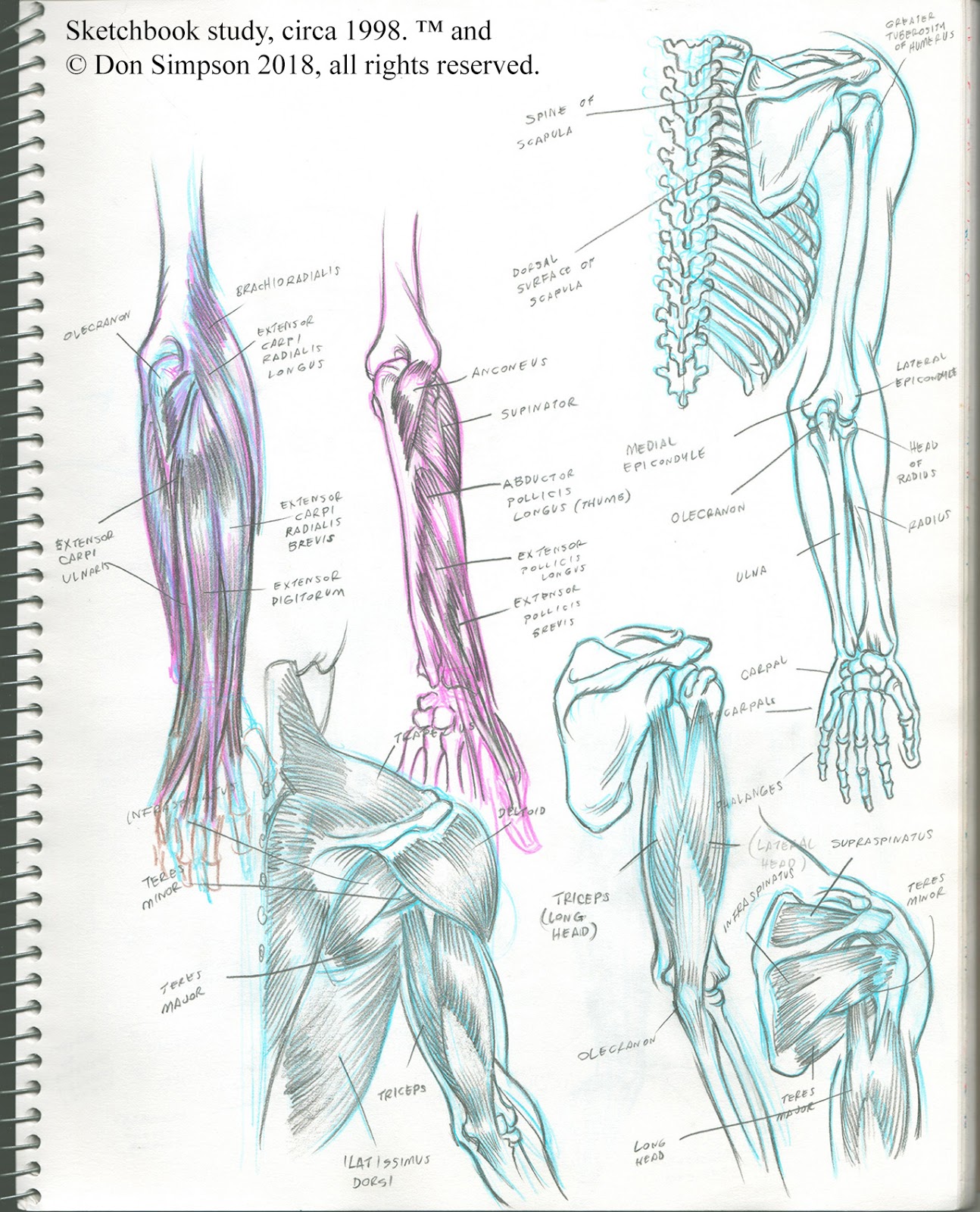
Here is a selection of anatomical studies I made in my sketchbook around 1998. I had been studying anatomy, principally the books of Burne Hogarth, at this point for some twenty years (1978), and would periodically brush up on anatomy every 18 months or couple of years or so. The studies here are unusually elaborate, and I recall at this point trying to "get it" once and for all (an unachievable goal!).


They are based on, in no particular order, Louise Gordon, How to Draw the Human Figure: An Anatomical Approach (Viking, 1979); Stephen Rogers Peck, Atlas of Human Anatomy for the Artist (Oxford, 1951); David K. Rubins, The Human Figure: An Anatomy for Artists (Viking, 1953); and Jack Hamm, Drawing the Head and Figure (Putnam, 1963). There may also be a stray bit of Andrew Loomis, culled from a Walter T. Foster edition, but I don't think so.


The fact that I was no longer interested in Burne Hogarth's Dynamic Anatomy or Dynamic Figure Drawing (Watson Guptill, 1958 and 1970, respectively) suggests I was looking for more realistic instruction than the kind that fueled the superhero studies of my teenage years (and which I tried to rid myself of in the early, exaggerated Megaton Man comics). But the oldies are the goodies, and nearly all of the titles here are old chestnuts in the genre.


As I used to tell my workshop and drawing class students, while software programs become outdated every three weeks, human anatomy hasn't changed significantly in tens of thousands of years; there is no better investment of time and effort than studying the subject.


Many newfangled anatomy books, especially the execrable Human Anatomy Made Amazingly Easy, by that cynical charlatan Christopher Hart, are worse than no instruction at all. Stick to the classics.


They are based on, in no particular order, Louise Gordon, How to Draw the Human Figure: An Anatomical Approach (Viking, 1979); Stephen Rogers Peck, Atlas of Human Anatomy for the Artist (Oxford, 1951); David K. Rubins, The Human Figure: An Anatomy for Artists (Viking, 1953); and Jack Hamm, Drawing the Head and Figure (Putnam, 1963). There may also be a stray bit of Andrew Loomis, culled from a Walter T. Foster edition, but I don't think so.


The fact that I was no longer interested in Burne Hogarth's Dynamic Anatomy or Dynamic Figure Drawing (Watson Guptill, 1958 and 1970, respectively) suggests I was looking for more realistic instruction than the kind that fueled the superhero studies of my teenage years (and which I tried to rid myself of in the early, exaggerated Megaton Man comics). But the oldies are the goodies, and nearly all of the titles here are old chestnuts in the genre.


As I used to tell my workshop and drawing class students, while software programs become outdated every three weeks, human anatomy hasn't changed significantly in tens of thousands of years; there is no better investment of time and effort than studying the subject.

Many newfangled anatomy books, especially the execrable Human Anatomy Made Amazingly Easy, by that cynical charlatan Christopher Hart, are worse than no instruction at all. Stick to the classics.
Wednesday, March 19, 2014
After Critical Thinking: The Non-Thought of Frenemies
In "After Criticism," Lane Relyea notes, the evaluation of contemporary art has passed from "the paranoid guardianship of cliquish connoisseurs" (357) to
Relyea's remarks are from an excellent anthology called Contemporary Art: 1989 to the Present, a volume I am using in a class I currently teach. It was recommended by an extremely intelligent colleague as a supplement to a more conventional textbook, and it has more or less supplanted that other resource as the semester has progressed. The anthology is filled with a number of texts by what another author in the volume refers to as "friendly enemies" of the art world (186). Like Relyea's penetrating if unsettling assessment of the current state of art evaluation, which expresses neither a preference nor an abhorrence for the current situation, there are many clear-headed and sober observations on the current art world to be found within its pages. Scholars today are nothing if not acutely aware of the many contradictions to be seen in contemporary art, and their own conflicts of interest stemming from their reliance on the very institutions of that art, but their observations are always carefully offered as frenemies. I have supplemented these offerings with a further reading or two from more snarky mainstream observers of art (disaffiliated critics who, one is tempted to say, are good enough writers to get their work published in magazines like Harper's and Vanity Fair) who for whatever paranoid or cliquish reason cannot find it in themselves to remain quite so obligingly neutral. My hope is to influence my students at least to the extent that they consider the possibility of thinking for themselves, and above all to question the material presented to them, particularly the version of contemporary art history as presented by the institutionally-connected and interest-conflicted.
I am reminded of this passage because of very recent interactions with my own "hyperlinked network." Anyone who knows the conformist, hierarchical culture of academia will realize that what is sacrificed in the passage from the critic to the art historian is more than mere personal opinion; it is perhaps individuality itself. Relyea sees this somewhat optimistically as "the demise of consensus" (358), but it is in fact its opposite. It is a mindless consensus supported by endless footnotes (ingratiating oneself to one's more important peers), CVs (one's life lived and career pursued always in contrivance of what will look good on paper), and favorable letters of recommendation (the most subtle form of institutional behavioral control ever devised), yielding a consensus of opinion that is safe and utterly without meaning to the extent that it remains impersonal. As Boris Groys remarks, the end result is an art that "expresses no taste at all—no public taste, no personal taste, not even the taste of the artists themselves." It is an art that appears to have happened at the behest of the Invisible Hand of History. It is an art and a scholarship of non-taste and non-thought, more rigorously policed by cliques far more draconian than those they have supposedly supplanted.
Scholarship developed in the West as a means of situating one's intellectual efforts among and building upon the ideas and thinkers of the past. It was a means of interacting with and reanimating a cultural heritage that would have otherwise become remote and inaccessible, if not lost, over time. As a means of advancing one's career among the living, and of excluding the noncomformist, the amateur, and the heretical in favor of the unoriginal, the conventional, and the pedestrian, it is worse than a corruption. Diachronically, scholarship is a means of connecting with the greatest minds across time. Synchronically, the institutional networking of contemporaneity serves only as a totalitarian means of mystifying contemporary life and culture, of exclusion and barriers, and promoting a stifling and repressive status quo.
Minor edits and additions made 3/20/2014, including the modification of the subtitle. The final paragraph was added 3/21/2014.
Sources:
Alexander Dumbadze and Suzanne Hudson, eds., Contemporary Art: 1989 to the Present (Wiley-Blackwell, 2013).
professional art historians who are more institutionally networked. The critic, by comparison, looks isolated and unconnected: she or he is too inward turned, still supposedly privileging a subjective interior, the place where the experience of art is received and submitted to aesthetic judgment. The art historian instead privileges an exterior, a field of [...] disciplinary discourses, all bridged and related. Art historians are strongly identified and integrated as professionals; they conduct their practices within institutionally defined fields that are striated and organized by title, rank, and collegiality; they belong to professional associations; they advance their respective fields by situating their efforts in relation to contributions by their fellow practitioners. In short, they are abundantly hyperlinked [...]. Critics don't have any equivalent of academia or the museum world; they lack institutional grounding and organization; they have no well-organized system of training that erects high educational barriers of qualifications. [...] Compared to professional historians, critics are unincorporated, even amateurish (361-2).I felt a chill down my spine when I first read this passage, as I think anyone would who has managed to climb over those "high educational barriers" to see what passes for collegiality on the other side. I find Relyea's view of scholarship as enforcing a bland, careerist, credentialed, tribalistic group-think, supplanting an independent, not to say introverted, contemplation of aesthetics deeply chilling. This situation is not presented by Relyea as a good or bad thing, but simply the way things happen to be now. But in fact we have a choice. We always have to choose whether we will conform to the herd or not.
Relyea's remarks are from an excellent anthology called Contemporary Art: 1989 to the Present, a volume I am using in a class I currently teach. It was recommended by an extremely intelligent colleague as a supplement to a more conventional textbook, and it has more or less supplanted that other resource as the semester has progressed. The anthology is filled with a number of texts by what another author in the volume refers to as "friendly enemies" of the art world (186). Like Relyea's penetrating if unsettling assessment of the current state of art evaluation, which expresses neither a preference nor an abhorrence for the current situation, there are many clear-headed and sober observations on the current art world to be found within its pages. Scholars today are nothing if not acutely aware of the many contradictions to be seen in contemporary art, and their own conflicts of interest stemming from their reliance on the very institutions of that art, but their observations are always carefully offered as frenemies. I have supplemented these offerings with a further reading or two from more snarky mainstream observers of art (disaffiliated critics who, one is tempted to say, are good enough writers to get their work published in magazines like Harper's and Vanity Fair) who for whatever paranoid or cliquish reason cannot find it in themselves to remain quite so obligingly neutral. My hope is to influence my students at least to the extent that they consider the possibility of thinking for themselves, and above all to question the material presented to them, particularly the version of contemporary art history as presented by the institutionally-connected and interest-conflicted.
I am reminded of this passage because of very recent interactions with my own "hyperlinked network." Anyone who knows the conformist, hierarchical culture of academia will realize that what is sacrificed in the passage from the critic to the art historian is more than mere personal opinion; it is perhaps individuality itself. Relyea sees this somewhat optimistically as "the demise of consensus" (358), but it is in fact its opposite. It is a mindless consensus supported by endless footnotes (ingratiating oneself to one's more important peers), CVs (one's life lived and career pursued always in contrivance of what will look good on paper), and favorable letters of recommendation (the most subtle form of institutional behavioral control ever devised), yielding a consensus of opinion that is safe and utterly without meaning to the extent that it remains impersonal. As Boris Groys remarks, the end result is an art that "expresses no taste at all—no public taste, no personal taste, not even the taste of the artists themselves." It is an art that appears to have happened at the behest of the Invisible Hand of History. It is an art and a scholarship of non-taste and non-thought, more rigorously policed by cliques far more draconian than those they have supposedly supplanted.
Scholarship developed in the West as a means of situating one's intellectual efforts among and building upon the ideas and thinkers of the past. It was a means of interacting with and reanimating a cultural heritage that would have otherwise become remote and inaccessible, if not lost, over time. As a means of advancing one's career among the living, and of excluding the noncomformist, the amateur, and the heretical in favor of the unoriginal, the conventional, and the pedestrian, it is worse than a corruption. Diachronically, scholarship is a means of connecting with the greatest minds across time. Synchronically, the institutional networking of contemporaneity serves only as a totalitarian means of mystifying contemporary life and culture, of exclusion and barriers, and promoting a stifling and repressive status quo.
Minor edits and additions made 3/20/2014, including the modification of the subtitle. The final paragraph was added 3/21/2014.
Sources:
Alexander Dumbadze and Suzanne Hudson, eds., Contemporary Art: 1989 to the Present (Wiley-Blackwell, 2013).
Saturday, February 8, 2014
Can Doc Savage be Adapted to Comics? Or to Anything?
I've been looking forward to Dynamite Entertainment's new comic book adaptation of Doc Savage ever since I heard about it through Comic Shop News last fall. Not because I was particularly impressed with any of the preview art, or even the Alex Ross faux-James Bama covers, but because of this very question: Can Doc Savage be adapted to comics? Or to anything?
I was first exposed to Doc Savage with Marvel Comics' Doc Savage #1 with the cover date of October, 1972. This was the second month for me as a Marvel reader (the September 1972 cover date, probably June or July in reality, still holding a nigh-cosmic significance in my life experience), and the first #1 issue of a comic book series I ever bought, thus an unforgettable milestone. It was a weird experience: a crimefighter who was not a super-powered costumed character, set in the Depression era, and adapted from another medium, books. I immediately latched onto several of the Bantam Books paperbacks, themselves reprints of something from the past called pulps, and within months had also sent away for Steranko's History of Comics volume I, which included a chapter called "The Bloody Pulps," positing the even stranger thesis that the comic book artform had evolved out of pulp fiction (still problematic in my mind), with a lengthy passage on Lester Dent's (the real name of the pseduonymous author Kenneth Robeson) Doc Savage adventures. Later, I bought Bantam's 1976 edition of Philip José Farmer's Doc Savage: His Apocalyptic Life, an even weirder experience. (This mind-blowing tome suggested, among other things, that Doc Savage, The Shadow, Tarzan, and Sherlock Holmes, among others, were all real and in fact related to one another through something called the Wold-Newton family tree.) Lastly, I recall Marvel's Doc Savage magazine by Doug Moench, John Buscema, and Tony DeZuniga, perhaps the best adaptation of Doc Savage ever done (peremptorily answering my own question on one level, that yes, Doc Savage can be adapted to comics, at least in longer-format chunks), in any case more satisfying than the Steve Englehart and Ross Andru version of 1972.
To make a long story short, I was nearly as much a Doc Savage fan, for a certain portion of my teenage years, as I was a Marvel fan, and at least as much as I was a fan of Jeff Rice's Kolchak: The Night Stalker, Pierre Boulle's Planet of the Apes, and Martin Caidin's The Six-Million Dollar Man. While I can't say that I've read more than twenty of the 181 "supersagas," I've read Farmer's Gnostic history of The Man of Bronze at least a dozen times, and pondered the impracticalities (to say nothing of the social implications) of the Wold-Newton Universe.
To make a short story even shorter, I don't think the new Dynamite version is very good. Let me be clear that my purpose is not to pick on writer Chris Roberson (who after all boasts three editions of Farmer's Apocalyptic Life in his library) or newcomer artist Bilquis Evely, for whom this is clearly a labor of love. Let me further state that I could never imagine performing the research on all the Art Deco necessary to pull off an even passable period adaptation of Doc Savage.
In any case, the first two issues are far from satisfying. I can't imagine anyone other than a diehard Savage fan being at all interested in this project. In each, a complete, original "supersaga" is presented, telescoped into something barely as long as your average movie trailer. The Savage supersagas were known for there outlandishly improbably and inexhaustible twists and turns, if not intellectual complexity; here they are simplified into brief glimpses of icon Savage locales: the Empire State Building, the Fortress of Solitude, the Crime College. In these two installments, the nemeses turns out to a be lone nut jobs with ham radios who are easily dispensed with a few punches, hardly the Johnny Sunlight-caliber evil-doers who could keep Doc and his fabulous five at bay for at least a hundred prose pages. Further, it is often difficult to tell Doc apart from his fabulous five aides, since this adaptation has forgone the dark bronze complexion, has chosen to integrate both the Clark Gable loose hair and James Bama widow's peak, and not even shown him in a torn shirt (except for the Ross covers), or even the 1972 Marvel blue vest.
On the other hand, I will say that there does come across, even in these absurdly truncated exploits, a certain egalitarian camaraderie among Doc and his five aides that is quite enjoyable, reminiscent perhaps more of Buckaroo Banzai than the Doc stories proper, or of any of Doc's artistic progeny (James Bond, Indiana Jones, Jor El -- all of whom I at least tend to think of as loners). And Ms. Evely's art, although indecisive when it comes to depicting the male characters (they all wear suits and are about the same stature, with even Monk blending into the crowd), her art really comes alive when she is drawing that butch-femme dynamo Pat Savage. Pat, Doc's proto-feminist metrosexual sister, is seen in jodhurs and unbuttoned safari shirt that, while not torn to shreds, recalls the iconography of the Bama covers associated with Doc more vividly and convincingly than even the Ross covers (the first of which fetishize the shreds into a kind of swirling whirlwind of flames--a kind of divine transfiguration). One is tempted to say just to forget the traced skyscrapers and cardboard male characters altogether, and let Evely draw Pat kicking ass for 17 pages an issue. And let the shirt get torn to shreds. I would buy it.*
It is too soon to tell where Roberson (not to say Robeson) is going with his multi-decade story arc (if you can call these fleeting episodes stories at all). It seems clear that Doc and Pat are the only ones who will not age (although whether this is the result of Doc's pharmacological ingenuity or of immortal chromosomes mutated by the Wold-Newton meteor remain to be seen), while Monk, Ham, and the other three (who were never very discernible anyway) are slated to die off, to be replaced by next-gen whiz kids. Frankly, I would prefer to see the comics adapters attempt a "rattling good story" faithful to the original time period rather than a meta-discursus on the post-Street and Smith narrative (with its obsession of integrating the various hair-eras of Doc with Farmer's Gnostic history of pulplit). Needless to say, the only creative idea that Marvel and DC have been able to come up with these past few decades have been these kinds of Talmudic exegesis on continuity rather than creative storylines, and this is hardly in the spirit of the American comic book. Neither is it in the spirit of Doc or the pulps.
On the other hand, it just may be that Doc is too plainclothes, too cerebral (after a fashion), too literary a property to be properly adapted to such a visual medium as comics (the George Pal and Ron Ely film version not offering much a rebuttal on behalf of film). I have always felt, since the time I was enjoying various entertainment in media in my teen years, that certain ideas lent themselves to certain artforms better than other, and that adaptation for the sake of spin-off licensing always involved either radical alteration or sheer loss of the charm and magic of the idea in its native form. Doc Savage was best in prose; Planet of the Apes (as it was transformed by Rod Serling and others) best in film; superheroes (prior to big-budget special effects in the late 1970s and cgi since) in comics, and so on. Since Star Wars, The Lord of the Rings, and Harry Potter, however, we've all gotten used to the idea that properties that can be more than just merchandising bonanzas but actually artistically successful on multiple platforms while at the same time faithful to their original conceptions. But I'm still not convinced this is now a universal law, hence my continued interest in the Dynamite Doc Savage as it unfolds. Can Doc Savage be adapted to comics? Or to anything? To my mind, the jury is still out.
More art from the Dynamite adaptation and an interview with Chris Roberson @ Between the Covers.
___
* Let's be honest, I would draw it. Jenny Woodlore, the female protagonist from my series Border Worlds, had her origins in an eroticized drawing I made in high school of a brunette in a Bamaesque torn shirt and jodhpurs--not exactly Pat Savage, but close enough. Such is the power of that curious motif over one young (now middle-aged) male imagination.
I was first exposed to Doc Savage with Marvel Comics' Doc Savage #1 with the cover date of October, 1972. This was the second month for me as a Marvel reader (the September 1972 cover date, probably June or July in reality, still holding a nigh-cosmic significance in my life experience), and the first #1 issue of a comic book series I ever bought, thus an unforgettable milestone. It was a weird experience: a crimefighter who was not a super-powered costumed character, set in the Depression era, and adapted from another medium, books. I immediately latched onto several of the Bantam Books paperbacks, themselves reprints of something from the past called pulps, and within months had also sent away for Steranko's History of Comics volume I, which included a chapter called "The Bloody Pulps," positing the even stranger thesis that the comic book artform had evolved out of pulp fiction (still problematic in my mind), with a lengthy passage on Lester Dent's (the real name of the pseduonymous author Kenneth Robeson) Doc Savage adventures. Later, I bought Bantam's 1976 edition of Philip José Farmer's Doc Savage: His Apocalyptic Life, an even weirder experience. (This mind-blowing tome suggested, among other things, that Doc Savage, The Shadow, Tarzan, and Sherlock Holmes, among others, were all real and in fact related to one another through something called the Wold-Newton family tree.) Lastly, I recall Marvel's Doc Savage magazine by Doug Moench, John Buscema, and Tony DeZuniga, perhaps the best adaptation of Doc Savage ever done (peremptorily answering my own question on one level, that yes, Doc Savage can be adapted to comics, at least in longer-format chunks), in any case more satisfying than the Steve Englehart and Ross Andru version of 1972.
To make a long story short, I was nearly as much a Doc Savage fan, for a certain portion of my teenage years, as I was a Marvel fan, and at least as much as I was a fan of Jeff Rice's Kolchak: The Night Stalker, Pierre Boulle's Planet of the Apes, and Martin Caidin's The Six-Million Dollar Man. While I can't say that I've read more than twenty of the 181 "supersagas," I've read Farmer's Gnostic history of The Man of Bronze at least a dozen times, and pondered the impracticalities (to say nothing of the social implications) of the Wold-Newton Universe.
To make a short story even shorter, I don't think the new Dynamite version is very good. Let me be clear that my purpose is not to pick on writer Chris Roberson (who after all boasts three editions of Farmer's Apocalyptic Life in his library) or newcomer artist Bilquis Evely, for whom this is clearly a labor of love. Let me further state that I could never imagine performing the research on all the Art Deco necessary to pull off an even passable period adaptation of Doc Savage.
In any case, the first two issues are far from satisfying. I can't imagine anyone other than a diehard Savage fan being at all interested in this project. In each, a complete, original "supersaga" is presented, telescoped into something barely as long as your average movie trailer. The Savage supersagas were known for there outlandishly improbably and inexhaustible twists and turns, if not intellectual complexity; here they are simplified into brief glimpses of icon Savage locales: the Empire State Building, the Fortress of Solitude, the Crime College. In these two installments, the nemeses turns out to a be lone nut jobs with ham radios who are easily dispensed with a few punches, hardly the Johnny Sunlight-caliber evil-doers who could keep Doc and his fabulous five at bay for at least a hundred prose pages. Further, it is often difficult to tell Doc apart from his fabulous five aides, since this adaptation has forgone the dark bronze complexion, has chosen to integrate both the Clark Gable loose hair and James Bama widow's peak, and not even shown him in a torn shirt (except for the Ross covers), or even the 1972 Marvel blue vest.
On the other hand, I will say that there does come across, even in these absurdly truncated exploits, a certain egalitarian camaraderie among Doc and his five aides that is quite enjoyable, reminiscent perhaps more of Buckaroo Banzai than the Doc stories proper, or of any of Doc's artistic progeny (James Bond, Indiana Jones, Jor El -- all of whom I at least tend to think of as loners). And Ms. Evely's art, although indecisive when it comes to depicting the male characters (they all wear suits and are about the same stature, with even Monk blending into the crowd), her art really comes alive when she is drawing that butch-femme dynamo Pat Savage. Pat, Doc's proto-feminist metrosexual sister, is seen in jodhurs and unbuttoned safari shirt that, while not torn to shreds, recalls the iconography of the Bama covers associated with Doc more vividly and convincingly than even the Ross covers (the first of which fetishize the shreds into a kind of swirling whirlwind of flames--a kind of divine transfiguration). One is tempted to say just to forget the traced skyscrapers and cardboard male characters altogether, and let Evely draw Pat kicking ass for 17 pages an issue. And let the shirt get torn to shreds. I would buy it.*
 |
| "Do these jodhpurs make my thighs look fat?" More problematic is the shirt, clearly made of more durable fabric than those of her clothing-optional cousin. Bilquis Evely's art comes (Tarzan!) alive when she draws Pat Savage, from the Dynamite adaptation. |
It is too soon to tell where Roberson (not to say Robeson) is going with his multi-decade story arc (if you can call these fleeting episodes stories at all). It seems clear that Doc and Pat are the only ones who will not age (although whether this is the result of Doc's pharmacological ingenuity or of immortal chromosomes mutated by the Wold-Newton meteor remain to be seen), while Monk, Ham, and the other three (who were never very discernible anyway) are slated to die off, to be replaced by next-gen whiz kids. Frankly, I would prefer to see the comics adapters attempt a "rattling good story" faithful to the original time period rather than a meta-discursus on the post-Street and Smith narrative (with its obsession of integrating the various hair-eras of Doc with Farmer's Gnostic history of pulplit). Needless to say, the only creative idea that Marvel and DC have been able to come up with these past few decades have been these kinds of Talmudic exegesis on continuity rather than creative storylines, and this is hardly in the spirit of the American comic book. Neither is it in the spirit of Doc or the pulps.
On the other hand, it just may be that Doc is too plainclothes, too cerebral (after a fashion), too literary a property to be properly adapted to such a visual medium as comics (the George Pal and Ron Ely film version not offering much a rebuttal on behalf of film). I have always felt, since the time I was enjoying various entertainment in media in my teen years, that certain ideas lent themselves to certain artforms better than other, and that adaptation for the sake of spin-off licensing always involved either radical alteration or sheer loss of the charm and magic of the idea in its native form. Doc Savage was best in prose; Planet of the Apes (as it was transformed by Rod Serling and others) best in film; superheroes (prior to big-budget special effects in the late 1970s and cgi since) in comics, and so on. Since Star Wars, The Lord of the Rings, and Harry Potter, however, we've all gotten used to the idea that properties that can be more than just merchandising bonanzas but actually artistically successful on multiple platforms while at the same time faithful to their original conceptions. But I'm still not convinced this is now a universal law, hence my continued interest in the Dynamite Doc Savage as it unfolds. Can Doc Savage be adapted to comics? Or to anything? To my mind, the jury is still out.
More art from the Dynamite adaptation and an interview with Chris Roberson @ Between the Covers.
___
* Let's be honest, I would draw it. Jenny Woodlore, the female protagonist from my series Border Worlds, had her origins in an eroticized drawing I made in high school of a brunette in a Bamaesque torn shirt and jodhpurs--not exactly Pat Savage, but close enough. Such is the power of that curious motif over one young (now middle-aged) male imagination.
Saturday, November 30, 2013
American Illustration and Modern Art: Mind the Gap
Here is my letter to the editors of The New York Review of Books, in response to Christopher Benfey's article on Norman Rockwell ("An American Romantic," December 19, 2013). Since I've never had a letter to the editor published in a national periodical (and don't expect this one to be published either), I've decided to peremptorily blog it here.
To the editors:
[Norman] Rockwell's body of work will compare poorly with [Edward] Hopper's as long as it goes unremarked that the greatness of such artists as Hopper has largely been constructed in opposition to the popularity of artists such as Rockwell to begin with. The modern canon after all exists only in opposition to that which is outside the canon. Never mind Hopper's beginnings as an illustrator, or the fact that by now he can be relied upon to sell a comparable number of calendars. If you’ve seen six great Hoppers, you've pretty much seen them all; whereas you need to see several dozen Rockwells before you can say the same of his career. In other words, as important as Hopper’s view of America, it is rather simple if not monotonous (composed as it is of alienation, unfulfilled desire, and large empty voids, even when more than one human figure is present on a canvas), while Rockwell’s America is far more varied, subtle, and complex. It may be a largely contrived and sentimental complexity, in a Dickensian sense, but it is a complexity that can no more be grasped by the handful of images circulated around the holidays than the literary scope of Dickens can be fully derived from A Christmas Carol.
Alas, "the old battles" over canonical modernism have not waned nearly so much as Christopher Benfey suggests. As an art history instructor, I can report from the front lines that the most daring young researchers wishing to study American illustration end up getting diverted by their advisers from straight art history into "visual culture studies," a circuitous theoretical slog presented as tolerant and open-minded interdisciplinarity, but which in reality is a ham-fisted effort to defend and keep pure the realm of high art at all costs. It is a move sadly rendered necessary only because [Peter] Schjeldahl’s "gap" between illustration and high art is still reified as "a battle line," blinding art history to material the study of which clearly belongs in its domain.

This despite the fact that the conveyance of such narratives of exclusion has become increasingly untenable in the twenty-first century classroom. Fewer and fewer undergraduate art history majors today are equipped to grasp unaided the concept of print distribution, let alone any rationale for the exclusion from consideration of an entire class of imagery created for such bygone artifacts as mass-market magazines. Particularly when the work is as demonstrably fecund and accomplished (use of the word talented being forbidden) as Rockwell's. Many students, of course, will accept that Rockwell is "not an artist" in the modern sense if that is what they are told (and understand will be on the exam), just as many will accept at face value the narrative in which Maya Lin is the hero and Frederick Hart the villain of the 1980 Vietnam Veterans' Memorial competition. But those students who think at all critically (or simply for themselves) about such assertions, as we ask them to do, will see no more validity in academia’s blatant discrimination against proletarian (i.e., working professional and almost always representational) artists of the modern era than that suffered by females prior to Linda Nochlin’s 1971 "Why Have There Been No Great Women Artists?," an essay that suggested for the first time that the problem may not have been with the quality of the art so much as with criteria that had been meticulously stacked.
It is only when the gap itself can be seen as entirely illusory that it may begin to close or completely vanish, and an assessment of the full spectrum of artistic practice in the twentieth century become possible. Until then, any history that picks winners and losers (as art history has so blatantly done over the past generation or two), instead of supplying an objective and critical account of what actually transpired, is a history unworthy of the name.
Sincerely,
Donald E. Simpson, PhD
History of Art and Architecture
University of Pittsburgh
See also: The Withering Away of Drawing
To the editors:
[Norman] Rockwell's body of work will compare poorly with [Edward] Hopper's as long as it goes unremarked that the greatness of such artists as Hopper has largely been constructed in opposition to the popularity of artists such as Rockwell to begin with. The modern canon after all exists only in opposition to that which is outside the canon. Never mind Hopper's beginnings as an illustrator, or the fact that by now he can be relied upon to sell a comparable number of calendars. If you’ve seen six great Hoppers, you've pretty much seen them all; whereas you need to see several dozen Rockwells before you can say the same of his career. In other words, as important as Hopper’s view of America, it is rather simple if not monotonous (composed as it is of alienation, unfulfilled desire, and large empty voids, even when more than one human figure is present on a canvas), while Rockwell’s America is far more varied, subtle, and complex. It may be a largely contrived and sentimental complexity, in a Dickensian sense, but it is a complexity that can no more be grasped by the handful of images circulated around the holidays than the literary scope of Dickens can be fully derived from A Christmas Carol.
Alas, "the old battles" over canonical modernism have not waned nearly so much as Christopher Benfey suggests. As an art history instructor, I can report from the front lines that the most daring young researchers wishing to study American illustration end up getting diverted by their advisers from straight art history into "visual culture studies," a circuitous theoretical slog presented as tolerant and open-minded interdisciplinarity, but which in reality is a ham-fisted effort to defend and keep pure the realm of high art at all costs. It is a move sadly rendered necessary only because [Peter] Schjeldahl’s "gap" between illustration and high art is still reified as "a battle line," blinding art history to material the study of which clearly belongs in its domain.

This despite the fact that the conveyance of such narratives of exclusion has become increasingly untenable in the twenty-first century classroom. Fewer and fewer undergraduate art history majors today are equipped to grasp unaided the concept of print distribution, let alone any rationale for the exclusion from consideration of an entire class of imagery created for such bygone artifacts as mass-market magazines. Particularly when the work is as demonstrably fecund and accomplished (use of the word talented being forbidden) as Rockwell's. Many students, of course, will accept that Rockwell is "not an artist" in the modern sense if that is what they are told (and understand will be on the exam), just as many will accept at face value the narrative in which Maya Lin is the hero and Frederick Hart the villain of the 1980 Vietnam Veterans' Memorial competition. But those students who think at all critically (or simply for themselves) about such assertions, as we ask them to do, will see no more validity in academia’s blatant discrimination against proletarian (i.e., working professional and almost always representational) artists of the modern era than that suffered by females prior to Linda Nochlin’s 1971 "Why Have There Been No Great Women Artists?," an essay that suggested for the first time that the problem may not have been with the quality of the art so much as with criteria that had been meticulously stacked.
It is only when the gap itself can be seen as entirely illusory that it may begin to close or completely vanish, and an assessment of the full spectrum of artistic practice in the twentieth century become possible. Until then, any history that picks winners and losers (as art history has so blatantly done over the past generation or two), instead of supplying an objective and critical account of what actually transpired, is a history unworthy of the name.
Sincerely,
Donald E. Simpson, PhD
History of Art and Architecture
University of Pittsburgh
See also: The Withering Away of Drawing
Sunday, August 25, 2013
The Colors of Shakespeare!
Okay, so I lied. I couldn't sketch Romeo and Juliet just once, so I went back Saturday for a longer rehearsal, using Prismacolor sticks and pencils to capture the Pittsburgh Shakespeare in the Parks' production. It was another, final, glorious summer afternoon in Frick Park, and it was a privilege to draw these talented performers. Sketching is such sweet sorrow! But students flock to Oakland, and it is time to bid summer's follies and frolics adieu!
(Actually, I suggested that the Capulets and Montagues be updated to rival Mexican drug cartels, who off the Prince in Act I, but this idea was rejected, so you could say I am parting ways with the production over creative differences!! Just kidding.)
See also: Romeo ... Banish-ed!
(Actually, I suggested that the Capulets and Montagues be updated to rival Mexican drug cartels, who off the Prince in Act I, but this idea was rejected, so you could say I am parting ways with the production over creative differences!! Just kidding.)
 |
| Warm ups: 50 jumping jacks! |
 |
| More circle warm-ups. |
 |
| The personalities of Chuck and Jeff emerge. |
 |
| Street brawl in fair Verona! |
 |
| Pre-rehearsal notes. |
 |
 |
| Chuck as a Falstaffian Mercutio. |
 |
| Jeff Chips as the Prince following the script; Danielle Powell wondering, "Wherefore art thou, Romeo?"; and Mike Magliocca as Paris. |
 |
| Ron Siebert as the Friar, harvesting his narcotizing blossoms. |
 |
| Andy as Romeo; Andy and Chuck after Mercutio gets sliced. |
 |
| Andy Miller as Romeo, Danielle Powell as Juliet, in the bedroom scene. Previously, the Friar tells the banished Romeo to pull himself together! |
 |
| Juliet dies, then Romeo dies, then Juliet dies again! |
 |
| Michael Mykita and an overworked sketch of Danielle during notes. |
 |
| Andy stretching out during notes. |
 |
| Danielle during notes. |
Thursday, August 22, 2013
"Romeo...Banish-ed!"
Last evening I was invited to sketch the rehearsal of Pittsburgh Shakespeare in the Parks' forthcoming production of Romeo and Juliet by Danielle Powell, who plays Juliet. It would take longer than two hours to get to know the various personalities involved in this intricate production, and these miserable scribbles barely scratch the surface or do justice to what I witnessed, but it was fascinating to watch the creative process unfold.
I used light blue and graphite pencil on white paper, and darkened the scans, giving some of them a greenish tinge, but you get the idea. I had barely gotten warmed up when darkness descended upon Frick Park, enshrouding us in the tender embrace of a warm summer's eve (okay, I'm no Shakespeare). Unfortunately, the school year beckons, and I won't get a chance to do this again, but I look forward to catching a performance! Thanks to the cast and crew for letting me sit in. (And the cookies were wonderful!)
I used light blue and graphite pencil on white paper, and darkened the scans, giving some of them a greenish tinge, but you get the idea. I had barely gotten warmed up when darkness descended upon Frick Park, enshrouding us in the tender embrace of a warm summer's eve (okay, I'm no Shakespeare). Unfortunately, the school year beckons, and I won't get a chance to do this again, but I look forward to catching a performance! Thanks to the cast and crew for letting me sit in. (And the cookies were wonderful!)
 |
| A park bench serves as a balcony. |
 |
| Jeff Chips runs lines for a scene in the Capulet household. |
 |
| Juliet learns that Romeo is banished from fair Verona. |
 |
| The agony and the ecstasy of the young couple. |
 |
| Juliet warming up. |
 |
| Performers warming up before rehearsal, and a cart. |
 |
| Juliet laid out in the crypt. |
 |
| A maid drops to her knees in grief; Juliet; Mercutio. |
 |
| Danielle Powell warming up prior to rehearsal. |
 |
| Helen Meade directs Yvonne Hudson as the Nurse. |
 |
| Danielle going over how to drink the poison. |
Saturday, August 3, 2013
Don, You Drew a Frank Santoro and a Rachel Masilmani
These are studies I made of Frank Santoro's "Frank, You Made a Tom Wesselmann," which was exhibited as part of the Pittsburgh Biennial in 2011. I brought my Carnegie Museum of Art sketchbook class through the exhibit and must have made a quick sketch of it on site; later I refined the figure with two layers of tracing paper. Frank's original was a large airbrush sketch that was somewhere between a contour and gesture line, somewhat indefinite, but suggestive of the entire figure. I loved the pose and wanted to fill it in and render it more literally (in my inimitable flat-footed way, as is my wont). I've done that with other sources, such as Duchamp's Nude Descending a Staircase and Picasso, etc., where I've taken sketchy or abstract figures that I've tried to interpret more literally. (More recently, I've done this with some of my old sketchbook doodles, to mixed success.)
(Note: This effort, including the tracings, has remained in my sketchbook, and therefore technically is a study and not a swipe, the latter being only when one attempts to pass off a published drawing as one's own work without acknowledgement or satiric intent.)
I saw Frank last night at the Little Book Fair in the Garfield section of Pittsburgh, and met him recently at Copacetic Comics, but never made the connection that he was the gallery artist whose work I had swiped! I've owned a copy of his Storeyville for years. Apparently I need names, faces, and work impressed on me all at once to make the connection, or the information goes flying off into space.


Below, I did pretty much the same thing with a selection of figures from Rachel Masilmani's haunting comic Las Cuerpas (you can download a pdf) after coming across it and meeting her in April 2013, again at the Carnegie Museum of Art, at Drawing Power, a 'zine-and-comics fair and symposium. I've extracted all the pretty figures, but as you'll see, the story concerns the gruesome gynocide of women in Juarez, Mexico, and the conspiracy of silence surrounding these murders, and the revenge of a ghostly, gargantuan Goyaesque figure who strides over the landscape.

(Note: This effort, including the tracings, has remained in my sketchbook, and therefore technically is a study and not a swipe, the latter being only when one attempts to pass off a published drawing as one's own work without acknowledgement or satiric intent.)
I saw Frank last night at the Little Book Fair in the Garfield section of Pittsburgh, and met him recently at Copacetic Comics, but never made the connection that he was the gallery artist whose work I had swiped! I've owned a copy of his Storeyville for years. Apparently I need names, faces, and work impressed on me all at once to make the connection, or the information goes flying off into space.


Below, I did pretty much the same thing with a selection of figures from Rachel Masilmani's haunting comic Las Cuerpas (you can download a pdf) after coming across it and meeting her in April 2013, again at the Carnegie Museum of Art, at Drawing Power, a 'zine-and-comics fair and symposium. I've extracted all the pretty figures, but as you'll see, the story concerns the gruesome gynocide of women in Juarez, Mexico, and the conspiracy of silence surrounding these murders, and the revenge of a ghostly, gargantuan Goyaesque figure who strides over the landscape.

Tuesday, July 30, 2013
Teaching Cartooning: Streetwise (2000)
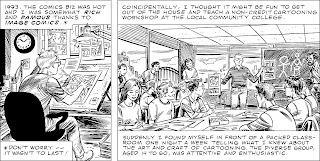
Here's the autobiographical short story I created for TwoMorrow's Streetwise (edited by Jon B. Cooke in 2000). It begins with my experiences teaching a non-credit workshop in cartooning for the Community College of Allegheny County in the early 1990s, which was a wonderful experience, and where I met my wife (the marriage lasted a decade). Then it deals with my experiences with a shabby but venerated "art" institution in Pittsburgh, which had its moments, but to which I would not send an inmate on parole (it is a notorious for-profit tuition-fleecing operation). Since then, I've had the far more uplifting experience of teaching workshops for the Carnegie Museum of Art and completing my PhD at the University of Pittsburgh, so despite some early rough spots I am still very much an arts educator. Live and learn!



Subscribe to:
Posts (Atom)