It has been ninety days since we lost Ed Piskor, a
brilliant cartoonist and comics historian whose career was only beginning to
ramp up. Here, in under 4000 words, is a comprehensive summation of what is known after three months:
Showing posts with label comics history. Show all posts
Showing posts with label comics history. Show all posts
Friday, July 5, 2024
The Ed Piskor "Grooming" Hoax: A Recap

Tuesday, June 4, 2024
Beat to Death: The Ed Piskor "Grooming" Hoax
On Saturday, May 30, 2024, an acquaintance messaged me: “Off topic, but can you believe all that crap going on with Piskor??” I hadn’t heard a word about Ed Piskor—apparently, I was living on the dark side of the moon—even though social media had blown up the Saturday before.
Sunday, May 5, 2024
Read It and Weep: Collected Writings, April 2024
I’ve posted a number of times on social media since the passing of Ed Piskor (1982-2024) and have written a couple pieces for publication elsewhere. Several people have commented that they have found my words consoling, although I want to stress that I wrote purely for my own personal, selfish, therapeutic reasons—to help me process this awful tragedy and loss. For what they may be worth, I’ve gathered them here for the record:
Wednesday, April 3, 2024
You Want a Piece of Me? The Art of the Transactional
“You want a piece of me?”
Perhaps the most hilarious moment in Seinfeld is when Frank Costanza, played by the great Jerry Stiller, asks Elaine, played by Julia Louis-Dreyfus, “You want a piece of me?” Even funnier is the blooper reel of outtakes as Jerry repeatedly delivers the line to Julia, who can’t keep from cracking up.
Thursday, June 16, 2022
The Summer of '85 and the Megaton Man Reprints That Never Happened
By the summer of 1985, it was clear that Megaton Man was the hottest title Kitchen Sink Press had ever published to that point.
Sunday, June 12, 2022
What Makes GApds - Golden Age Public Domain (Costumed) Characters - So Different, So Appealing?
What is the appeal of Golden Age public domain characters?
Fans may rightly ask, and I certainly ask this myself: Why am I wasting time drawing Golden Age public domain characters, especially when I have so many creator-owned characters under IP (intellectual property, i.e., creator-owned projects like Megaton Man and Border Worlds) going begging?
Thursday, May 12, 2022
Byron Starkwinter: Alan Moore's Self-Fulfilling Prochecy?
Shortly after I drew "In Pictopia" in1986, Fantagraphics forwarded a plot synopsis from the same author to consider illustrating. Unfortunately, Anything Goes, the fund-raising series for which it was intended, came to an end.
Monday, May 9, 2022
The Secrets of Dumbalmoore: Fantastic Bleats and Where to Find Them
This text began as a Facebook reply to Stephen Bissette, who was commenting on a link to Mikey Crotty's video, and somehow turned into yet another long-winded and self-serving blog post, rehashing the same tired, stale tropes as I've done elsewhere, on my insignificant collaboration with Alan Moore. Enjoy!
Thursday, March 3, 2022
Shows and Other Cons: The Disappearance of Comics, Episode Omega
The comic book convention as we know is disappearing out from under us; the replacement of the word “con” with “show” in the fan vernacular is our first clue. I for one am ambivalent; except for the 1985 Dallas Fantasy Fair, which was a rip-roaring good time, I can’t think of a convention that wasn’t in some way excessive, vulgar, in bad taste, arduous, or sleep-deprived—apart from discovering the occasional treasure and meeting some my then still-living drawing board heroes (Gil Kane, Murphy Anderson, John Romita, Jack Kirby, Jean Giraud/Moebius, Burne Hogarth—even Jerry Siegel). Being a professional comic book artist during the years when attendance was virtually mandatory for a professional career, I can tell you: Cons were hard work.
Wednesday, January 26, 2022
Why In Pictopia Has No Author
Update - December 16, 2023: Now including my groveling final plea to Alan prior to his final response!
This is the last communication I received from the author of “In Pictopia,” a story I illustrated with the help of Mike Kazaleh and Pete Poplaski, beautifully colored by Eric Vincent, in 1986 (as I was making the transition from Megaton Man to Border Worlds and then obscurity). The story originally appeared in Anything Goes #2, published by Fantagraphics Books in December, 1986 (a benefit book for their now-legendary legal hassles), and later collected in Fantagraphics’ Best Comics of the Decade, Volume I (June 1986). In 2021, Fantagraphics Underground issued what I consider the definitive edition of the story, but without the author’s name.
Monday, August 5, 2019
King Kong Cover for Amazing Heroes!
Originally posted July 13, 2017; updated with an addendum below, August 5, 2019.
Perhaps the best piece of art I created for the entire King Kong adaptation I drew for Fantagraphics' Monster Comics imprint in the early 1990s never appeared as part of the series. Instead, it was the cover for Amazing Heroes, the little sister publication to their more upscale publication, The Comics Journal. Here is a look at the original colored blueline.

Perhaps the best piece of art I created for the entire King Kong adaptation I drew for Fantagraphics' Monster Comics imprint in the early 1990s never appeared as part of the series. Instead, it was the cover for Amazing Heroes, the little sister publication to their more upscale publication, The Comics Journal. Here is a look at the original colored blueline.

For more on the art of my Kong adaptation, visit my King Kong blog!
Monday, May 6, 2019
Pictopia in Pittsburgh: Pulse-Pounding Panel PIX Didn't Want You to See!
I will be offering a slideshow lecture at this year's 2019 Three Rivers Comic Con on Sunday, May 12, 2019 at 3:00 pm.
Saturday, December 1, 2018
Comics Bait: Why Hate Has Erupted in the Superhero Mainstream
Certainly one of the most unwelcome developments in the world of cartooning in 2018 has been the emergence of a fascistic Far-Right Wing among comic book creators – calling for not only that certain well-known corporate-own trademarks be “restored” to their original straight-white-male secret identity orientation (this will surely make America great again – but don’t call me Shirley) – but also for boycotts and even acts of violence against those they see as corrupting their “hobby” by fighting for social justice (usually hapless editors and publishers with the thankless task of trying to widen comics readership in a dwindling digital age).
Elsewhere I have discussed the many ways the Comics Haters’ “reasoning” makes little sense, and how their political attributions are merely misplaced frustration at having been through the mainstream fuck mill and dumped out, obsolete and useless, on the other side.
What has gone unremarked, as far as I can tell – and perhaps isn’t even all that remarkable – is that these reactionary hate-mongers (one hesitates to use the term “creators”) were all work-for-hire labor (again, one hesitates to use the term “talent”) employed by big mainstream superhero publishers in the 90s and 2000s.
When you think about it, it’s not all that surprising that a Far-Right Comics Hate movement would emerge among work-for-hire superhero has-beens. After all, as freelancers, their minds have necessarily been preoccupied with decades of continuity in the two major superhero universes – not to mention pockets of comics and pop-culture history like Fiction House's Jungle Comics, Lev Gleason-Charles Biro Crime Does Not Pay comics, hardboiled detective fiction, pulps, and the like – leaving little room for nuanced thought.
Much of this material may be viewed as socially regressive (I’ve long maintained it requires a generous sense of humor if not a bit of Philip José Farmer-esque schizophrenia to properly enjoy it), but that’s not my point. Rather, these freelancers have had no choice but to study this material religiously, since making pitches to the Big Publishers for new spins over well-trod ground depends on being knowledgeable about which kinds of soles belong on which boots in which multiverse.
Being immersed in such continuity trivia means these Comics Haters have had little time to read The Nation or The New York Review of Books, let alone listen to NPR or watch the PBS Newshour. By the same token, their lucrative employment allows them to subscribe to cable, and mainstream creators can be forgiven for confusing leggy blondes on Roger Ailes’ Fox News with actual journalists. (Alternative cartoonists, as I can attest, can only afford free, and therefore liberal, broadcast media.)
It also goes without saying that none of the Comics Haters seems to have come from the ranks of alternative comics. The comic book Left – if I can employ such an over-simplified term – traces its lineage back to EC Comics (perhaps the most left-leaning, socially progressive comic book imprint in the history of newsstand comics) and blatantly counter-cultural1960s Undergrounds.
Significantly, neither EC nor the Undergrounds ever generated much in the way of identifiable trademarks to rival the major corporate-owned superhero properties, or for that matter ongoing comic book series or continuing characters. Rather, the Left has always seemed to specialize in one-off short stories (particularly in the case of EC, Harvey Kurtzman's anti-war Frontline Combat and irreverent Mad, and Ray Bradbury adaptations and proto-Rod Serling Twilight Zone black-outs in Shock SuspenStories), and only sporadically-recurring characters such as Robert Crumb’s Mr. Natural or Frank Stack’s New Adventures of Jesus. The most notable exception would be Mad Magazine itself, which has since devolved into more of a brand than a property, and Gilbert Shelton’s Fabulous Furry Freak Brothers, the closest thing the Underground ever came to launching a licensable commodity.
[Crumb himself, so paranoid about selling out and so revolted by Ralph Bakshi’s animated adaptation, famously killed off Fritz the Cat, just as the character was on the brink of becoming a household word.]
That’s not to say that Comics Haters are completely ignorant of EC or the UGs; it just that this rich tradition of Leftist comics and comix material has never been on the mainstream freelancer’s required reading list. That’s because the bread and butter of your average hapless freelancer consists of putting together pitches to revamp forgotten Silver Age superheroes and hoping to convince Big Company editors to hire them for the script and art chores. Who would you pitch a spin-off to Bernie Krigstein’s Master Race to, anyway?
As I’ve said before, the “social justice warriors” that Comics Haters see as having taken over mainstream comics have always existed; indeed, nearly all of the characters that are the subject of contention and condemnation for being rebooted as female, LGBTQ, African-American, or asexual by Comics Hate were created by a generation of Left-leaning, socially conscious, and – mostly – Jewish creators, who, if alive today and aware of the controversy, would steadfastly condemn the Comics Haters as the regressive, white-supremacist, Apartheid-mongering pigs that they are.
If the Far Right Comics Hate is more or less ignorant of or willfully oblivious to the Leftist origins of the American comic book and the history of the frankly Leftist EC-UG-Alternative comix lineage, Leftists often display an equivalent ignorance and/or bias against the superhero genre. Those who work in the Leftist tradition tend to have an innate abhorrence for mainstream superheroes (one thinks of Daniel Clowes’ Dan Pussey stories, the constant use of pejoratives like “muscle-boy comics” by Alternative cartoonists, or the bias comics scholars demonstrate for autobiographical, nominally “realist” memoir comics over other genres). Too often, this has resulted in drawing that appears completely ignorant of human anatomy and art history and writing that seldom if ever rises above Beatnik nihilism.
Whether the superhero genre is latently conservative, regressive, or fascistic – as Leftist cartoonists have always feared – even in its most liberal manifestations (one thinks of Denny O’Neil and Neal Adams “finding America” riff on Stirling Silliphant’s Route 66 in Green Lantern-Green Arrow), it is curious that mainstream comics have tended to favor continuing series and marketable trademarks while the Left has tended to concentrate on self-contained short stories (come to think of it, Route 66 – in which Buz Murdock and and Tod Stiles tooled across the country in a silver Corvette – has been described as an anthology TV series masquerading as an episodic continuity). Perhaps there is something fractured and discontuous in the Leftist worldview that mitigates against serialized (and therefore capitalist) entertainment.
To finish this essay by making it all about myself – and to place myself as morally superior to all sides in the current controversy – let me just point out that I have always occupied a no-man’s land, thanks to Megaton Man. Ostensibly a parody of Silver Age superhero clichés but initially published by a legacy Underground publisher (Kitchen Sink Press), Megaton Man was neither a mainstream success nor a critical darling; both the Left and the Right found something to hate in it. For the Fantagraphics snobs (for whom I would later make a tidy sum of money with King Kong and the Anton Drek Eros Comix), Megaton Man was obviously a “muscle-boy” comic; for the mainstream, or at least a large swath of those employed by the Big Companies in the 1980s and 1990s, it was a frontal assault on the precious trademarks that represented their livelihoods.
No doubt this is why raising a child out of wedlock, a female-and-black incarnation of the title character (Ms. Megaton Man), an obviously-but-never-outed gay character (Preston Percy), and other “Social Justice Warrior” transgressions in my 1980s storylines flew under the radar.
Neither tribe was paying particular attention.
Elsewhere I have discussed the many ways the Comics Haters’ “reasoning” makes little sense, and how their political attributions are merely misplaced frustration at having been through the mainstream fuck mill and dumped out, obsolete and useless, on the other side.
What has gone unremarked, as far as I can tell – and perhaps isn’t even all that remarkable – is that these reactionary hate-mongers (one hesitates to use the term “creators”) were all work-for-hire labor (again, one hesitates to use the term “talent”) employed by big mainstream superhero publishers in the 90s and 2000s.
When you think about it, it’s not all that surprising that a Far-Right Comics Hate movement would emerge among work-for-hire superhero has-beens. After all, as freelancers, their minds have necessarily been preoccupied with decades of continuity in the two major superhero universes – not to mention pockets of comics and pop-culture history like Fiction House's Jungle Comics, Lev Gleason-Charles Biro Crime Does Not Pay comics, hardboiled detective fiction, pulps, and the like – leaving little room for nuanced thought.
 |
| Comics Haters who decry mainstream comics’ “sudden lurch to the Left” appear blithely ignorant of the rich Leftist orientation of mainstream comics, including this masterpiece: Bernie Krigstein and Al Feldstein’s “Master Race,” from Impact #1 (EC Comics, April 1955). |
Much of this material may be viewed as socially regressive (I’ve long maintained it requires a generous sense of humor if not a bit of Philip José Farmer-esque schizophrenia to properly enjoy it), but that’s not my point. Rather, these freelancers have had no choice but to study this material religiously, since making pitches to the Big Publishers for new spins over well-trod ground depends on being knowledgeable about which kinds of soles belong on which boots in which multiverse.
Being immersed in such continuity trivia means these Comics Haters have had little time to read The Nation or The New York Review of Books, let alone listen to NPR or watch the PBS Newshour. By the same token, their lucrative employment allows them to subscribe to cable, and mainstream creators can be forgiven for confusing leggy blondes on Roger Ailes’ Fox News with actual journalists. (Alternative cartoonists, as I can attest, can only afford free, and therefore liberal, broadcast media.)
It also goes without saying that none of the Comics Haters seems to have come from the ranks of alternative comics. The comic book Left – if I can employ such an over-simplified term – traces its lineage back to EC Comics (perhaps the most left-leaning, socially progressive comic book imprint in the history of newsstand comics) and blatantly counter-cultural1960s Undergrounds.
Significantly, neither EC nor the Undergrounds ever generated much in the way of identifiable trademarks to rival the major corporate-owned superhero properties, or for that matter ongoing comic book series or continuing characters. Rather, the Left has always seemed to specialize in one-off short stories (particularly in the case of EC, Harvey Kurtzman's anti-war Frontline Combat and irreverent Mad, and Ray Bradbury adaptations and proto-Rod Serling Twilight Zone black-outs in Shock SuspenStories), and only sporadically-recurring characters such as Robert Crumb’s Mr. Natural or Frank Stack’s New Adventures of Jesus. The most notable exception would be Mad Magazine itself, which has since devolved into more of a brand than a property, and Gilbert Shelton’s Fabulous Furry Freak Brothers, the closest thing the Underground ever came to launching a licensable commodity.
[Crumb himself, so paranoid about selling out and so revolted by Ralph Bakshi’s animated adaptation, famously killed off Fritz the Cat, just as the character was on the brink of becoming a household word.]
That’s not to say that Comics Haters are completely ignorant of EC or the UGs; it just that this rich tradition of Leftist comics and comix material has never been on the mainstream freelancer’s required reading list. That’s because the bread and butter of your average hapless freelancer consists of putting together pitches to revamp forgotten Silver Age superheroes and hoping to convince Big Company editors to hire them for the script and art chores. Who would you pitch a spin-off to Bernie Krigstein’s Master Race to, anyway?
As I’ve said before, the “social justice warriors” that Comics Haters see as having taken over mainstream comics have always existed; indeed, nearly all of the characters that are the subject of contention and condemnation for being rebooted as female, LGBTQ, African-American, or asexual by Comics Hate were created by a generation of Left-leaning, socially conscious, and – mostly – Jewish creators, who, if alive today and aware of the controversy, would steadfastly condemn the Comics Haters as the regressive, white-supremacist, Apartheid-mongering pigs that they are.
If the Far Right Comics Hate is more or less ignorant of or willfully oblivious to the Leftist origins of the American comic book and the history of the frankly Leftist EC-UG-Alternative comix lineage, Leftists often display an equivalent ignorance and/or bias against the superhero genre. Those who work in the Leftist tradition tend to have an innate abhorrence for mainstream superheroes (one thinks of Daniel Clowes’ Dan Pussey stories, the constant use of pejoratives like “muscle-boy comics” by Alternative cartoonists, or the bias comics scholars demonstrate for autobiographical, nominally “realist” memoir comics over other genres). Too often, this has resulted in drawing that appears completely ignorant of human anatomy and art history and writing that seldom if ever rises above Beatnik nihilism.
Whether the superhero genre is latently conservative, regressive, or fascistic – as Leftist cartoonists have always feared – even in its most liberal manifestations (one thinks of Denny O’Neil and Neal Adams “finding America” riff on Stirling Silliphant’s Route 66 in Green Lantern-Green Arrow), it is curious that mainstream comics have tended to favor continuing series and marketable trademarks while the Left has tended to concentrate on self-contained short stories (come to think of it, Route 66 – in which Buz Murdock and and Tod Stiles tooled across the country in a silver Corvette – has been described as an anthology TV series masquerading as an episodic continuity). Perhaps there is something fractured and discontuous in the Leftist worldview that mitigates against serialized (and therefore capitalist) entertainment.
To finish this essay by making it all about myself – and to place myself as morally superior to all sides in the current controversy – let me just point out that I have always occupied a no-man’s land, thanks to Megaton Man. Ostensibly a parody of Silver Age superhero clichés but initially published by a legacy Underground publisher (Kitchen Sink Press), Megaton Man was neither a mainstream success nor a critical darling; both the Left and the Right found something to hate in it. For the Fantagraphics snobs (for whom I would later make a tidy sum of money with King Kong and the Anton Drek Eros Comix), Megaton Man was obviously a “muscle-boy” comic; for the mainstream, or at least a large swath of those employed by the Big Companies in the 1980s and 1990s, it was a frontal assault on the precious trademarks that represented their livelihoods.
No doubt this is why raising a child out of wedlock, a female-and-black incarnation of the title character (Ms. Megaton Man), an obviously-but-never-outed gay character (Preston Percy), and other “Social Justice Warrior” transgressions in my 1980s storylines flew under the radar.
Neither tribe was paying particular attention.
Sunday, August 10, 2014
Kunzle’s Pre-History of Comics: But Is It Really?
The scholar David Kunzle declared in 1973 that he was
writing “a history or pre-history” of the modern newspaper comic strip. This
enterprise has come to encompass a significant portion of his professional scholarship,
including four major books with the term “comic strip” in the title: History of the Comic Strip, Volume I: The
Early Comic Strip—Narrative Strips and Picture Stories in the European
Broadsheet from c.1450 to 1825 (1973)[1]; The History of the Comic Strip, Volume II: The Nineteenth Century (1990)[2]; Rodolphe Töpffer: The Complete Comic Strips (2007)[3]; and
Father of the Comic Strip: Rodolphe
Töpffer (2007)[4].
These four volumes are preceded by one of Kunzle’s first published articles, a
translation of Francis Lacassin’s “The Comic Strip and the Film Language,”
which is augmented by almost 4 ½ pages of “supplementary notes” by Kunzle and
amounts to a prolegomena to Kunzle’s own scholarship on pre-twentieth-century
picture stories and their relationship with cinematic history.[5] Such
a sizeable corpus of research and writing,[6]
to say nothing of the publication of these sometimes cumbersome and profusely
illustrated works, would be a worthy if not magisterial achievement for any
scholar, particularly one working in such a pioneering area of graphic art as
pre-twentieth-century printed picture stories. However, the twentieth-century term
“comic strip” figures prominently in each of the titles mentioned, and Kunzle
in his own right has become considered a father of sorts to scholars of comics,
and has had a surprising and unexpectedly substantial impact on the way comics
are being perceived today.
So it may seem impertinent to ask: is Kunzle's undeniable
accomplishment really a history or pre-history of the comic strip? Does it do
justice to the pre-twentieth-century material Kunzle studies to be considered
primarily as comic strips or precursors to comic strips? What are Kunzle’s motivations
for claiming the term “comic strip” as his rubric, and would his material have been
better served by another term, such as “picture story”? What effect has
Kunzle’s work, and his assimilation of his material to the modern comic strip, had
on comics (both on its scholarship and the art form)? Would it be more productive,
in fact, for comics scholars and artists to think, not of earlier graphic
(printed) picture stories as latent comic strips (or comic books or graphic
novels), but of comics as a particular formulation or solution to the problems
presented by the graphic picture story? Would it be more productive for
twenty-first century creators to consider the creative potential of
combining words and pictures freely, with the entirety of the history of
culture offering suggestion, rather than reducing the history of all previous words-and-pictures
experiments down to a teleological, evolutionary drama narrowly concerned with
the perfection of a specific, marketable form of picture story?
 |
| The reference room of the Frick Fine Arts Libary, University of Pittsburgh, which holds a copy of Kunzle’s History of Comics Volume I (not pictured). |
An informal search Google N-Gram search and search of databases at my disposal suggests that the term comic strip did not emerge as a term of description for the American newspaper feature we now know by that name until probably the mid-1910s. All the material Kunzle studies in his four major works dates from prior to the twentieth century. The few times that Kunzle mentions twentieth-century newspaper comic strips throughout this corpus, it is with at least mild disdain; he seems to regard the more popular successors to his material as an attenuated if not fallen and debased artform when compared to the earlier material he finds more richly varied as to subject matter and political and social viewpoint and consequently so much more engrossing. So why does he so emphatically embrace the term comic strip by placing it firmly in the titles of all his works, and why does he so earnestly want us to view the narrative strips, picture stories, broadsheets, and other material under scrutiny as comic strips?
Kunzle acknowledges more than once that his project was
inspired by the art historian Ernst Gombrich, who published his ground-breaking
Art and Illusion in 1960 (which is
still on some required reading lists).[7]
Gombrich is the first to make the connection between early print picture
stories (and specifically the work of Töpffe) to the modern newspaper comic
strip form. Gombrich asserts, “to Töpffer belongs the credit, if we want to
call it so, of having invented and propagated the picture story, the comic
strip.”[8]
Gombrich views Töpffer’s combination of words and pictures as especially prescient,
“In view of what has happened during the last decades,” presumably a reference
to the rising popularity of newspaper comic strips and children’s books
(Gombrich was writing in the 1960s).[9]
Gombrich, however, does not elaborate on the distinctions or definitions of the
terms “picture story” or “comic strip,” let alone recount the evolution from
one to the other.
Enter Kunzle, Gombrich’s student, who does explore this
terrain, and also assumes the elder scholar’s identification of Töpffer as a
key figure in the development of the form(s). Kunzle also, at least at the
outset, also assumes Gombrich’s terminological ambiguity (“the picture story,
the comic strip”). Kunzle himself claims to “use the terms picture story and
comic strip indifferently,” although he frequently refers to “the development
of the picture story and comic strip,”[10]
along with other terms, quite often, as if they were separate and distinct
forms demanding the covering of all bases.
Kunzle establishes his use of the term comic strip in the
Introduction to History of the Comic
Strip Volume I, although he never justifies or explains his choice, or
indeed, that he is making a choice. In the opening section, Kunzle considers a
range of terms used to describe the twentieth century newspaper feature,
particularly foreign variants such as Italian fumetti, the French bandes
désinées (drawn strip), and the German term Bilderstreifen and Bildergeschichte
(literally, picture strip and picture story, respectively), and the French term
bande dessinée. Kunzle blandly
asserts, “Of all these terms, ‘comic strip’ is the most commonly used for the
newspaper strip,” which he describes as “an artistic phenomenon.” He writes,
All over the Western world, the comic strip has become a major form of mass communication, a potent force in molding public opinion, an international language […] understood and enjoyed by the literate and semi-literate alike.
But Kunzle offers no rationale as to why the term “comic
strip” should be favored in describing this phenomenon, let alone why it should
be applied retroactively to graphic material prior to the advent of the
American daily newspaper.
The clear inference is that Kunzle is saddled with the term “comic
strip” whether he finds it appropriate or not for the pre-twentieth-century
material he is studying. And indeed, he finds in completely inappropriate,
arguing, “only the English language […] insists that ‘drawn strips’ are comic,”
while in fact
the truly comic strip [Kunzle’s emphasis] does not emerge until … late eighteenth-century England. At this stage of its development, however, I have preferred to use the phrase “caricatural strip” …. [Therefore] I never refer to the pre-caricatural (i.e. pre-1780) strip as the “comic strip,” even when it contains an element of humor. I generally use the terms “narrative strip” or “narrative sequence,” “picture story” or “pictorial sequence” (depending on the format involved) in order to stress the narrative role of the medium, which I consider primary.[11]
Kunzle finds formal similarities between the material of his
study and twentieth-century newspaper comic strips sufficient to justify the
connection previously made by Gombrich, and constructs a definition of the term
“comic strip” broad enough (most notably by not being dependent on the word
balloons) to justify its application to his material.[12]
However, Kunzle never again employs the term “comic strip” in History of the Comic Strip Volume I following
the Introduction.
Further, Kunzle’s anachronistic application of the term
“comic strip” to the material of his study is all the more puzzling, since he seems
to have little knowledge or interest in twentieth-century material, or in
discussing “comic strips” per se. Indeed, Kunzle rarely discusses twentieth
century newspaper strips throughout his oeuvre, and then only generally and
vaguely, usually only with broad reference to their popularity, and often with
a good deal of disdain for what he sees as an artistic devolution from the rich
social commentary and propaganda of his favored era into banal soap opera and
gags of the time of his writing. Kunzle is also dismissive of the historically uninformed
“Compilers of books on the twentieth-century comic strip” and their “potted”
histories.[13]
For example, Kunzle blasts a biography, “that modern stalwart, Milton Caniff,” for
the name-dropping pretentions of its subtitle (“Rembrandt of the Comic Strip”),
and the author’s ignorance in conflating Renaissance cartoons (preparatory
drawings for paintings or tapestries) with the modern graphic form.[14]
Kunzle expresses no interest in extending his own research into twentieth
century material, to write a corrective history of twentieth century comic
strips, or even to compare examples of the pre-1896 material of his study with
more recent examples.
In fact, Kunzle seems to have regretted his choice of
placing the term “comic strip” in the title of his history of broadsheets and
picture stories. In the Preface to History
of the Comic Strip Volume II (1996), Kunzle goes on an extended,
unscholarly rant about the problems the term “comic strip” has created for the
reception of his scholarship in the intervening two decades.
As a respectable academic I have, I suppose, sought to give the comic strip academic respectability. I doubt that I have succeeded yet. The “scientific literature” of my discipline (art history) has tended to pass by Volume 1, The Early Comic Strip, no doubt because of its frivolous title, which has not convinced even the (nonacademic) celebrants of the genre in the 20th century that there is indeed a comic strip worthy of the name before the Americans “invented” it in 1896 or so. I was recently sent a script for an ambitious television series on the (20th century) comic strip, for which funding was being sought and to which I was nominated a “scholarly advisor.” The script started with the assertion that the first comic strips appeared in American newspapers at the end of the 19th century. Of course. By now I should have learned that to deny in the face of the U.S. media that the United States invented the comic strip is about as pointless as denying that the United States invented freedom and democracy. So I look once more to academe, which should understand that the real title of the present volume is “The acquisition and Manipulation of New Sites of Comoedic [sic] Narrative Discourses and Significations by Volatility-prone Social Sectors.” A big book should have a big title anyway.[15]
Kunzle further laments that his two-volume prehistory of the
comic strip “has been a lonely endeavor in many ways, just how lonely I can now
measure, in retrospect, as I enter the well-established field of 17th century
Dutch art.”[16]
More well established, and presumably more academically respectable.
 |
Fischer von Erlach’s Entwürf einer Historischen Arkitektur (inventive history), 1721, showing the Halikarnassus plate.
|
Nonetheless, Kunzle retains the term “comic strip” for the title of his second mammoth volume, and more freely and boldly uses the term in discussing nineteenth-century material, even while acknowledging its anachronism. He muses,
The comic strip in the 19th century, for all its popularity, is without a recognized name. Töpffer called his comic albums either “picture novels” or, deprecatingly, “little follies.” In the trade they were called “caricatural albums,” or the “série Jabot,” after the initiating title. Töpffer himself pretended anonymity, which the pirates all too scrupulously observed. It is as if Jabot, the social upstart, having forced himself and his upstart graphic genre upon the public, was forever to be denied the dignity of a distinct literary or artistic category.[17]
Kunzle, to his credit, would stick with his guns, and even
more boldly assert the term “comic strip” in the titles of his two subsequent
publications on Töpffer.
But why did Kunzle initially adopt the term “comic strip” in
the early 1970s? Kunzle seems to have made the pragmatic calculation that
labeling his research on broadsheets and picture stories a “history or
pre-history of the comic strip” would be of benefit to his scholarship both
academically and in terms of landing a publisher for what was no doubt a
prohibitively expensive undertaking. In the post-war era, after cinema and
jazz, the comics strip seemed next in line as the American art destined for
academic validation and publishing success. Several decades had elapsed since
Coulton Waugh’s The Comics (1947),
but in the first half of the 1970s, the first of a new wave of comic-strip
histories were beginning to appear, or were being readied for publication.
These included Dick Lupoff and Don Thompson’s anecdotal anthology All in Color for a Dime (1970)[18];
Les Daniels’ Comix: A History of Comic
Books in America (1971)[19];
Marvel artist Jim Steranko’s two-volume The
Steranko History of Comics (1970, 1972)[20];
Arthur Asa Berger’s sociological study The
Comic-Stripped American: What Dick Tracy, Blondie, Daddy Warbucks and Charlie
Brown Tell Us About Ourselves (1973)[21];
and Jerry Robinson’s The Comics: An
Illustrated History of Comic Strip Art (1974)[22].
Kunzle may even had been aware of Maurice Horn’s The World Encyclopedia of Comics (1976), then in preparation.[23]

An important hint may lie in the fact that the Preface to History of the Comic Strip Volume I, dated 1968, contains no reference to or use of the term “comic strip” all, only “picture story” (twice).[24] But the volume was not published by the University of California Press until 1973, a five-year interval encompassing not only the publication of most of the comic strip histories listed above, but also Kunzle’s translation of the Lacassin article for Film Quarterly, also a UC publication (1972). The titling of the History of the Comic Strip Volume I and the writing of its Introduction, which uses the term “comic strip” more than 30 times (nowhere else in the volume does the term appear) may have taken place only after the Preface and body of the volume had been complete in 1968. The foregrounding of the term “comic strip,” for which Gombrich had already paved the way, may have belatedly occurred to Kunzle or been suggested by his publisher in recognition of a “comic strip” trend in publishing that had emerged since 1968. Such a move would not have been merely a cynical ploy to make the publication of the mammoth volume more feasible, but could have also been a sincere effort to connect Kunzle’s rather obscure study of broadsheets and picture stories to more current (and more sexy) scholarly discourses, particularly cinema.
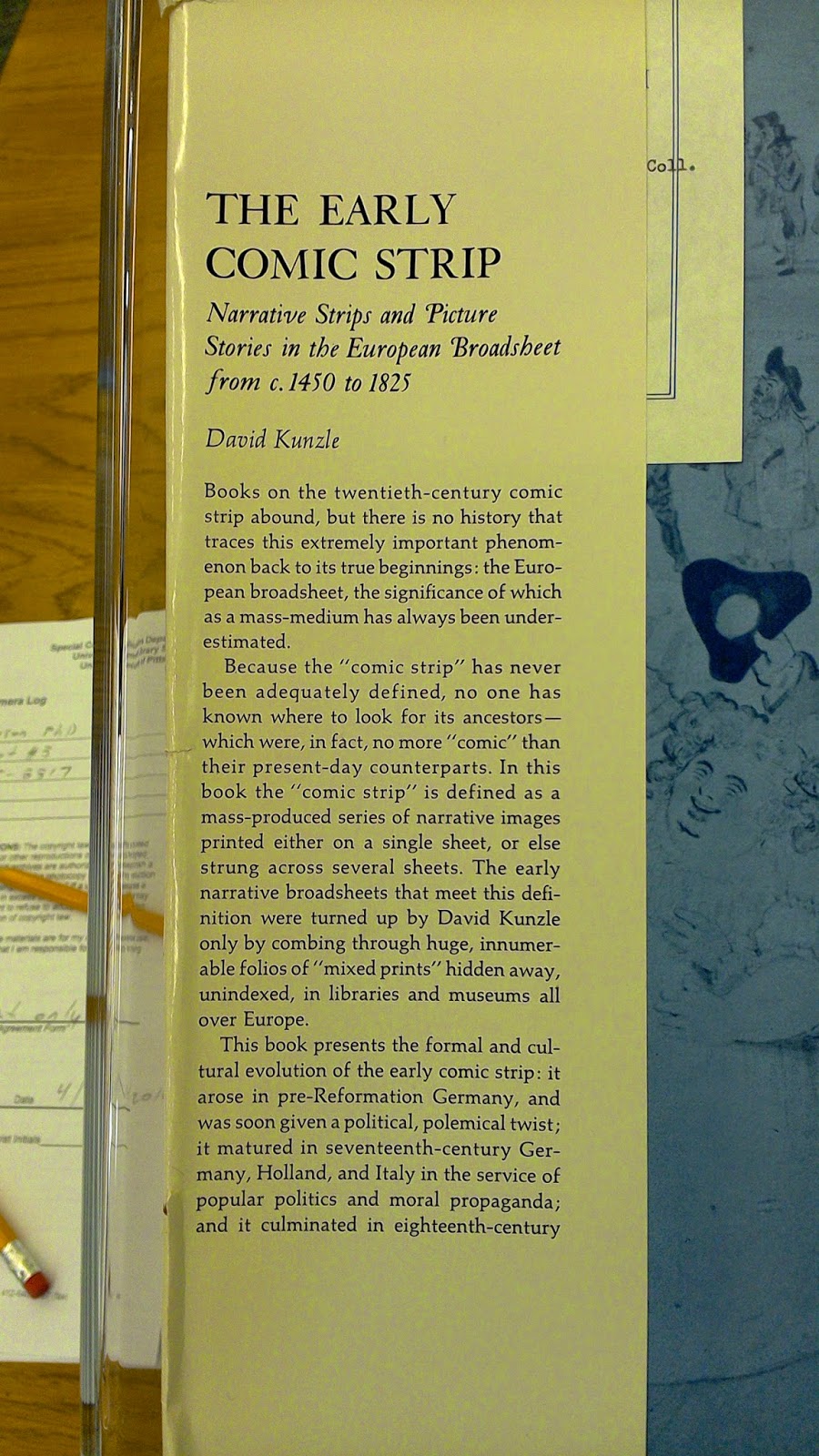 |
| Back dustjacket flap of Kunzle's History of the Comic Strip Volume I: The Early Comic Strip—Narrative Strips and Picture Stories in the European Broadsheet from c.1450 to 1825, at the Special Collections room, Hillman Library, University of Pittsburgh. |
This is most emphatically suggested by Kunzle’s 1972 translation of Lacassin for Film Quarterly. The introduction to the article, set in large bold italic that upstages the body text, presents the article not only as a precursor but also an unprecedented plug for Kunzle’s forthcoming History, and explicitly ties Kunzle’s work to the “intellectual respectab[ility]” belatedly emerging for comics that had been established for film “three or four decades ago.” The notes added by Kunzle, “which qualify some of Lacassin’s findings,” are half as long as Lacassin’s text.[25] Kunzle begins,
This is not the place to quarrel with Lacassin’s
assumption, which is so widely shared, that the comic strip and cinema were
born at the same period. Since the material has simply not been available
hitherto, critics cannot know that, in fact, the narrative picture strip
reached a certain maturity in German, Dutch, and English broadsheets in the
seventeenth century. In my book, which the University of California Press will
shortly publish, I reproduce an extensive corpus of these remarkable early
picture stories, which will thus become available for analysis and discussion.
Nor need we at this point question by what feat of logic Lacassin makes the
“birth” of the comic strip postdate by two generations one of the recognized
“fathers” of the art (for Gombrich, the
father), Rodolphe Töpffer.[26]
Whatever his reasoning or motivation for declaring his work “a
history or pre-history” of the comic strip, Kunzle stuck to his guns, using the
term “comic strip” in the title of two more scholarly publications on Töpffer.
It is now common, in fact, to see references in academic art historical
publications and museum exhibition catalogs to Töpffer as father or inventor of the comic strip.[27]
But as Geoffrey Batchen reminds us in the case of the history of photography,
such determinations are suspect. He remarks that historians
continue to squabble over which of them was the first to discover the one, true inventor of photography. […] [T]his is invariably an argument as much about virility and paternity as about history, as much about the legitimacy of both photographer and historian as historic primogenitors as about the timing of the birth itself.[28]
To the extent that Kunzle’s work is seen as foundational to
comic strip and comic book scholarship, his legacy is a mixed bag. The
unfortunate example of Kunzle’s snarky Preface to Volume II, mentioned above, as well as its Introduction which dwells at length on the status of nineteenth
century picture stories as a “childish genre,”[29]
suggests that a cloying desire for “academic respectability” has been passed
down to more recent scholars who continue to openly bitch, “Why Are Comics Still in Search of Cultural Legitimization?”[30]
On the positive side, as David Carrier attests, “I admire Kunzle, a bold and
original scholar, for gathering these materials, without which my own
philosophical study [on comics] could not have been conceived,” but departs
from Kunzle on the issue of word balloons.[31]
The more substantial implication being that Kunzle’s scholarship is not about
comics at all, but something that predates comics historically, and if anything
chronicles part of a pictorial and textual tradition that is larger than
comics.
To the extent that Kunzle’s scholarship is a rebuke of
twentieth and twenty-first century comic strips, comic books, and graphic
novels (and there is plenty of ammunition for such an argument throughout Kunzle’s four major works on pre-twentieth-century picture stories),[32]
and a prompt to live up to the larger pictorial and textual tradition that is Kunzle’s concern, this
admonition might be stated in a more effective way. Instead of saying comics
should be better than they are, one could simply say, stories told in words and pictures don’t have to be comics. Perhaps
that is the far greater lesson to be derived from Kunzle’s work.
[1] David Kunzle, History of the Comic Strip,
Volume I: The Early Comic Strip—Narrative Strips and Picture Stories in the
European Broadsheet from c.1450 to 1825 (Berkeley, University of California
Press, 1973).
[2] David Kunzle, History of the Comic Strip,
Volume II: The Nineteenth Century (Berkeley, University of California
Press, 1990).
[3] David Kunzle, ed., trans., Rodolphe Töpffer: The Complete Comic Strips
(Jackson: University Press of Mississippi, 2007).
[4] David Kunzle, Father of the Comic Strip:
Rodolphe Töpffer (Jackson
: University Press of Mississippi, 2007).
[5] Francis
Lacassin, “The Comic Strip and the Film Language,” trans. with additional notes
by David Kunzle, Film Quarterly, vol.
26, no. 1, (Autumn 1972), pp. 11-23. Kunzle’s footnote on p. 11 reads as
follows: “Translated from Lacassin’s Pour
un neuvième art: la bande dessinée (Paris: Union Generale, 1971) and his
preceding article “Bande dessinée et langage cinematographique,” Cinema ‘71, (September1971), by
permission of the publishers. The material has been slightly abridged from its
longer version in the book, but incorporates the refinements Lacassin made in
the book.” Kunzle’s additional notes occupy the final 4 ½ pages of the article,
set at the same type size as translated text, pp. 19-23.
[6] For brevity, these works will be referred to hereafter as History I and II, Complete, Father, and “Lacassin.”
[7] See Kunzle, History vol. 1, preface,
and Father, p. ix.
[8] Ernst Gombrich, Art and Illusion: A Study
in the Psychology of Pictorial Representation, 3rd ed. (Princeton:
Bollingen, 2000 [1960]) p. 336.
[9] Gombrich, p. 337.
[10] Father, quotes from pp. xi and 53
respectively.
[11] History I, p. 1.
[12] History I, p. 2-3. David Carrier, among
others, takes issue with Kunzle, claiming “The speech balloon is a defining
element of the comic [strip].” See David Carrier, The Aesthetics of Comics, (University Park: The Pennsylvania State
University Press, 2000), pp. 3-4; quote p. 4.
[13] History I, p. 1.
[14] History I, p. 2.
[15] History II, p. xix.
[16] History II, p. xx.
[17] History II, p. 6.
[18] Dick
Lupoff and Don Thompson, eds., All in
Color for a Dime (New Rochelle NY: Arlington House, 1970).
[19] Les
Daniels, Comix: A History of Comic Books
in America (New York: Bonanza Books, 1971).
[20] Jim
Steranko, The Steranko History of Comics,
vols I and II (Reading PA: Supergraphics1970, 1972).
[21] Arthur
Asa Berger, The Comic-Stripped American:
What Dick Tracy, Blondie, Daddy Warbucks and Charlie Brown Tell Us About
Ourselves (New York: Walker, 1973).
[22] Jerry
Robinson, The Comics: An Illustrated
History of Comic Strip Art (New York: Putnam, 1974).
[23] Maurice
Horn, The World Encyclopedia of Comics
(New York: Chelsea House, 1976).
[24] History I, Preface [n.p.].
[25] The introduction or abstract of the article reads, in bolder and larger type than
the article, “The comic strip is now becoming intellectually respectable in
somewhat the same way that film did, three or four decades ago. Studies of
contemporary strips abound; serious artists are using the form for their own
purposes-often, of course, satirical purposes. As the French historian Francis
Lacassin argues in the pioneering article below, the “language” or syntax of
the comic strip shows many similarities to (and certain historical priorities
over) the language of film. The article has been translated by David Kunzle,
author of the forthcoming The Early Comic
Strip: Narrative Strips and Picture Stories in the European Broadsheet, c.
1450-1826—a sociocultural history of the first mass medium’s origins—and he
adds notes of his own which qualify some of Lacassin’s findings and extend them
even further back in time.” See Lacassin, p. 11.
[26] Lacassin, p. 19. The Lacassin article and its influence on comics
scholarships merits a discussion of its own, which in fact I first essayed on
an earlier incarnation of this blog around 2005. I plan to revisit that article
and repost soon.
[27] See for example Laura Hoptman, Drawing Now: Eight Propositions (New York:
Museum of Modern Art, 2002), p. 129.
[28] Geoffrey
Batchen, Burning with Desire: The
Conception of Photography (Cambridge, MA: The MIT Press, 1997), p. 35.
[29] History II, pp. 2-4.
[30] Thierry Groensteen, “Why Are Comics Still in Search of Cultural Legitimization?”
in Jeet Heer and Kent Worcester, eds., A
Comics Studies Reader (Jackson: University Press of Mississippi Press,
2009), pp. 3-11. [I discuss this article in a previous post on this blog.]
[31] Carrier, pp. 3-4; quote p. 3.
[32] Not
to mention Kunzle’s translation of Dorfman and Armand Mattelart’s 1973 Para leer al pato Donald into English as
How to Read Donald Duck in 1975,
suggesting that if Kunzle were to regard modern comics at all, their status as
capitalist commodities would be foremost in his critique.
 |
| Back dustjacket flap of Kunzle's History of the Comic Strip Volume II: The Nineteenth Century, at the Special Collections room, Hillman Library, University of Pittsburgh. |
Saturday, February 8, 2014
Can Doc Savage be Adapted to Comics? Or to Anything?
I've been looking forward to Dynamite Entertainment's new comic book adaptation of Doc Savage ever since I heard about it through Comic Shop News last fall. Not because I was particularly impressed with any of the preview art, or even the Alex Ross faux-James Bama covers, but because of this very question: Can Doc Savage be adapted to comics? Or to anything?
I was first exposed to Doc Savage with Marvel Comics' Doc Savage #1 with the cover date of October, 1972. This was the second month for me as a Marvel reader (the September 1972 cover date, probably June or July in reality, still holding a nigh-cosmic significance in my life experience), and the first #1 issue of a comic book series I ever bought, thus an unforgettable milestone. It was a weird experience: a crimefighter who was not a super-powered costumed character, set in the Depression era, and adapted from another medium, books. I immediately latched onto several of the Bantam Books paperbacks, themselves reprints of something from the past called pulps, and within months had also sent away for Steranko's History of Comics volume I, which included a chapter called "The Bloody Pulps," positing the even stranger thesis that the comic book artform had evolved out of pulp fiction (still problematic in my mind), with a lengthy passage on Lester Dent's (the real name of the pseduonymous author Kenneth Robeson) Doc Savage adventures. Later, I bought Bantam's 1976 edition of Philip José Farmer's Doc Savage: His Apocalyptic Life, an even weirder experience. (This mind-blowing tome suggested, among other things, that Doc Savage, The Shadow, Tarzan, and Sherlock Holmes, among others, were all real and in fact related to one another through something called the Wold-Newton family tree.) Lastly, I recall Marvel's Doc Savage magazine by Doug Moench, John Buscema, and Tony DeZuniga, perhaps the best adaptation of Doc Savage ever done (peremptorily answering my own question on one level, that yes, Doc Savage can be adapted to comics, at least in longer-format chunks), in any case more satisfying than the Steve Englehart and Ross Andru version of 1972.
To make a long story short, I was nearly as much a Doc Savage fan, for a certain portion of my teenage years, as I was a Marvel fan, and at least as much as I was a fan of Jeff Rice's Kolchak: The Night Stalker, Pierre Boulle's Planet of the Apes, and Martin Caidin's The Six-Million Dollar Man. While I can't say that I've read more than twenty of the 181 "supersagas," I've read Farmer's Gnostic history of The Man of Bronze at least a dozen times, and pondered the impracticalities (to say nothing of the social implications) of the Wold-Newton Universe.
To make a short story even shorter, I don't think the new Dynamite version is very good. Let me be clear that my purpose is not to pick on writer Chris Roberson (who after all boasts three editions of Farmer's Apocalyptic Life in his library) or newcomer artist Bilquis Evely, for whom this is clearly a labor of love. Let me further state that I could never imagine performing the research on all the Art Deco necessary to pull off an even passable period adaptation of Doc Savage.
In any case, the first two issues are far from satisfying. I can't imagine anyone other than a diehard Savage fan being at all interested in this project. In each, a complete, original "supersaga" is presented, telescoped into something barely as long as your average movie trailer. The Savage supersagas were known for there outlandishly improbably and inexhaustible twists and turns, if not intellectual complexity; here they are simplified into brief glimpses of icon Savage locales: the Empire State Building, the Fortress of Solitude, the Crime College. In these two installments, the nemeses turns out to a be lone nut jobs with ham radios who are easily dispensed with a few punches, hardly the Johnny Sunlight-caliber evil-doers who could keep Doc and his fabulous five at bay for at least a hundred prose pages. Further, it is often difficult to tell Doc apart from his fabulous five aides, since this adaptation has forgone the dark bronze complexion, has chosen to integrate both the Clark Gable loose hair and James Bama widow's peak, and not even shown him in a torn shirt (except for the Ross covers), or even the 1972 Marvel blue vest.
On the other hand, I will say that there does come across, even in these absurdly truncated exploits, a certain egalitarian camaraderie among Doc and his five aides that is quite enjoyable, reminiscent perhaps more of Buckaroo Banzai than the Doc stories proper, or of any of Doc's artistic progeny (James Bond, Indiana Jones, Jor El -- all of whom I at least tend to think of as loners). And Ms. Evely's art, although indecisive when it comes to depicting the male characters (they all wear suits and are about the same stature, with even Monk blending into the crowd), her art really comes alive when she is drawing that butch-femme dynamo Pat Savage. Pat, Doc's proto-feminist metrosexual sister, is seen in jodhurs and unbuttoned safari shirt that, while not torn to shreds, recalls the iconography of the Bama covers associated with Doc more vividly and convincingly than even the Ross covers (the first of which fetishize the shreds into a kind of swirling whirlwind of flames--a kind of divine transfiguration). One is tempted to say just to forget the traced skyscrapers and cardboard male characters altogether, and let Evely draw Pat kicking ass for 17 pages an issue. And let the shirt get torn to shreds. I would buy it.*
It is too soon to tell where Roberson (not to say Robeson) is going with his multi-decade story arc (if you can call these fleeting episodes stories at all). It seems clear that Doc and Pat are the only ones who will not age (although whether this is the result of Doc's pharmacological ingenuity or of immortal chromosomes mutated by the Wold-Newton meteor remain to be seen), while Monk, Ham, and the other three (who were never very discernible anyway) are slated to die off, to be replaced by next-gen whiz kids. Frankly, I would prefer to see the comics adapters attempt a "rattling good story" faithful to the original time period rather than a meta-discursus on the post-Street and Smith narrative (with its obsession of integrating the various hair-eras of Doc with Farmer's Gnostic history of pulplit). Needless to say, the only creative idea that Marvel and DC have been able to come up with these past few decades have been these kinds of Talmudic exegesis on continuity rather than creative storylines, and this is hardly in the spirit of the American comic book. Neither is it in the spirit of Doc or the pulps.
On the other hand, it just may be that Doc is too plainclothes, too cerebral (after a fashion), too literary a property to be properly adapted to such a visual medium as comics (the George Pal and Ron Ely film version not offering much a rebuttal on behalf of film). I have always felt, since the time I was enjoying various entertainment in media in my teen years, that certain ideas lent themselves to certain artforms better than other, and that adaptation for the sake of spin-off licensing always involved either radical alteration or sheer loss of the charm and magic of the idea in its native form. Doc Savage was best in prose; Planet of the Apes (as it was transformed by Rod Serling and others) best in film; superheroes (prior to big-budget special effects in the late 1970s and cgi since) in comics, and so on. Since Star Wars, The Lord of the Rings, and Harry Potter, however, we've all gotten used to the idea that properties that can be more than just merchandising bonanzas but actually artistically successful on multiple platforms while at the same time faithful to their original conceptions. But I'm still not convinced this is now a universal law, hence my continued interest in the Dynamite Doc Savage as it unfolds. Can Doc Savage be adapted to comics? Or to anything? To my mind, the jury is still out.
More art from the Dynamite adaptation and an interview with Chris Roberson @ Between the Covers.
___
* Let's be honest, I would draw it. Jenny Woodlore, the female protagonist from my series Border Worlds, had her origins in an eroticized drawing I made in high school of a brunette in a Bamaesque torn shirt and jodhpurs--not exactly Pat Savage, but close enough. Such is the power of that curious motif over one young (now middle-aged) male imagination.
I was first exposed to Doc Savage with Marvel Comics' Doc Savage #1 with the cover date of October, 1972. This was the second month for me as a Marvel reader (the September 1972 cover date, probably June or July in reality, still holding a nigh-cosmic significance in my life experience), and the first #1 issue of a comic book series I ever bought, thus an unforgettable milestone. It was a weird experience: a crimefighter who was not a super-powered costumed character, set in the Depression era, and adapted from another medium, books. I immediately latched onto several of the Bantam Books paperbacks, themselves reprints of something from the past called pulps, and within months had also sent away for Steranko's History of Comics volume I, which included a chapter called "The Bloody Pulps," positing the even stranger thesis that the comic book artform had evolved out of pulp fiction (still problematic in my mind), with a lengthy passage on Lester Dent's (the real name of the pseduonymous author Kenneth Robeson) Doc Savage adventures. Later, I bought Bantam's 1976 edition of Philip José Farmer's Doc Savage: His Apocalyptic Life, an even weirder experience. (This mind-blowing tome suggested, among other things, that Doc Savage, The Shadow, Tarzan, and Sherlock Holmes, among others, were all real and in fact related to one another through something called the Wold-Newton family tree.) Lastly, I recall Marvel's Doc Savage magazine by Doug Moench, John Buscema, and Tony DeZuniga, perhaps the best adaptation of Doc Savage ever done (peremptorily answering my own question on one level, that yes, Doc Savage can be adapted to comics, at least in longer-format chunks), in any case more satisfying than the Steve Englehart and Ross Andru version of 1972.
To make a long story short, I was nearly as much a Doc Savage fan, for a certain portion of my teenage years, as I was a Marvel fan, and at least as much as I was a fan of Jeff Rice's Kolchak: The Night Stalker, Pierre Boulle's Planet of the Apes, and Martin Caidin's The Six-Million Dollar Man. While I can't say that I've read more than twenty of the 181 "supersagas," I've read Farmer's Gnostic history of The Man of Bronze at least a dozen times, and pondered the impracticalities (to say nothing of the social implications) of the Wold-Newton Universe.
To make a short story even shorter, I don't think the new Dynamite version is very good. Let me be clear that my purpose is not to pick on writer Chris Roberson (who after all boasts three editions of Farmer's Apocalyptic Life in his library) or newcomer artist Bilquis Evely, for whom this is clearly a labor of love. Let me further state that I could never imagine performing the research on all the Art Deco necessary to pull off an even passable period adaptation of Doc Savage.
In any case, the first two issues are far from satisfying. I can't imagine anyone other than a diehard Savage fan being at all interested in this project. In each, a complete, original "supersaga" is presented, telescoped into something barely as long as your average movie trailer. The Savage supersagas were known for there outlandishly improbably and inexhaustible twists and turns, if not intellectual complexity; here they are simplified into brief glimpses of icon Savage locales: the Empire State Building, the Fortress of Solitude, the Crime College. In these two installments, the nemeses turns out to a be lone nut jobs with ham radios who are easily dispensed with a few punches, hardly the Johnny Sunlight-caliber evil-doers who could keep Doc and his fabulous five at bay for at least a hundred prose pages. Further, it is often difficult to tell Doc apart from his fabulous five aides, since this adaptation has forgone the dark bronze complexion, has chosen to integrate both the Clark Gable loose hair and James Bama widow's peak, and not even shown him in a torn shirt (except for the Ross covers), or even the 1972 Marvel blue vest.
On the other hand, I will say that there does come across, even in these absurdly truncated exploits, a certain egalitarian camaraderie among Doc and his five aides that is quite enjoyable, reminiscent perhaps more of Buckaroo Banzai than the Doc stories proper, or of any of Doc's artistic progeny (James Bond, Indiana Jones, Jor El -- all of whom I at least tend to think of as loners). And Ms. Evely's art, although indecisive when it comes to depicting the male characters (they all wear suits and are about the same stature, with even Monk blending into the crowd), her art really comes alive when she is drawing that butch-femme dynamo Pat Savage. Pat, Doc's proto-feminist metrosexual sister, is seen in jodhurs and unbuttoned safari shirt that, while not torn to shreds, recalls the iconography of the Bama covers associated with Doc more vividly and convincingly than even the Ross covers (the first of which fetishize the shreds into a kind of swirling whirlwind of flames--a kind of divine transfiguration). One is tempted to say just to forget the traced skyscrapers and cardboard male characters altogether, and let Evely draw Pat kicking ass for 17 pages an issue. And let the shirt get torn to shreds. I would buy it.*
 |
| "Do these jodhpurs make my thighs look fat?" More problematic is the shirt, clearly made of more durable fabric than those of her clothing-optional cousin. Bilquis Evely's art comes (Tarzan!) alive when she draws Pat Savage, from the Dynamite adaptation. |
It is too soon to tell where Roberson (not to say Robeson) is going with his multi-decade story arc (if you can call these fleeting episodes stories at all). It seems clear that Doc and Pat are the only ones who will not age (although whether this is the result of Doc's pharmacological ingenuity or of immortal chromosomes mutated by the Wold-Newton meteor remain to be seen), while Monk, Ham, and the other three (who were never very discernible anyway) are slated to die off, to be replaced by next-gen whiz kids. Frankly, I would prefer to see the comics adapters attempt a "rattling good story" faithful to the original time period rather than a meta-discursus on the post-Street and Smith narrative (with its obsession of integrating the various hair-eras of Doc with Farmer's Gnostic history of pulplit). Needless to say, the only creative idea that Marvel and DC have been able to come up with these past few decades have been these kinds of Talmudic exegesis on continuity rather than creative storylines, and this is hardly in the spirit of the American comic book. Neither is it in the spirit of Doc or the pulps.
On the other hand, it just may be that Doc is too plainclothes, too cerebral (after a fashion), too literary a property to be properly adapted to such a visual medium as comics (the George Pal and Ron Ely film version not offering much a rebuttal on behalf of film). I have always felt, since the time I was enjoying various entertainment in media in my teen years, that certain ideas lent themselves to certain artforms better than other, and that adaptation for the sake of spin-off licensing always involved either radical alteration or sheer loss of the charm and magic of the idea in its native form. Doc Savage was best in prose; Planet of the Apes (as it was transformed by Rod Serling and others) best in film; superheroes (prior to big-budget special effects in the late 1970s and cgi since) in comics, and so on. Since Star Wars, The Lord of the Rings, and Harry Potter, however, we've all gotten used to the idea that properties that can be more than just merchandising bonanzas but actually artistically successful on multiple platforms while at the same time faithful to their original conceptions. But I'm still not convinced this is now a universal law, hence my continued interest in the Dynamite Doc Savage as it unfolds. Can Doc Savage be adapted to comics? Or to anything? To my mind, the jury is still out.
More art from the Dynamite adaptation and an interview with Chris Roberson @ Between the Covers.
___
* Let's be honest, I would draw it. Jenny Woodlore, the female protagonist from my series Border Worlds, had her origins in an eroticized drawing I made in high school of a brunette in a Bamaesque torn shirt and jodhpurs--not exactly Pat Savage, but close enough. Such is the power of that curious motif over one young (now middle-aged) male imagination.
Subscribe to:
Posts (Atom)