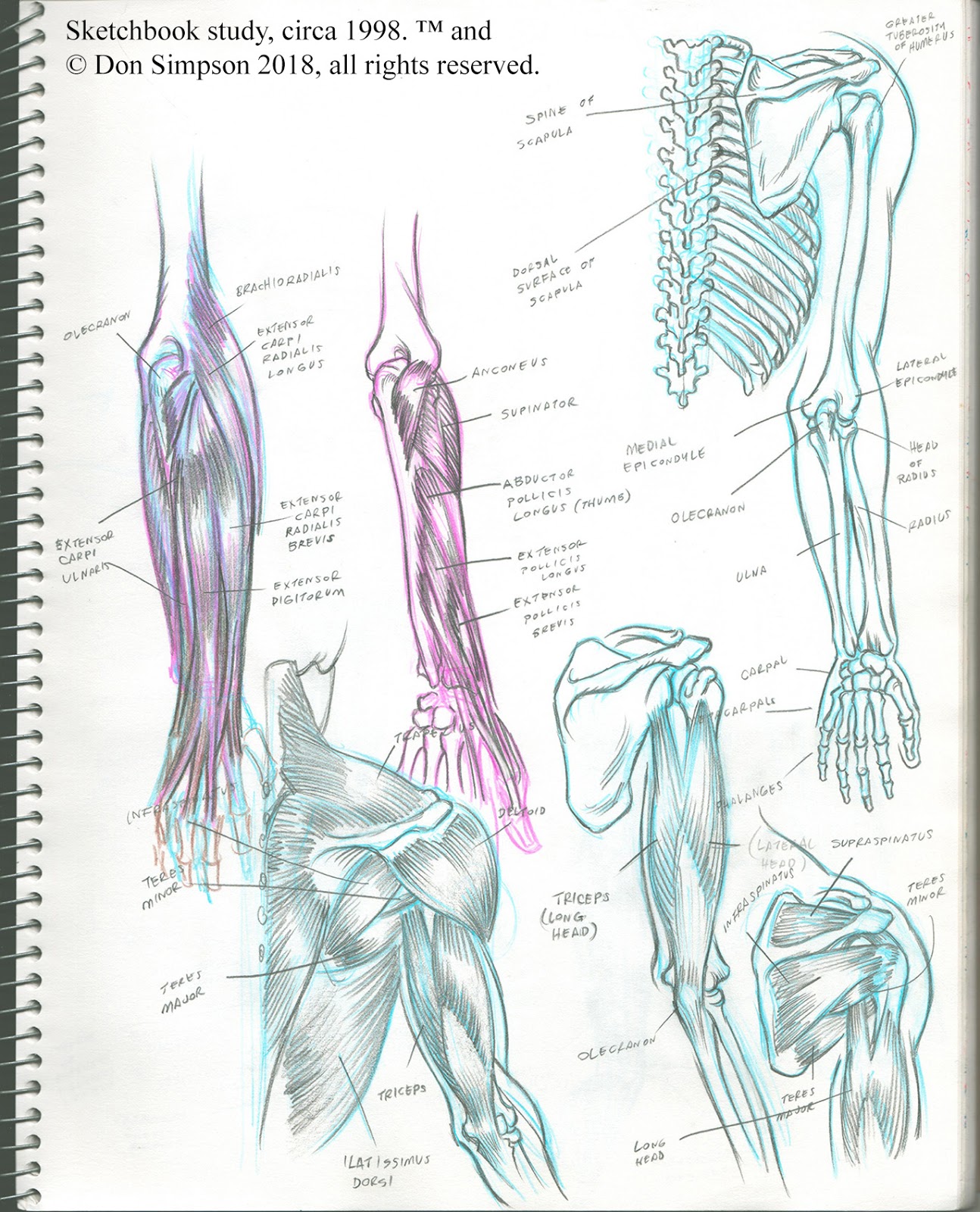
Here is a selection of anatomical studies I made in my sketchbook around 1998. I had been studying anatomy, principally the books of Burne Hogarth, at this point for some twenty years (1978), and would periodically brush up on anatomy every 18 months or couple of years or so. The studies here are unusually elaborate, and I recall at this point trying to "get it" once and for all (an unachievable goal!).
They are based on, in no particular order, Louise Gordon, How to Draw the Human Figure: An Anatomical Approach (Viking, 1979); Stephen Rogers Peck, Atlas of Human Anatomy for the Artist (Oxford, 1951); David K. Rubins, The Human Figure: An Anatomy for Artists (Viking, 1953); and Jack Hamm, Drawing the Head and Figure (Putnam, 1963). There may also be a stray bit of Andrew Loomis, culled from a Walter T. Foster edition, but I don't think so.
The fact that I was no longer interested in Burne Hogarth's Dynamic Anatomy or Dynamic Figure Drawing
(Watson Guptill, 1958 and 1970, respectively) suggests I was looking
for more realistic instruction than the kind that fueled the superhero
studies of my teenage years (and which I tried to rid myself of in the
early, exaggerated Megaton Man comics). But the oldies are the goodies, and nearly all of the titles here are old chestnuts in the genre.
As I used to tell my workshop and drawing class students,
while software programs become outdated every three weeks, human anatomy
hasn't changed significantly in tens of thousands of years; there is no
better investment of time and effort than studying the subject.
Many newfangled anatomy books, especially the execrable Human Anatomy Made Amazingly Easy, by that cynical charlatan Christopher Hart, are worse than no instruction at all. Stick to the classics.
Blurring the Boundaries between Text and Graphic, Word and Picture, Art and Culture
Tuesday, July 3, 2018
Thursday, October 26, 2017
Whither Drawing?
Here's what the 2016-2017 Handbook of the National Association of Schools of Art and Design has to say about a Bachelor of Fine Arts Degree in drawing (p. 103-104):
Here's what the handbook says about computers in general (p. 101):
This is why I am a self-taught figurative artist, and why I advise students to make the most of their college tuition pursuing a well-rounded "book-learning" liberal arts curriculum (English, languages, history, philosophy, sociology, etc.), and skip the BFA.
Art school in the broadest sense only makes sense for a profession that requires actual accreditation, such as architecture or interior design.
See also: The Withering Away of Drawing
a. Understanding of basic design principles, concepts, media, and formats. The ability to place organization of design elements and the effective use of drawing media at the service of producing a specific aesthetic intent and a conceptual position. The development of solutions to aesthetic and design problems should continue throughout the degree program.Note that there is no mention of human anatomy, figure drawing, or manual perspective drawing (although computer-aided perspective is an advised competency).
b. Understanding of the possibilities and limitations of the drawing medium.
c. Knowledge and skills in the use of basic tools and techniques sufficient to work from concept to finished product. This includes mastery of the traditional technical and conceptual approaches to drawing.
d. Functional knowledge of the history of drawing.
e. Extensive exploration of the many possibilities for innovative imagery and the manipulation of techniques available to the draftsman.
f. The completion of a final project related to the exhibition of original work.
![]() |
| From "Teaching Cartooning" in Streetwise (Two Morrows, 2000). |
Here's what the handbook says about computers in general (p. 101):
Digital Media. The Bachelor of Fine Arts is appropriate as the undergraduate degree in which digital technology serves as the primary tool, medium, or environment for visual work. Titles of majors for these degrees include, but are not limited to: digital media, media arts, media design, multimedia, computer arts, digital arts, digital design, interactive design, Web design, and computer animation.No mention of mastery of traditional fundamental drawing principals, and digital technology is the "primary tool."
This is why I am a self-taught figurative artist, and why I advise students to make the most of their college tuition pursuing a well-rounded "book-learning" liberal arts curriculum (English, languages, history, philosophy, sociology, etc.), and skip the BFA.
Art school in the broadest sense only makes sense for a profession that requires actual accreditation, such as architecture or interior design.
See also: The Withering Away of Drawing
Tuesday, July 11, 2017
'S Prose, Not Superheroes: Recently Read Real Books
I'm going through my second childhood--only this time, I'm reading prose fiction instead of wasting my time with dumbed-down ol' comic books!
Here's a snooty selection of what I've read over the past year or so, in no apparent order:
Harry Potter by J.K. Rowling--I read all seven books and watched all eight DVDs in eight weeks in the summer of 2015. I'm a late adopter--having worked at Border's in the early 2000s and probably handled (conservatively) some 10,000 individual copies of the various HP editions through the end of 2005 as a part-time bookseller. I never read a single sentence at the time, being exclusively interested in non-fiction (which lead to me returning to college for a decade-long stint). But I've read pp. 317-421 of The Prisoner of Azkaban (the Shrieking Shack sequence) a total of eight times--it's the most brilliantly orchestrated piece of storytelling I am aware of in any media.
Sunday, March 13, 2016
Whirled Building: The Working Out of Megaton Man's Megaverse
This is an unpublished page from 1984. Megaton Man #1 had already been accepted for publication by Kitchen Sink Press in April of that year, but a series of hang-ups with printers and promotion would delay the release until December. Over the spring and summer, asked if I could turn the one-shot into an ongoing series, I struggled to envision a series for the satire, producing dozens of stream-of-consciousness pages, none of which added up to a coherent whole. Later that summer, on a nice sunny day, I went for a long walk around Midtown Detroit (from my off-campus apartment near Wayne State University around the General Motors and Fisher Building in the so-called New Center area, rumored to be Ground Zero in case of Soviet missile attack), and got the idea for the second issue, which I drew from scratch in about five weeks. Of the 64 aborted pages, several made it into subsequent issues as set pieces and dream sequences. Other pages, like the one here, penciled in a manic emulation of Neal Adams, was never inked, but many of the narrative ideas were later redrawn, and still resonate in the new Megaton Man material I have been dreaming up!
Fans familiar with the original series will recognize the landing scene from issue #9, when the Partyers from Mars finally land in Megatropolis Central Park, albeit in a more primitive form. Uncle Farley, the Golden Age Megaton Man appears, along with Stella Starlight, Megaton Man's estranged girlfriend, now emphatically pregnant. While Stella appeared in civilian clothes in the published comic, here she appears as The Earth Mother, a persona she will not take in the Megaton Man narrative until Bizarre Heroes, the series I self-published in 1994 through 1996. The Devengers also appear (they appear for the first time in Megaton Man #8), except that the Angel of Death (not penciled in yet) is referred to as the Corpse Lady. In fact, Bad Guy hadn't even appeared in the series yet (he would not appear until #3), and yet here he is already a long-time nemesis of Megaton Man, and turning into Good Guy! Captain Androgynous has never appeared in any of my comics.
What is remarkable is how consistent my ideas have proven to be over the years. This piece of art would have been buried in storage when I was drawing Bizarre Heroes ten years later, and essentially forgotten, and yet the Earth Mother persona still resided in my imagination, her basic costume design (a kind of maillot unitard with gloves and boots) remaining intact, although the logo I would later give her looked more like the symbol for ecology. Colonel Turtle looks like an actual in this first draft; later he would be decidedly a middle-aged guy in a cumbersome costume.
There have been numerous other instances over the years of making notes, sketches, and misfired pages, and either misplacing them or simply never referring to them again, and yet when I finally get to putting an idea in a comic book story, I somehow manage to realize the original idea in most of its main its essentials, Later, when I unearth the original conception, I am surprised at how consistent my imagination is. I have also found this to be true for particular characterizations of such characters as Rex Rigid and Pamela Jointly. When I've written them into new storylines, I think I'm having them behaving in new, selfish, or malevolent ways, but then I go back and reread earlier comics, and realize that that has always been a part of their conception. It is reassuring to know that when I imagine something and establish it as "real" in my mind, it seldom gets lost just because I can no longer locate the original note or sketch.
As for this page, the new graphic novel I am working on, Megaton Man: Return to Megatropolis, still draws upon themes established in my mind practically when I came up with the name Megaton Man. Nuclear terror, psychotic machismo, extended non-traditional family arrangements, and in fact Simon Phloog, the son of Megaton Man and the Earth Mother, are all intrinsic elements in the ongoing storyline. Rest assured that as I have been elaborating new storylines (and endeavoring to retroactively World-Build), I have reread all the old comics so as to preserve established character history, which is how I've realized how consistent my notions are. (Or maybe I just don't have as many new, original ideas as I thought I had!) Previews of this new material can be seen in abundance almost as it is coming off the ol' drawing board on the Megaton Man blog, with further publication details to be announced soon!
Wednesday, August 26, 2015
Chain Culture: The Loss of Borders and the End of a World
When the Borders brothers sold their budding bookstore chain, the company was well known for its impeccable customer service, top-notch inventory system and large-format approach that uprooted the way the books were sold.But the Borders shopping experience eroded over the years as the chain grew in size, management became unwieldy, the Internet encroached on sales and electronic books emerged as an alternative for avid book readers.[1]
A number of reasons have been given as to why Borders, a
used bookstore founded in Ann Arbor in 1971 that became a retail chain in 1992,
ended in bankruptcy in 2011. Among the most prevalent are: the rise of the
ebook, competition with Amazon, overexpansion of retail locations,
overinvestment in music sales, and various mismanagement decisions. Slate.com
quipped, “It died by a thousand—OK, maybe just four or five—self-inflicted
paper cuts.”[2]
But Nathan Bomey is right when he places the erosion of the
Borders shopping experience at the head of the list.
A shopping experience may be a more difficult thing to
quantify than the ubiquitous assertion of mismanagement, but it is very real.
In the case of Borders, the erosion of the shopping experience was deadly.
I grew up in suburban Detroit in the 1970s, about 40 minutes
from Ann Arbor. Two youth counselors at my church had been students at the
University of Michigan, and were well acquainted with the first Borders Store
on State Street, and took us there on an expedition. This was not its very
first location, but it was already a fully mature destination of wonder. Large,
with brick walls and multiple levels, it seemed to have every coffee table art
book under the sun, scholarly titles, mystical new age books, books on world
cinema, and cultural journals. I never had any money in those days, but in the
early 80s, when me and my friends haunted the art film houses ensconced all
over campus, Borders was a place to explore before or between screenings. (Undoubtedly, the mystique of Borders influenced the naming of 1980s science fiction comic book saga Border Worlds.)
When store #9 appeared in the South Hills of Pittsburgh in
the early 90s, I did have money, and I spent a lot of it there. I can’t
remember if I saw the store logo driving past, or heard about it from a friend,
but as soon as I learned that a Borders store had opened, I realized that the
world had become a better place. It was not as great as the Ann Arbor location,
but it was still a destination and a treasure house. I spent many a rainy
Saturday night there, sipping coffee and coming home with Neil Forsyth’s The Old Enemy: Satan and the Combat Myth,
or Joseph Campbell, or many a coffee table book that I still have in my
library.
When store #174 open in the North Hills, it was not as great
as store #9, it was still good. From 2000 to 2005, I worked there part time on
and off. It was there that I was inspired to go back to school, finally earning
my PhD in art history in 2013. This was during the heyday of Harry Potter and Chicken Soup, and one of my own freelance illustration jobs, for Al
Franken’s Lies and the Lying Liars Who
Tell Them: A Fair and Balanced Look at the Right appeared. It was only
slightly absurd that the book for which I had drawn The Adventures of Supply Side Jesus was one of the innumerable items I
rang up as a cashier, or helped people to locate as a bookseller. (No, I never
mentioned that, by the way, I was the cartoonist!)
But I was not that unusual in having an example of my work
on sale at Borders. A number of the staff were highly creative, particularly in
music but also in theater. The manager recorded a smooth country album produced
by another employee that played on the store sound system for several weeks,
and other employees often had publications and creative offerings of one sort
or another featured in the store.
![]() |
| Life without Culture: Undoubtedly, the mystique of Borders influenced the naming of 1980s science fiction comic book saga Border Worlds. An unpublished panel. |
But during my time at Borders, the shopping or customer
experience did erode noticeably, along with the employee experience, at the end
of my time there quite precipitously. At the beginning, each store had its own
CRC or Community Relations Coordinator, a person responsible for scheduling
events such as folk singers in the café, local author signings, or weekly or
monthly meetings of the poetry group; it had a rack of free brochures and local
independent newsweeklies; a plethora of scholarly titles; and still a wide
selection of off-beat magazines. Most importantly, it had knowledgeable employees
who cared about culture in its manifold forms.
But quickly the CRCs were replaced by regional staffers
overseeing multiple stores, and finally event planners in the corporate
headquarters. The quirky folk singers were routed out, and events were stripped
down to a few big-label music releases. Author signings followed suit, with
local authors eliminated for fewer, bigger national names. Groups that were
once given coupons for free cups of coffee and announced over the store sound system
were quietly eliminated. The number of sofas and chairs strewn about the store
for customers were eliminated, as well as (maliciously) the stools for
employees manning the service desk. The brochure rack disappeared.
None of these clunky, handmade aspects of Borders were
profit centers in and of themselves, and many of them were inefficient and
bothersome to employees. I personally found the local iteration of the Socrates
Café, a meeting of overly loud bullshitters named after the book, extremely
fatuous. But they all contributed to the atmosphere of Borders as a unique,
even sometimes bizarre experience, and their loss contributed to the erosion of
the shopping experience and, guess what, the bottom line.
A word about those knowledgeable employees: a typical
Borders bookseller was college educated, perhaps changed majors too many times
to complete a degree, maybe had even dropped out of grad school, or was by temperament
or otherwise unsuited either to academia or the corporate business world. For
these sensitive souls, work at a chain bookstore at slightly above minimum wage
might not have amounted to a career, but it allowed them to utilize their minds
and earn an employee discount, and to be among some of the rich cultural resources that they loved.
Such a labor pool certainly existed in Ann Arbor in the
1970s, and nearly every major city and college town into which the Borders
chain initially expanded had a ready supply of such employees. In more than one
way, the growth of the chain eventually outstripped this labor pool, and by the
early 2000s (myself notwithstanding), such knowledgeable, geeky, cultured, and
book-loving employees were in increasing short supply. (College, it seemed, had become too expensive for humanities majors, or at least for humanities majors to drop out before completing their degrees and getting a real job to pay back their student loans.) New employees could have been
working in any kind of retail or fast food business, and manifestly could not have cared
less about books or culture. Indeed, many of the older, knowledgeable employees
of the type that built the Borders brand were consciously being routed out by
management as the 2000s wore on, along with the free weekly newspapers, the quirky folk singers, and
the pompous poetry groups.
While ringing up a Schaum’s Algebra workbook in 2002, I had
a serendipitous (serendipity being one of my church youth counselors’ favorite
words) moment, and realized I should go back to college. I started part-time in
January 2003 at the Community College of Allegheny County, and was full-time by the fall. I earned 60 gen ed transfer credits and started at Pitt in 2005. During this time I phased out my part-time
employment at Borders, which finally concluded with the end of the 2005 Christmas
season (a notoriously bullying manager that had been transferred to our store was summarily fired after the holidays). By this time, the chain had already cultivated a corporate feel
virtually indistinguishable from Barnes & Noble.
It is important to note that even as store stock contracted and the notorious Categories scheme was implemented (turning the de facto control of entire genres over to the highest-bidding publishers), it was still useful to work part-time at Borders even and especially as I returned to school full-time. Familiar with the ordering system, I could make SPOs (special purchase orders) of virtually any title in print and quite a few out of print (particularly those I needed for school), usually at the highest employee discount rate, and virtually risk-free, making it more convenient than Amazon. At some point, however, working at Borders became not worth it, and ordering through Amazon became the preferred mode of acquiring necessary books during grad school.
I still occasionally shopped there, but my own shopping experience
was noticeably less enjoyable than in the past. Selection was curtailed, bland
bestsellers dominated, games and gifts replaced scholarly titles, and it became
easier to order books for school online. It was no longer a destination or a
treasure house, but a cold, unfeeling, alienating experience.
The shopping experience had eroded over the years. Was
nobody watching?
I still miss Borders every rainy Saturday night, like one sometimes
yearns for a bygone lover.
Friday, July 24, 2015
The Bizarre Heroes Fiasco: How Megaton Man #11 Still Almost Happened!
Our Story Thus Far: For a three-year period, from December 1984 to October 1987,
I had created 17 consecutive bimonthly comic book issues for my first
publisher, Kitchen Sink Press. These included the color Megaton Man #1-10, a Silver Age superhero parody, and the black-and-white Border Worlds #1-7, a dark, brooding science
fiction saga for mature readers. Each issue averaged more than 33 pages per,
for a total of 510 pages of story, art, and lettering (with some coloring), an
accomplishment unmatched by any other creator for the imprint.
During the second three-year period, from 1988 through 1990,
I created only half that amount of material, or about 250 pages, in eight comic
book issues. These included Return of
Megaton Man #1-3, Megaton Man Meets
the Uncategorizable X+Thems #1, Yarn
Man #1, and Pteranoman #1, all of
which (slightly) furthered the Megaton Man
narrative; Bizarre
Heroes #1, a dramatic superhero tale about Megaclones being cooked up in a secret research lab; and Border Worlds: Marooned #1, an
adults-only eighth issue of my unfinished space station epic.
All tolled, my 750 pages for Kitchen Sink Press in six years would remain
an unmatched achievement by any other creator in the publisher’s history, including Will
Eisner, who created about as much new material over a 30-year association with
the publisher, but not exclusively (works such
as The Building, for example, were first published
in England some time before appearing in a Kitchen Sink Press edition in North America).
The dividing line had been what I wanted to call Megaton Man #11, but which, after the publisher’s
initial acceptance, was by decree renumbered #1, becoming the first issue of the Return of Megaton Man three-issue mini-series. The
communication I received from the publisher around Thanksgiving 1987,
just in time for my 26th birthday, was filled with brutal bullying, verbal
abuse, gross distortions, and uncharitable exaggerations: I was called a prima donna, a hack, and a spoiled egomaniac; I was told
that I had killed or abandoned Megaton
Man and Border Worlds simply
because I had tired of them; and that I had betrayed my fans and publisher, all
because I was incensed that the publisher had reneged on his agreement to
maintain the consecutive numbering of Megaton
Man with issue #11, and had the temerity to point out how a new #1 was a cheap gimmick that belied publishing impotence (see Part II).
Instead, I had been remonstrated by the publisher,
No one the fuck will care about the numbering in the long run if the strip itself has substance. That is the real goal. The short-term pragmatic decisions in the realm of packaging and marketing are traditionally (and best) left to the publisher. Your input is welcome, and you damn well know I’ve been responsive to your input. Your demands are another thing altogether; they are intrusive and likely to backfire.
I was further taunted,
And if you don’t think any publisher can handle your genius, you can always become another Dave Sim, create your “own” self-publishing empire and peddle whatever you want however you want and eliminate the evil middleman. Believe me, it ain’t easy. Settle down and learn to trust my judgment more. Second-guessing everything is your prerogative, but you’re scattering your energy in what I see as a self-destructive path. You’re diluting your output and hurting both of us. Get back to the drawing board and produce that pace-setting comic that stands toe to toe with the best. And then, believe me, we’ll both profit. [1]
As I had tried to explain, maintaining the consecutive numbering
of Megaton Man was important to my sense of extending a cohesive, organic narrative, one that,
much as my erstwhile editor had suggested, viewed the characters over the
long-haul as more than mere parody vehicles. Conversely, the repetitious #1
ploy, which by1988 had metastasized into a virtual declaration by the publisher that they were not really interested in publishing
anything but Don Simpson #1s ever again (see Part II), fractured my sense of Megaton Man as a coherent, ongoing
narrative, and severely retarded the organic growth of the characters and
the relationships that I wanted to explore. The need I felt to creatively justify the
gratuitous #1s also slowed down my imaginative process as I tried my
best to make each stand-alone issue more than just a marketing gimmick.
In retrospect, I regard the Megaton Man #11 moment as one in which I might have been induced to
create Megaton Man once again on a
regular frequency. Instead, the strict #1 regiment enforced upon me a piecemeal, Ground Hog Day routine in perpetuity, ironically guaranteeing
a scattering of my creative energies and dilution of what had been an unmatched,
consistent output. On the one hand, I was free to draw any comic book I wanted
each and every time out (dramatic superhero, science fiction, comedy,
underground, etc.), but on the other, any feeling of momentum of an ongoing “strip”
was perpetually being erased with the next #1. Worse, the marketing gimmick
boomeranged; not only could I no longer recall how many Megaton Man issues I had created, but neither could my fans.
The last straw came at a convention in Ohio in late 1989,
where I met an ardent Megaton Man fan
who monitored the industry closely and ordered comics every month from their
local shop. This particular fan had no idea that Yarn Man #1 had already come and gone, and completely missed it.
Had the miniseries and one-shots been consecutively numbered (Megaton Man #14, #15, #16), overlooking
a back-issue would have been impossible. Moreover, sales for the one-shots were falling, and I was subsidizing my
creator-owned work by freelancing “work-for-hire” assignments from third parties (mostly DC Comics and Teenage Mutant Ninja Turtles), which involved illustrating
scripts for comics that I did not own, but which rewarded my labor in multiples over what I had ever earned from royalties on my creator-owned work. Kitchen Sink no longer treated a new Don
Simpson #1 as any kind of special event, and for the most part dumped my work
onto the market with little fanfare. [2] By 1990, I can vividly recall, I felt that I
would have rather thrown the original artwork for my next creator-owned comic book
into the river than have it appear with a Kitchen Sink logo on the cover.
Our parting of the ways was formalized in 1991, and I bought
out the “first right of refusal” clause in my contracts in exchange for the
original artwork for Megaton Man #1,
the original comic book that had taken me 13 months to complete while washing
dishes at a restaurant in Detroit. I was now free and clear to market any
sequels to Megaton Man, Border Worlds, or Bizarre Heroes to another publisher, or self-publish.
My first order of business was to devise a piece of work I
could sell at convention appearances. I had always been fascinated by the
letterhead of the Joe Simon and Jack Kirby studio from the 1940s, which showed
a variety of their creations for different publishers including Captain America
for Timely and the “kid gangs” for National, all arrayed in a “class portrait.”
I decided I would design a limited-edition print of all my characters from Megaton Man and Border Worlds, as well as characters I had created as far back as
junior high school, along with the explicitly erotic characters I had created
under the pseudonym Anton Drek for Fantagraphics, Wendy Whitebread, Undercover Slut and Forbidden Frankenstein, into a similar class portrait.
![]() |
| All my scattered, diluted energies in one place for the first time: the 1991 limited edition print. |
The Simon-Kirby letterhead showed the Red Skull chatting
amiably with an elegant gentleman in a Sherlock Holmes deerstalker cap, and other
characters created for diverse competitors in the comics publishing industry
interacting freely, if only for promotional purposes. No doubt, this image had
inspired the famous wrap-around cover to the publication in which I had seen it
reprinted as a ten-year old in the early 70s, Steranko’s History of Comics, Volume I. This piece including superhero
and adventure characters from nearly every publisher, composed in a spellbinding
mosaic.
Neither the Steranko cover, nor its inspiration, the
Simon-Kirby letterhead, offered “real” interaction between these fictional
characters in a narrative sense. While it was apparently permissible, either
for self-promotion or historical interest, to group Spider-Man and Superman, or
Captain America and the Guardian, in the same drawing, these events were not “really”
happening (it would be years before cross-company team-ups made this possible).
Further, I had been equal parts appalled and enthralled by Philip José Farmer’s
“family tree” concept, in which pulp character like Doc Savage, Tarzan, and the
Shadow turned out to be related (what has come to be known as the “Wold-Newton
Universe”).
![]() |
| The Simon-Kirby studio letterhead of the 1940s, featuring their creations for various publishers oddly mis-colored. |
As I created the artwork for my own print, I pondered the
paradox of Jetstream, a Megaclone from Bizarre
Heroes #1, standing shoulder-to-shoulder with the Frankenstein monster, and
Jenny Woodlore from Border Worlds in
the same contiguous space as Domina from Megaton
Man Meets the Uncategorizable X+Thems #1. These various narratives were
rigidly partitioned in my imagination, not only by time (the future setting of Border Worlds versus the contemporary
setting of everything else), but also by humor and “straight” superheroics. But
these partitions were self-imposed, not legal or contractural, as were the
boundaries separating the characters in the Steranko or Simon-Kirby drawings that
inspired my print.
Not only was I free from the constraints of the tyrannical mindset
of my old publisher, for whom publishing Gay
Comics and Steve Canyon made
perfect branding sense (but for whom my eclectic experiments were a dilution
and scattering of energies); I was also free to transgress the artificial
boundaries I had imposed upon myself. Not only could I draw all of my various characters
interacting in a “class portrait” for a poster-print; I could actually tell
stories with these characters if I felt like it.
I was most eager to continue the narrative of the Bizarre Heroes one-shot I created in my
latter days at Kitchen Sink Press. This featured John Bradford, a younger,
hipper version of Kolchak: The Night
Stalker, and The Meddler, a
character whose originated as a Halloween costume I made in ninth grade, and
the aforementioned mystery of a secret lab manufacturing Megaclones. These Megaclones
were super-powered beings based on normal people that were grown in cylinders to
become perfect specimens of humanity. Upon maturity, they would replace their
counterparts in the real world, assuming their civilian identities until called
upon by a fanatic eugenicist (maliciously made to resemble Will Eisner) to take
over society. At the end of the issue, four Megaclones had escaped, posing a
threat to this evil scheme, and The Meddler had caught wind of these
developments.
In my post-Kitchen Sink period, I now planned to continue
this storyline, particularly wanting to introduce a group of characters around
The Meddler I had created in junior high school that I had called The Crime
Busters, and had intended for comics but had never utilized. These included
Clown, Master of Disguise; B-50, the Hybrid Man; Negative Man (now sometimes
Negative Woman); The Slick (a new name for a hitherto unnamed character); and
more. This was clearly juvenilia recalled from my days as an enthusiastic
reader of comics and Doc Savage paperbacks,
but of such stuff enthusiastic comics could be made.
But the print I created suggested further possibilities.
What if The Phantom Jungle Girl, ostensibly a humorous character when she hung
around with Cowboy Gorilla or The Brilliant Brain, was The Meddler’s lover?
What if Clarissa James, the Detroiter who became Ms. Megaton Man, were to flirt
with John Bradford, columnist for The
Detroit Day? What if Megaton Man could meet Forbidden Frankenstein?
I decided that a new, ongoing series would establish all of
my contemporary characters in a single, organic universe, including those from
the Megaton Man comics as well as my
Anton Drek comics (with plans to eventually bring some of the Border Worlds cast time-travelling back
to late-twentieth-century Detroit). Bizarre
Heroes #1, the Kitchen Sink one-shot, would retroactively become the “pilot
episode,” and the its Megaclone storyline as the over-arching framework for the
series. Once I had established all of my creations in one Megaverse, I could
explore various characters and genres to my heart’s content, guaranteeing that
I would never run out of fresh inspiration or ideas. Creatively, I would have a
field day, and rather than diluting or scattering my energies, I would be able
to concentrate all my creativity in a single, ongoing series that would be
numbered #1, #2, #3, and so on indefinitely.
The problem was finding a new publisher, which I was loathe
to do, or finding the funding to publish Don
Simpson’s Bizarre Heroes myself. This problem was soon solved by the Image tent.
At the time, several prominent Marvel creators had defected
from the company (rebellion was in the wind), to form their own imprint, at
first in association with Malibu Comics. The first public event was held at the
1992 Chicago Comicon, to be housed in a large tent erected in the parking lot
outside the convention hotel. Arrangements for this were coordinated by Gary
Colabuono’s Moondog’s Comics, a Chicago chain, and my his staff, who consisted
of Larry Marder, Chris Ecker, and Bevin Brown, who would run security.
To make a long story very short, Larry Marder, creator of Tales of the Beanworld, had been my
friend for a long time, and in fact when I unexpectedly met him at Chicago
distributor’s warehouse party in 1985, I was carrying around Tales of the Beanworld #1 which I had
bought at a store signing I did months before but had forgotten about. Larry
was working closely with Image upstarts Jim Valentino and Rob Liefeld on the
Image Tent, and one day called me up to tell me that they wanted me to draw a
parody book of their shared universe. Larry wisely understood that I would have
likely blown a cold call, but I was prepared when Jim and Rob phoned me, and Splitting Image was born. When the
actual Chicago Comicon with Image Tent occurred, I spent half my time inside
the hotel in Artists’ Alley, and half outside in the parking lot, soaking up
the ambiance of the rebellion. Erik Larsen proposed a team-up between his
character, The Savage Dragon, and Megaton Man.
From a narrative standpoint, the two Image Megaton Man team-ups I would go on to do
did little to advance the Megaton Man
narrative; indeed, they only further affirmed the view instilled in me by erstwhile
publisher Denis Kitchen that Megaton Man
was merely a cash cow, worthy of only hit-and-run one-shots, and useful only for
funding other projects. On the other hand, the Image team-ups exposed the
character to an audience far larger than Megaton Man had ever enjoyed at
Kitchen Sink Press, and the six-figure windfall that fell into my lap as a
result of Splitting Image #1 and #2, The Savage Dragon vs. The Savage Megaton Man
#1, and later Alan Moore, Rick Veitch, and Steve Bissette’s 1963 and Jim Valentino’s normalman/Megaton Man Special, gave me
the nest egg I needed to launch Don
Simpson’s Bizarre Heroes under my own imprint, Fiasco Comics.
In many respects, while creatively exhilarating, the format
I settled upon for Bizarre Heroes
proved too improvisational, freewheeling, and undisciplined to maintain reader
attention. Characters were introduced but did not appear again for several
issues; storylines and subplots proliferated uncontrollably; there were lots of
fan favorites among the cast, but no stars to anchor the series.
![]() |
| John Bradford, a character I had created in junior high school, witnesses a Megaclone riot in Bizarre Heroes #12. |
On the other hand, Megaton Man and his supporting cast, who
had been on hand to launch Don Simpson’s
Bizarre Heroes #1, would not go away quietly. Even though the Man of
Molecules was relatively the new kid on the block, having been created only in
1982, whereas John Bradford first appeared in a short story I wrote in seventh
grade in 1974, I realized that I had formed long attachments to these
characters through experience of sixteen Kitchen Sink comic book issues (ten
issues of Megaton Man, the
three-issue Return of Megaton Man
mini-series, and three Megaton Man
one-shots). Within a few issues of DSBH,
Megaton Man had a new sidekick, X-Ray Boy; Stella Starlight, the mother of
Megaton Man’s son Simon, had evolved from The See-Thru Girl into The Earth
Mother and for all intents and purposes assumed leadership of the Crime
Busters; and Yarn Man, Cowboy Gorilla, and Gower Goose were raising hell in a
VW van, oblivious to the Megaclone threat.
![]() |
| Covers such as this vividly illustrated the Megaton Man narrative beginning to predominate over the Megaclone storyline. Bizarre Heroes #9 (Fiasco Comics, Inc., February 1995). |
By issue #10, it was becoming obvious to me that the Megaton Man narrative was beginning to
supplant the Megaclone storyline. As I began work on the eleventh issue, I
prepared two versions of the cover, one with the Bizarre Heroes logo, the other with the Megaton Man logo. I sent photocopies to Jeff Smith, creator of
Bone, at Cartoon Books in Columbus, Ohio, from my Fiasco Comics, Inc. office
space in Pittsburgh. I remember the phone call; Jeff urged me to go with Megaton Man #11.
![]() |
| The search was really for Megaton Man, and an alternate design had the Megaton Man logo predominating, almost making this issue Megaton Man #11. |
I really wanted to, but I knew I had at least several more
issues in which the Megaclone storyline would predominate. However, within a
year, Bizarre Heroes #15, essentially
a solo issue featuring The Slick, would be the last for the time being to
concentrate on characters from junior high school. Bizarre Heroes #16 would be doubly-titled Megaton Man vs. Forbidden Frankenstein #1, and Bizarre Heroes #17 would be co-titled Megaton Man #0. The latter was more of an illustrated text than a
comic book story, presenting an overview of the imaginative world I was then
calling the Fiascoverse, but now am inclined to call the Megaverse. The final
page showed the hotrod from Border Worlds,
gesturing toward the time-travel interlude I had planned but still hadn’t
gotten to.
After a seventeen issue run (mirroring the seventeen
non-Border Worlds issues at Kitchen Sink Press), my Image nest egg was
exhausted and the comic book industry began to fall apart. In 1996, more than a
dozen comic book distributors collapsed into two, then finally one; hundreds of
independent comic book shops closed up, and I decided to fold my tent. After a
dozen years in the print comic book industry, I had proven my point: I could publish and
promote my own work as badly as had Kitchen Sink Press! [3]
Next: The Megaton Man Weekly Serial and a few more Megaton Man comics at Image...
More at The Bizarre Heroes Blog!
Read “How Megaton Man Has Evolved in Thirty Years and Why I’m Still Creating Him”
[1] Denis Kitchen, letter to Don Simpson, November 25, 1987.
[2] Paradoxically, during the same period of 1988-1990, Xenozoic Tales
by Mark Schultz dropped in frequency from three to two to one per year,
yet remained unproblematically sequentially-numbered, and continued so even when it
dropped to one every two years through the mid-1990s. See Xenozoic Tales at ComicBook Database.
[3] Worse still, I had abandoned a third comic book series, just because I felt like it!
[3] Worse still, I had abandoned a third comic book series, just because I felt like it!
Subscribe to:
Posts (Atom)